

Ayre Acoustics K-3 preamplifier

The challenge for Ayre's Charley Hansen was formidable. Having already designed a world-class preamplifierthe highly acclaimed $7100 K-1 (see Wes Phillips' review in March 1997)Hansen set out to offer audiophiles "80 to 90%" of the K-1's sound and build quality at a price more of them can afford. Not that the new K-3 is a piece of "budget" gear. It's not. But at $4500, the fully loaded K-3, complete with phono section and remote control, is within reach of many.
Ayre Acoustics KX-5 Twenty line preamplifier

The hoary question of tubes vs transistors, once certain and clear, is made ambiguous by recent products from a few solid-state specialists, not the least being Ayre Acousticsthe company that endures in the wake of the passing of its founder, the widely admired Charley Hansen. In their solid-state preamplifiers and amplifiers of the past decade in particular, Ayre has enshrined a number of technologies that are more than just variations on the audio-engineering status quo, and that appear to pay real sonic dividends.
Ayre Acoustics KX-8 preamplifier

For the past decade or so, I haven't been using a preamplifier. The D/A processors I have been using all have volume controls, so I have been feeding their outputs directly to the power amplifiers. It would seem logical that having nothing in the signal path would have less of a degrading effect than a preamp's input and output sockets, switches, volume control, printed circuit-board traces, and active and passive parts, not to mention an additional pair of interconnects. However, with some of the preamplifiers I have auditioned in my system, there was no doubt that the sound quality improved compared with the direct connection from the digital processor.
The most recent of these preamps was the MBL N11 that Jason Victor Serinus reviewed in July 2021, which was preceded by the Pass Labs XP-32 I reviewed in March 2021, the Benchmark LA4 Kalman Rubinson reviewed in January 2020, and going back even further, the Ayre Acoustics KX-R Twenty I reviewed in December 2014, which was one of the products Ayre released to celebrate its 20th year of operation.
I am now reviewing the KX-8 line preamplifier, which costs $6500 in basic form.
Ayre Acoustics KX-R Twenty line preamplifier

The experience left me doubting my ears. After I'd performed all the measurements of Ayre Acoustics' KX-R preamplifier ($18,500) to accompany Wes Phillips's review in our November 2008 issue, I spent a weekend listening to it. To my astonishment, the sound of my system with a Transporter D/A processor feeding the preamplifier was better than when the DAC fed the power amplifier directly. Through the KX-R, images sounded more tangible, and the sound was better focused, despite the signal's having been passed through not just another set of interconnects but also through the preamp's input and output socketry, switches, a volume control, printed circuit-board traces, and active and passive parts. Logically, you'd think that having nothing in the signal path would have less of a degrading effect than so many somethings. But no, that was not what I heard, much as I would have preferred otherwise.
Ayre K-5xeMP line preamplifier

I asked for a sample of the K-5xe so I could do a Follow-Up to Sam's review, but other review commitments kept getting in the way. When I finally spent some time with it (S/N 10J002), I found the sound a little on the robust, forward side, which made system matching problematic. Then, as I was about to spill some ink on the K-5xe, I got an e-mail from Charlie Hansen letting me know that the development of the QB-9 USB DAC had led them to rethink the K-5xe's design, and that Ayre would be sending a sample of what would be called the K-5xeMP. After a longer delay than I had anticipated, the K-5xeMP, priced at $3500, arrived for review.
Ayre KX-R line preamplifier

I can't think of a product that was as eagerly anticipated as was Ayre's KX-R preamplifier ($18,500). Following in the footsteps of Ayre's MX-R">http://www.stereophile.com/solidpoweramps/407ayre">MX-R monoblock amplifier, a Stereophile 2007">http://www.stereophile.com/features/1207poty/index9.html">2007 Product of the Year, and milled, like the MX-R, from a 75-lb billet of aluminum, the KX-R also shares with its monoblock stablemate the Ayre ethos of zero feedback and fully balanced operation. But what really caused the buzz was the declaration by Ayre founder and chief designer Charles">http://www.stereophile.com/interviews/610">Charles Hansen that the KX-R, with its use of a technology he calls Variable Gain Transconductance (VGT) to control the volume, would set new standards for signal/noise ratio.
Balanced Audio Technology VK-40 preamplifier
Few topics will get audiophiles into an argument more readily than a discussion of the relative merits of tubed and solid-state equipment. A pollhttp://www.stereophile.com/showvote.cgi?189">poll; on the Stereophile website showed 53% of respondents choosing solid-state as their preferred amplifier design, while 38% indicated a preference for tubes—the remainder choosing "other," which presumably means digital amplifiers. (There has been no corresponding survey regarding preamplifier designs.) Opinions tend toward the dogmatic, with one respondent declaring "solid-state is more accurate," another stating unequivocally that "tubes sound closer to the real thing."
Bel Canto e1X DAC/Control Preamplifier

My late father-in-law used to say that life is like a roll of toilet paper. The closer you get to the end, the quicker it passes. I was reminded of that when I was asked to review Bel Canto's new e1X DAC/Control Preamplifier ($6800). It didn't seem that long ago that I favorably reviewed the Minnesota company's e.One DAC3, but Google told me that it was 15 years ago! "Other than the jitter performance via its USB input, the Bel Canto e.One DAC3 is the best-measuring digital component I have encountered," I wrote in November 2007 (footnote 1), adding that it "offers some impressive audio engineering in both the digital and analog domains."
Benchmark DAC1 Pre USB D/A headphone amplifier

Most of this column is dedicated to two hi-fi products for the massesnot from Lvov, via Vladimir Lamm, of Lamm Industries; or from Leningrad, via Victor Khomenko, of Balanced Audio Technologies; nor from any other Soviet-born audio hero. (Neither Vladimir nor Victor is on the list of "Name of Russia" contenders for greatest Russian of all time.) Nor from any consumer audio company, but from the world of professional audio. An Iron Curtain almost separates the two.
Benchmark HPA4 headphone amplifier/line preamplifier
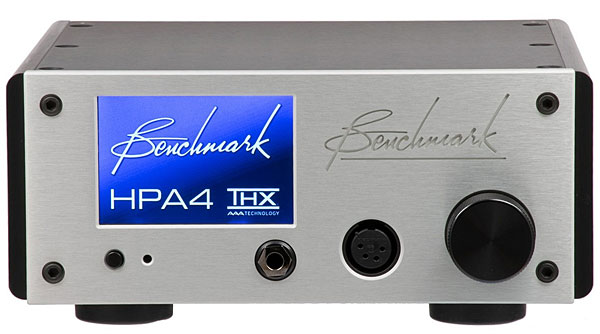
I am certain the quality of life I live is determined by two factors: who and what I give my attentions to, and my ability to observe all that I encounter with an open mind. This approach to living has served me wellespecially during this review of the Benchmark Media Systems HPA4 headphone amplifier ($2999).