

Benchmark LA4 line preamplifier

Upon hearing about this new product from Benchmark Media, the LA4, my mind turned to Laurindo Almeida, Bud Shank, Ray Brown, and Shelly Mannethe original L.A. Four jazz quartet. No such association was intended, however: the "4" merely designates change from previous Benchmark designs.
Boulder 1012 D/A preamplifier
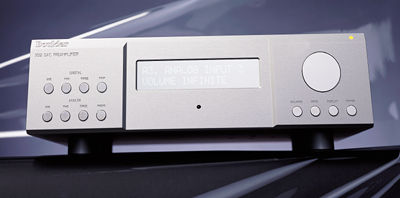
The Boulder 1012's is a line-level preamplifier and DAC in one box. Its design and build qualities are icons to elegant engineering know-how. No screws show on the rectangular box of large but not massive proportions, for example, which is all done up in matte aluminum and set off with a few highly polished stainless-steel buttons. The chassis construction uses tongue-and-groove techniques. The sides of the 1012 benefit from styling cues found on Boulder's newer amplifiers. As you can see from the photograph, the look is both elegant and hi-tech in a way very few other manufacturers manage.
Boulder 2008 phono preamplifier & 2010 preamplifier

It's not every Consumer Electronics Show that someone introduces a $29,000 solid-state phono preamplifier—and I miss it. The 2002 CES was one. My show report in the April issue made it seem as if I'd found out about it there, but the fact is, someone clued me in after I'd returned home. I needed to come clean on that.
Boulder 810 line preamplifier & 860 power amplifier

Boulder Amplifiers, named after the Colorado town where the company has resided since its founding 23 years ago, makes some of the most elegant-looking solid-state amps around. Chassis are anodized, aircraft-grade aluminum with rounded edges, machined and finished in-house. The two models reviewed here, the 810 line preamplifier and the 860 power amplifier, each have a sleek, compact build—stacked atop each other, the two stand just over a foot high—owing to extremely efficient packing of the circuitry inside. These are the company's "entry-level" electronics, but there's nothing cheap about them—the preamp retails for $6900, the amp for $8500—and for all their economical size, they look like luxury goods as well.
Boulder Amplifiers 2110 line preamplifier

Founded in 1984, Boulder Amplifiers is a conservative audio company that goes quietly about its business, choosing not to call attention to itself with marketing flash or acronym-laden features. Change comes slowly to such companies, which is why the just-retired 2010 preamplifier enjoyed a 17-year run.
Brilliant Corners #13: The EM/IA Remote Autoformer and Listening with Master Jazzman Jerome Sabbagh

Ever notice that the language we use to talk about sound can be pretty aggressive? Reviewers often write about amplifiers "taking control" of a speaker, possibly "ironfisted control," especially if the amplifier in question happens to be a "juggernaut." In this particular linguistic trash fire, we also find "razor-sharp transients," "hair-raising dynamics," and that ickiest of descriptors, "bass slam." If words could smell like hair gel and drugstore cologne, these might.
All this verbiage is describing brute force, which we might use to push open a heavy door. But there's another kind of force that we encounter in the world, and consequently in audio, captured in the expression "life force." It denotes a sense of vitality and presence that isn't readily perceived by the sensessomething lingering just out of reach of our rational minds. This force can be experienced in the terse saxophone solos of the young Sonny Rollins, the eerie abstract paintings of Mark Rothko and Pat Steir, and the deceptively quiet poems of Elizabeth Bishop. If you've ever been drawn in by one of the squat, gouged, lopsided jars made by a traditional Japanese potter, you know what I'm talking about.
Bryston BP-173 line preamplifier

Each equipment report in Stereophile focuses on a single audio component. When listening to a component for review, I leave unchanged all other components in my audio system. Other Stereophile reviewers experiment with different interconnects, speaker cables, power cords, or stands. As I found while reviewing Bryston's BP-173 (Cubed) preamplifier, being flexible has its rewards.
Description
My first lesson in flexibility was learning what Bryston means by "Cubed" (footnote 1). Jim Tanner, Bryston's VP of sales and marketing, explained that all their Cubed models employ an array of 12 active devices for the first 6dB of gain. Developed by the late Dr. Ioan Alexandru Salomie, this array acts as "a super-linear" input buffer to filter out audio- and radio-frequency noise, particularly anomalies that originate in the power line, reducing the overall noise and distortion to less than 0.001%.
My first lesson in flexibility was learning what Bryston means by "Cubed" (footnote 1). Jim Tanner, Bryston's VP of sales and marketing, explained that all their Cubed models employ an array of 12 active devices for the first 6dB of gain. Developed by the late Dr. Ioan Alexandru Salomie, this array acts as "a super-linear" input buffer to filter out audio- and radio-frequency noise, particularly anomalies that originate in the power line, reducing the overall noise and distortion to less than 0.001%.
Bryston BP25-MC preamplifier

The Bryston BP-25MC preamplifier is a full-function control center with one balanced and four single-ended inputs, including one input for a moving-coil cartridge. The BP-25 is shielded in a black steel cabinet said to reduce electromagnetic interference effects. The power transformer is housed in a small external chassis, the BP-PS. The BP-25's remote control allows volume up/down, along with buttons for mute and absolute polarity. Signal switching and audio connections, including balanced and unbalanced input and output connectors, are heavily gold-plated to provide good long-term connections. A 12V AC/DC screw terminal connector on the rear of the power supply provides convenient use when used in conjunction with the remote start feature optionally available on Bryston power amplifiers.
Burmester 011 preamplifier

Back in 2003, while auditioning the Burmester 001 CD player ($14,000, reviewedhttp://www.stereophile.com/digitalsourcereviews/1203burmester">reviewed…; in the December 2003 Stereophile, Vol.26 No.12), I discovered that my system sounded much better if I bypassed my preamplifier and ran the 001 directly into the power amps. I concluded by suggesting that potential customers consider building a system around the 001 itself and forgo a preamp altogether. The response from Burmester fans was immediate and unambiguous: As good as the 001 was on its own, it sounded even better run through its stablemate, Burmester's 011 preamplifier ($15,999). The pair had, they claimed, a significant synergy that I absolutely had to hear. It's hard to argue with determined German logic, and I'd begun shopping for a new preamp anyway. So here we are.
Burmester 151 MK2 MusicCenter streaming D/A preamplifier

Ah, domesticity. Just when I had the reference system sounding better than ever, the husband decided to relocate his electric keyboard and music stand, which had been positioned along the right wall of the detached music room, to the dining room in the main house. His reason was rational: While I did the reviewer thing in one space, he'd be free to practice keyboard and sing in another. But what was rational to him screwed with my reference sound and drove me to the brink of irrationality.