

Molto Molto—a New Stereophile Album from Sasha Matson

We started issuing recordings on the Stereophile label at the end of the 1980s, both to make available some of test tracks that we were using in our reviews and to enable readers to have access to recordings where the provenance was fully documented. That way the "Circle of Confusion" that Bob Katz discussed on the Stereophile website in 2017, where the sound quality of an audio component couldn't be judged using a recording with unknown sound quality potential, could be avoided. As Bob wrote, "How can any reviewer make a judgment about a transducer without knowing what a recording is supposed to sound like?"
Serenade: the 1996 Santa Fe Chamber Music Festival CD

A musical highlight for us at Stereophile in 1995 was the opportunity to record several concerts at the world-famous Santa Fe Chamber Music Festival. The result was a Stereophile CD, Festivalhttps://secure.stereophile.com/stereophile/recordings.shtml">Festiva…; (STPH007-2), which features the original chamber version of Aaron Copland's Appalachian Spring, Darius Milhaud's jazz-inspired La création du monde, and the premiere recording of the 1995 Festival commission, Tomiko Kohjiba's The Transmigration of the Soul (see Stereophile, January 1996, Vol.19 No.1, p.132). We were pleased, therefore, to be asked back by the Festival in 1996. Once again we have produced a CD of live recordings, Serenade (STPH009-2), which features chamber works by Mozart, Brahms, and Dvorák.
Stereophile Test CD 3

Back in the spring of 1990, Stereophile introduced its first Test">http://www.stereophile.com//reference/176/">Test CD, featuring a mixture of test signals and musical tracks recorded by the magazine's editors and writers. Even as we were working on that first disc, however, we had plans to produce a second disc which would expand on the usefulness of the first and feature a more varied selection of music. The result was our Test">http://www.stereophile.com//features/338/">Test CD 2, released in May 1992.
Tannhäuser: Wagner's "problem" opera
When I suggested to editor John Atkinson that the subject of my first "Building A Library" be Wagner's Tannhäuser, furrows ploughed his boyish brow. "Why such minor Wagner? Why not the Ring?"
15 For 50: 1975 in 15 Records

Was it something in the air, something in the water? Cosmically inspired by the stars and the moon? Or maybe the devil was finally claiming his own as rock music in all its variants was unassailably ascendant.
40 Years of Stereophile: The 40 Essential Albums

 And I used to think our annual "Records">http://www.stereophile.com/showcategory.cgi?category=Records%202%20Die%… To Die For" issue was difficult. Whew! When it came down to choosing the 40 most influential rock/pop, jazz, and classical records of the past 40 years, during which this magazine has been the most honest and enjoyable source of high-end audio journalism, my initial list contained more than 200 choices. A painful paring-down process ensued, with input from every member of the Stereophile staff.
A Fine Art: The Mercury Living Presence Recordings

It is perhaps the most cherished tale from hi-fi's primordial past: In 1951when music was first being recorded on magnetic tape, when the use of much-improved microphones became a mix of science and art, and when Stereophile's founder, J. Gordon Holt, was still a little nipper, years away from his first martini (though I wouldn't swear to that)the team of Robert (Bob) and Wilma Cozart Fine began to build a legendary catalog of recordings of classical music. It eventually included the work of conductors Rafael Kubelik, Antal Doráti, and Frederick Fennell; the Chicago and Minneapolis symphony orchestras; the pianists Byron Janis and Gina Bachauer; and the cellists Mstislav Rostropovich and János Starkerall released with often wildly colorful covers under the still-evocative title of Mercury Living Presence.
A Mosaic of Music: Stereophile's Clarinet Quintet CD
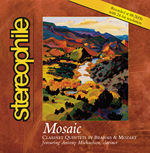
It's the grain elevators that break the monotony of driving across the Texas and Oklahoma Panhandle. As you pass one, another one appears on the horizon. Thus you know you're making progress, despite the fact that the landscape remains unchanged.
A Must-Have Rachmaninoff CD
It starts quietly enough, with a simple falling-fifth motif, but the first movement of Sergei Rachmaninoff's neglected Piano Sonata 1 develops into a work of epic proportions nearly 40 minutes in length, with haunting melodies, massive dynamic contrasts, and lush, sensual harmonies.
A New and Awful Silence
The electric clocks in my house keep better time than the ones I wind, yet I scarcely look at them. It is the ticking, I think, that comforts me. I like to lean my ear against these various pendulums and, back and forth, gently rock my life away.