

Exploring Bayreuth's Fabled Acoustic
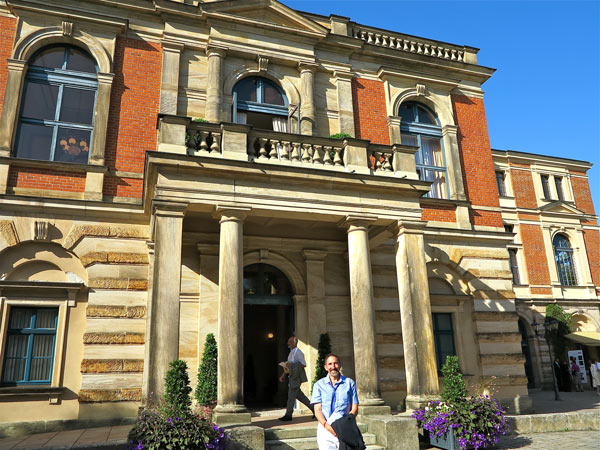
Photo of the author in Bayreuth: Paul Hyde
For audiophiles, the acoustic of the Bayreuth Festspielhause in Germany, home of the annual festival of Richard Wagner's operas, vies with Amsterdam's Concertgebouw and Vienna's Musikverein as one of the most fabled for recording as well as listening. As a participant in the Music Critics of North America 2012 institute at the Festival, I had the opportunity to not only explore the venue from a near-ideal seat in Row 25 Center, but to also visit the fabled "covered pit" from which many of the greatest Wagner conductors of the last 136 years have led exalted performances.Fate, I Defy You: The Robert Silverman Liszt CD
"Rarely, if ever, can this densely written sonata have been presented so lucidly with each note precisely in place...the dramatic and lyrical aspects were never slighted or taken for granted."
—Peter G. Davis, writing in the New York Times about Robert Silverman's New York debut in 1978, when he performed the Liszt B-Minor Piano Sonata in Alice Tully Hall.
—Peter G. Davis, writing in the New York Times about Robert Silverman's New York debut in 1978, when he performed the Liszt B-Minor Piano Sonata in Alice Tully Hall.
First Time Ever: Mahler Download in DSD
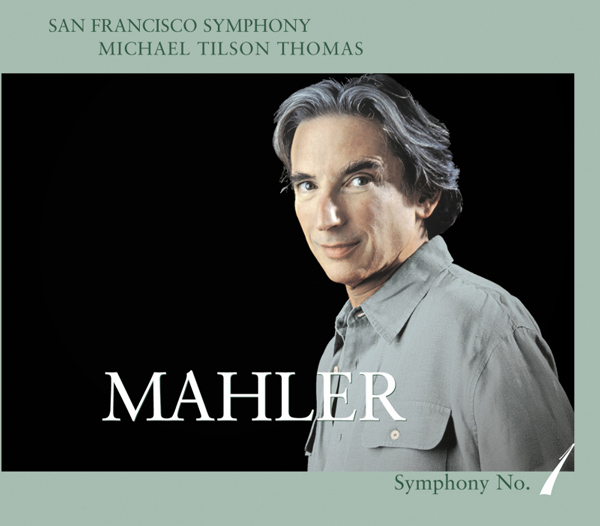
Just in time for the New Year, Cookie Marenco of Blue Coast Records has released the first-ever DSD (Direct-Stream-Digital) download of the San Francisco Symphony Orchestra's recording of Mahler's Symphony No.1. Recorded live in Davies Symphony Hall in September 2001, shortly after 9/11, and first released as a hybrid SACD in 2003, the recording is one of the only four Mahler symphonies in SFSO's complete Mahler cycle that were recorded directly to DSD.
The Mahler 1 files, available in four formats, are all derived directly from San Francisco Symphony's master, not from a copy of the SACD. The formats include two DSD formats: DFF and DSF. For those whose computer playback software or DACs are not equipped to play DSD files, 24/96 and 16/44.1 PCM files in WAV format are also available.
Four Outstanding Choral Recordings

We who love recordings of massed voices have learned the hard way that some succeed in blending vocal clarity with acoustic resonance, while others deliver echo-muddied jumbles. Happily, some very fine choral recordings have come my way in the last six months. Along with John Atkinson's acoustically stunning engineering of recordings by the vocally gifted Portland State Chamber Choir and the all-male ensemble Cantus, these aural documents do composers proud.
Frank Zappa on CD (and LP), Part I-III
Frank Zappa on CD (and LP), Part I
Stereophile Vol.10 No.8, November 1987
Stereophile Vol.10 No.8, November 1987
From Congo Square to Times Square: A Short History of Drums in Jazz
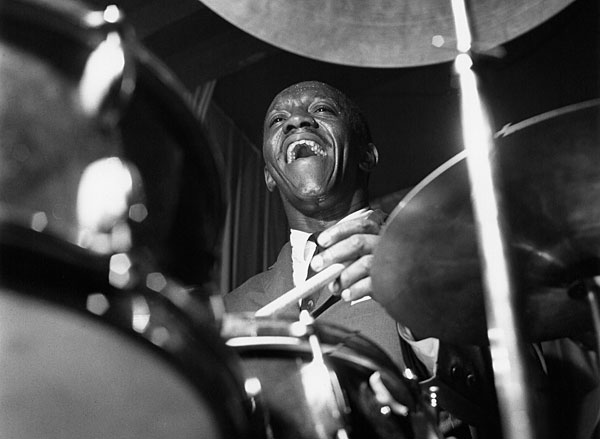
Celebrated New York Citybased jazz drummer Billy Drummond recalls his first visit, with the group OTB ("Out of The Blue"), to the Mount Fuji Jazz Festival in Yamanashi Prefecture, Japan. It was 1988. The Festival's elite drummers ranged in age from 69 (Art Blakey) to 26 (Ralph Peterson). In between were Roy Haynes, Tony Williams, Clifford Barbaro, Victor Lewis, Lewis Nash, Kenny Washington, Cindy Blackman"and me," Drummond told me, by phone.
Gary Clark Jr.: Up From The Blues

Playing the blues gets old fast. Since this most fundamental American popular music, stopped being the African-American party music of choice, and became a traditional music, celebrated as the precursor of rock'n'roll, blues players face a stark choice: change, or be content with playing small clubs and bars.
George Winston Climbs Aboard his Carousel
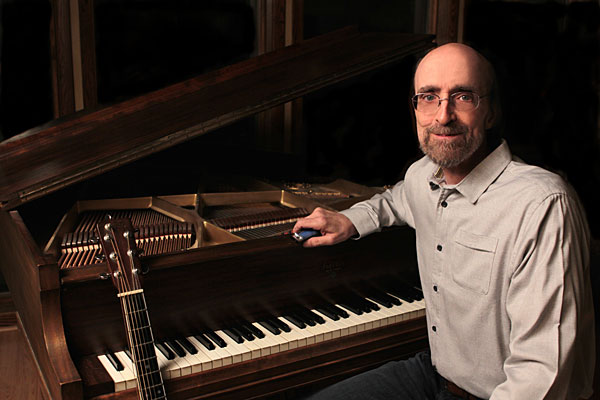
New Age. Most of it was acoustic. While there were vocals here and there, much of it featured instrumentalists playing solo or in groups. Some of it was meant to alleviate stress. Some of it was marginally connected to a similarly named movement in spirituality. Environmentalism and respect for nature were constant themes. Some New Age artists created moody, ambient sounds that were intended as background music, to promote healing and relaxation.
Gerald Wilson: Little Big Man
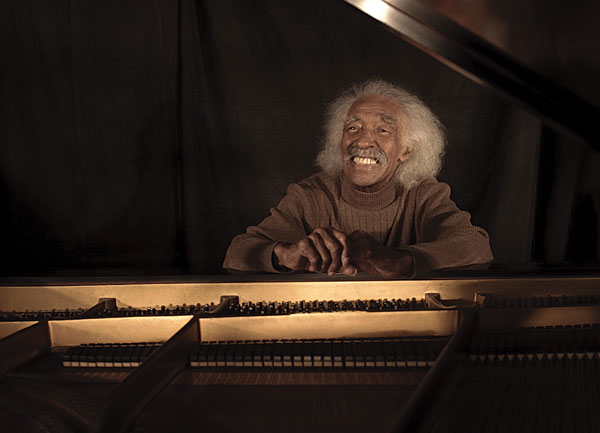
Big bands died out back in the 1950s, right? They went away when the jitterbug faded and folks began dancing to music other than swing? And then real jazz fans departed when the bebop soloists came along and made big-band players look clumsy and quaint?
Giant Step Arts: a Visionary Jazz Concept
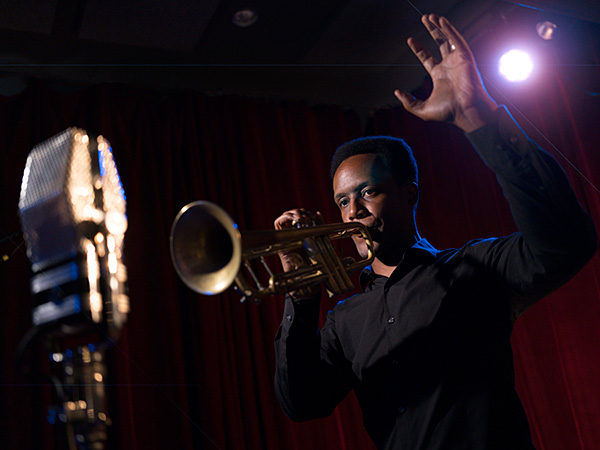
Early in 2019, three jazz CDs appeared on a new record label. They were Jason Palmer's Rhyme and Reason, Johnathan Blake's Trion (both double CDs), and Eric Alexander's Leap of Faith. The label was Giant Step Arts.
Given that hundreds of jazz recordsmany of them good are released every month, and that new jazz labels pop up all the time, is the release of three new albums really news?