

The Five Dealer Rule
Surfing the Usenet newsgroups and the Web audio forums recently, it struck me that the old wisdom is correct: If you keep your mouth shut, you won't say anything with which anyone can disagree. A topic that seems to be of perennial interest is how Stereophile chooses the products it reviews. Yet the more I have explained how it's done, the greater the criticism that is heaped on the magazine.
The Flexible Firms
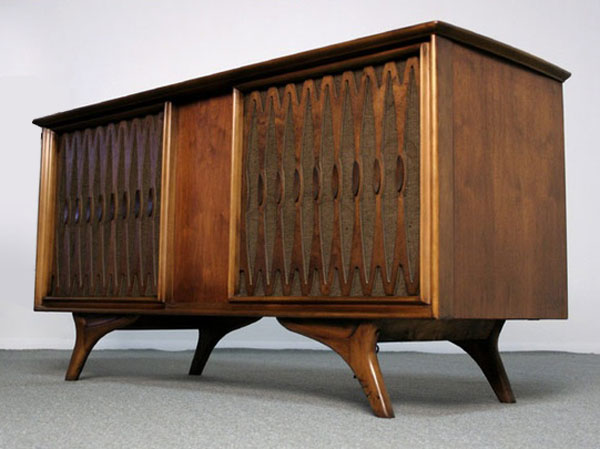
Some years ago, we attended a hi-fi show in New York City where one of the exhibitors was RCA Victor. Their presence there would have been forgotten were it not for the fact that their exhibit, featuring their own discs played on their own line of phonographs, was producing some of the filthiest sound at the entire show. And that, in the proverbial nutshell, is why you never see reports in Stereophile on equipment made by RCA, Philco or General Electric.
The Flip Side of Digital...
The following was submitted as a letter to J">http://www.stereophile.com/interviews/66">J. Gordon Holt, in response to his Editorial "Digital">http://www.stereophile.com/asweseeit/882awsi">Digital Revenge," in issue #53 (August 1982, Vol.5 No.6). We are publishing it as a guest editorial, because the writer is one of the few audio people whose judgement we respect who disagrees with us about digital's merits. The feeling, it would seem, is mutual.—Ed.
The Goodness of Your Heart: A Tragedy in One Act

Note: All dialogue quoted verbatim from e-mail exchanges to which I am privy; the stage directions are imaginary.
Dramatis Personae:
bill, director of marketing for PS Audio
randy, amateur reviewer for a commercial audiophile website
dick, professional reviewer for an established audio magazine (not Stereophile)
The Great Distortion Delusion
Hey, kids, here's the Big News. We've been deluding ourselves all along, worrying about piddling little bits of distortion that we can't hear at all. How's your preamp distortion? 1% at 1 volt out? You have a perfect preamp—a veritable straight wire with gain! That ear-shattering shrillness is all in your mind, because it has now been demonstrated that the human ear cannot perceive distortion levels of less than 6–12% on "normally complex music." If you think you can hear 0.1%, you are deluding yourself.
The Great Wall of China
"A newspaper can flout an advertiser...but if it alienates the buying public, it loses the one indispensable asset of its existence."—Walter Lippmann, 1922, reprinted in Public Opinion, New York: Free Press, 1965.
The High End, Mid-Fi, & Pretend High End
If there's a phrase that increasingly gets my dander up, it's "mid-fi." I'm even starting to lose patience with the term "High End."
The High-End Review
"To be an influence in any society...one can be a little different, but only a little; a little above one's neighbours, but not too much."---C.P. Snow, The Masters, 1951
The Holy Trinity
In an e-mail exchange with Stephen Mejias about why the mere mention of cassette decks on www.stereophile.com can so easily inflame our readers (and John Atkinson), I began to develop the idea that the brains of audiophiles and music lovers are governed by three complementary needs, or desires, that define who we are. I joked to SM that these desires, which apparently shift over time, constitute the Holy Trinity of Audiophiledom. They are, respectively, the love, desire, and need for:
The Importance of the Small Difference
During a recent visit to Canada's National Research Council, I noticed stuck to the wall of the prototype IEC listening room a page of results from one of Floyd Toole's seminal papers on the blind testing of loudspeakers. The scoring system was the one that Floyd developed, and that we adopted for Stereophile's continuing series of blind tests. "0" represents the worst sound that could possibly exist, "10" the perfection of live sound—a telephone, for example, rates a "2." The speakers in Floyd's test pretty much covered the range of possible performance, yet their normalized scoring spread, from the worst to the best, was just 1.9 points.