

KEF Home THX Loudspeaker System

KEF's Home THX speaker system is somewhat unusual in that it includes an active subwoofer. (While most Home Theater subs are powered types; it's just that few THX models are.) Although powered speakers have never enjoyed much popularity with American audiophiles, they can yield better results than the mix'n'match approach because each amplifier/driver combination can be optimized.
Keith O. Johnson: Reference Recordings
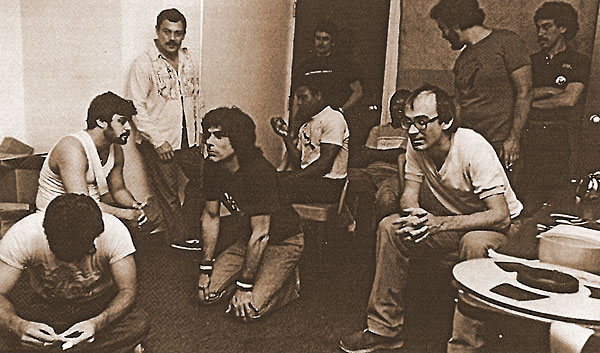
Keith Johnson is the man responsible for the records issued by Reference Recordings, from Professor Johnson's Astounding Sound Show through Tafelmusiknot to mention upcoming releases of Your Friendly Neighborhood Big Band and Respighi's Church Windows. As is frequently the case, Johnson's astounding recordings result from his intimate (molecular-level) knowledge of the process with which he deals and his ingenious adaptations to squeeze the most out of available (and not so available) technology. He is also one of the few critics of digital recording who has actually used a digital recorder, who has run tests to specifically identify digital's problems, and who would welcome a digital format that works as perfectly as the claims would have us believe the current system works.Larry Archibald
KLH Model Nine loudspeaker

Editor's Note: Although this product has been available for several years, it is being reviewed in considerable detail because it is a strong contender for the title of "Best Available Loudspeaker System, Regardless of Cost," and because we plan to review some of the other contenders for the same title within the next few issues. We feel that since all of these systems represent a considerable outlay of money, prospective buyers should have a thorough understanding of the merits and demerits of each system, so they will know what to expect from them in the way of performyince capabilities and operational requirements.
KLH Model Twelve loudspeaker

The idea of a loudspeaker system whose frequency response could be tailored to suit room acoustics and/or personal taste is one that has always appealed to the high-fidelity perfectionist. Ideally, such a loudspeaker would allow you to raise or lower the level of any part of the audio spectrum to correct for, say, a sharp 370Hz room resonance or a mild absorptive condition that weakens, say, the 800Hz3kHz range. Obviously, though, this kind of flexibility would require an infinite number of bandpass networks, each with its own volume controlwhich is an obvious impracticality.
Klyne Audio Arts SK-5A preamplifier

Klyne Audio Arts has an almost Zen-like approach to the design of its products. Like the best Japanese designs, Klyne's preamps are aesthetically pleasing in appearance, do exactly what they're supposed to, and their controls are not only where you would expect them to be, but have an almost sensually smooth action. Internal construction, too, is a work of art—the kind of design which, transferred to a tapestry, would grace the wall of any listening room. You have to see the insides of a Klyne preamp to appreciate how attractive-looking an audio component can be. But physical beauty is only one aspect of Stan Klyne's designs; of all the electronics manufacturers I know of, Klyne Audio Arts also makes products more adjustable than any others, so as to appeal to the needs of what I call compulsive tweaks.
Klyne SK-5 preamplifier

Klyne Audio Arts is such a low-profile outfit that I marvel at its continued existence. It is reliably absent from the Audio and Stereo Review annual equipment directories, and if Stan Klyne has ever run an advertisement for any of his products anywhere, I haven't seen it, Yet Klyne Audio Arts always manages to have an exhibit at CES, where they display some of the most beautiful preamps and head-amps we see there, only to go underground again for another six months.
Koss ESP-9 electrostatic Headphones
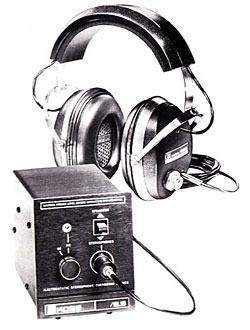 The top-of-the-line model from America's leading headphone manufacturer, these are bulky, heavy, very business-like in appearance, and very, very good.
The ESP-9 is dual-powered: from the AC line, or from the input signal itself, The power supply is rather large and heavy, and appropriate in appearance to the phones. Amplifier connections are via wires with spade lugs attached, and speaker connections are made to the rear of the power supply. A front-panel switch selects speaker or headphone operation, and terminates the amplifier outputs with 10 ohms in the Phones position.
Construction is typically top-of-the-line Koss: Rugged, nicely finished, and apparently very durable, and the phones are easy to handle. (Many headphones are so loosely pivoted on their headbands that they swing into impossible positions whenever you pick them up.)
The top-of-the-line model from America's leading headphone manufacturer, these are bulky, heavy, very business-like in appearance, and very, very good.
The ESP-9 is dual-powered: from the AC line, or from the input signal itself, The power supply is rather large and heavy, and appropriate in appearance to the phones. Amplifier connections are via wires with spade lugs attached, and speaker connections are made to the rear of the power supply. A front-panel switch selects speaker or headphone operation, and terminates the amplifier outputs with 10 ohms in the Phones position.
Construction is typically top-of-the-line Koss: Rugged, nicely finished, and apparently very durable, and the phones are easy to handle. (Many headphones are so loosely pivoted on their headbands that they swing into impossible positions whenever you pick them up.)Koss PRO-4, PRO-4A and Pro/4 AAA Plus headphones

Almost a dead-ringer for the early-model Sharpe HA-10, Koss's PRO-4 ($45) is readily distinguishable by a large knurled protuberance sticking out of the lower part of the right-hand phone. This, in case you've wondered, is a mounting for a "boom-type" lip microphone, for use in speech labs and for communication purposes. (Sharpe and Permoflux also provide facilities for attaching a lip-mike.)
Kyocera DA-910 CD player

Those of our readers who are still anti-CD are going to be offended by what I am about to say. Partly because they do not want it to be true, but mainly because it is. I shall utter the heresy anyway: the Compact Disc is, right now, doing more for the cause of high-end audio than anything that has ever come along before!
There, I've said it. Now I shall explain it.
Late Again!
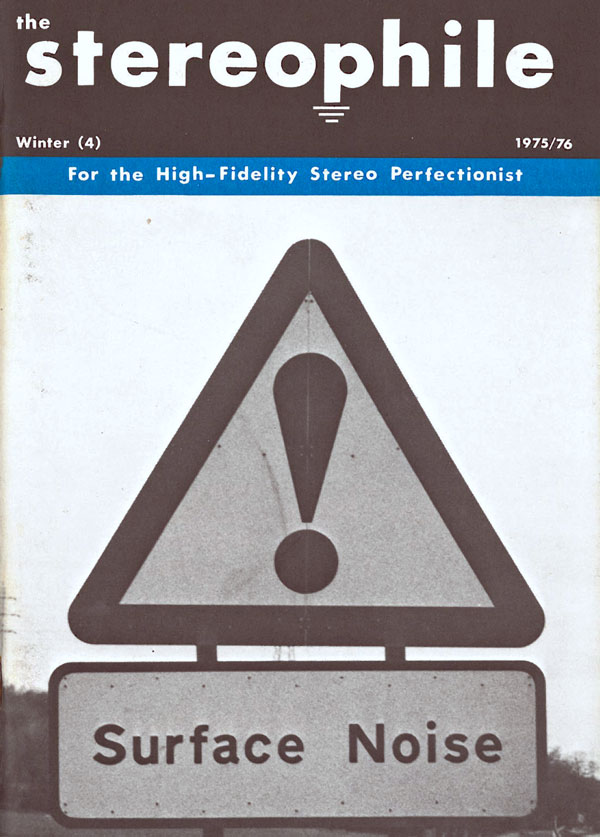
Editor's Note: In Stereophile's second decade of publication, things were starting to unravel, with long gaps between each issue. There were just seven issues published between January 1974 and January 1978. The late Harry Pearson has gone on record that he founded The Absolute Sound in 1973 part because he was tired of waiting for the next issue of Stereophile to reach his mailbox. In this "As We See It" essay from the "Surface Noise" issue in August 1976, founder J. Gordon Holt owns up to it appearing 8 months late!