

Infinity HCA power amplifier
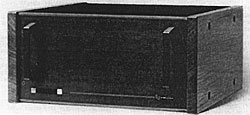 Imagine if you can a power amplifier with the bass richness, midrange liquidity, and high-end accuracy of the best tube amplifiers, and the inner detail, transient attack, and bass solidity and range of the best solid-state amplifiers. If you can imagine that, you can visualize what this amplifier sounds like.
Infinity IRS Beta loudspeaker

In 1966, two avid audiophile/music lovers—a nuclear physicist named Arnold Nudell and an airline pilot named Cary Christie—labored over weekends and evenings for 18 months in Nudell's garage to put together the world's first hybrid electrostatic/dynamic loudspeaker system. It cost them $5000 for materials, launched a company (New Technology Enterprises), and helped contribute to the popular myth that all of the really important audiophile manufacturers got started in somebody's basement or garage (footnote 1). The system was marketed as the Servo-Statik I, for the princely sum of $1795. (At the time, the most expensive loudspeaker listed in Stereo Review's "Stereo/Hi-Fi Directory" was JBL's "Metregon," at $1230.)
Infinity Reference Standard 1B loudspeaker
I'll say one thing right off about the Infinity RS-1B: It sure looks as if you're getting your money's worth.
Infinity RS-4.5 loudspeaker system

There are certain manufacturers for whom every new product implies the promise of countless modifications, Usually a month or so apart, culminating inevitably in a version so far removed from the original that it must be assigned a new model designation—usually a letter suffix ranging from A, to D. By the time E is envisioned, another CE Show is approaching, so the decision is made to give the unit an exterior facelift and a brand-new model number. Presto! A new product for CES.
Infinity Servo-Statik 1 loudspeaker

An equipment reviewer for one of the consumer hi-fi magazines once confided to a manufacturer that he found it hard to like electrostatics because of the kind of people who usually like electrostatics. His implication—that certain kinds of people gravitate towards certain kinds of sound—is an interesting thought, and one that might bear some further investigation. But there is no questioning the fact that electrostatic speakers in general do have a particular kind of sound, that might be characterized as "polite."
Is Music in Danger?
When I attended the Audio Engineering Society convention in October 1987 (my first time in over eight years; full report in this issue), I was impressed by the incredible technology now available to composers of music. I was also dismayed, however, by the extent to which so-called purist audio, as well as "acoustical" music, have been consigned to oblivion by the pro audio community. It was clear, both from the exhibits and the many conversations on which I eavesdropped, that audio professionals are no longer concerned about fidelity, in the sense of trying to reproduce sounds accurately. A "real" sound has become to them merely raw material of no value except as something to be processed, manipulated, folded, bent, and spindled to produce any sonic effect except the original one. About a third of the products displayed at the 83rd AES convention were tools for doing that.
It's the Real Thing!
We are aware that much of what we have to say about reproduced sound in these pages goes completely over the heads of a lot of our readers, simply because they have not heard live, un-amplified music recently enough (if ever) to relate their own listening experiences to our observations. These are the people who tend to have developed a strong mental image of what hi-fi ought to sound like, and it is not surprising that that image should bear little if any resemblance to reality. In most cases, this image of hypothetical perfection involves a broadly sweeping sense of spaciousness, awesome power, floor-shaking low end and silky, velvety highsrather similar, one might say, to the sound of a Magnificent Magnavox with a couple of extra octaves at each end.
Janszen Z-600, Z-900, & Z-960 loudspeakers

The Z-600 is the latest of the "console" (as opposed to "bookshelf") systems made by Neshaminy Corp., and using Janszen electrostatic tweeters (footnote 1) and a Neshaminy-designed 11" woofer. The nominal crossover frequency is 1500Hz, with a broad overlap between the woofer's top and the low end of the paralleled tweeters. Tweeter level is not adjustable (footnote 2).
JBL 250Ti loudspeaker
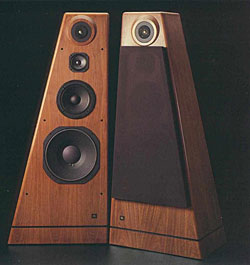 Once upon a time, in audio's infancy, anyone who wanted better than average soundaverage sound during the 1940s being rich, boomy and dullhad no choice but to buy professional loudspeakers. In those days, "professional" meant one of two things: movie-theater speakers or recording-studio speakers. Both were designed, first and foremost, to produce high sound levels, and used horn loading to increase their efficiency and project the sound forwards. They sounded shockingly raw and harsh in the confines of the typical living room.
Jecklin Float electrostatic headphones

These are some of the most lusciously transparent-sounding headphones we've ever put on our ears, but we doubt that they will every enjoy much commercial success, for a couple of reasons.