

Harman/Kardon Citation Eleven preamplifier

This is not a new component, but like most others that aspire to very high standards of performance, it has undergone some changes (for the better) since it first went into production.
Hegeman Model 1 omnidirectional loudspeaker

Ye Editor had his first exposure to a true omnidirectional speaker system 15 years ago, while he was employed as chief equipment tester for High Fidelity magazine. The speaker was a most unusual-looking device for its time, being roughly a foot square and standing 3 feet high, with a "cube" of grille cloth at the top like a cupola. Inside the cupola was an 8" woofer facing upwards. Directly above it was the weirdest-looking tweeter you ever saw.
High Fidelity at the Crossroads
101 years ago, the tinfoil cylinder started it all. Within 22 years, its heyday was done, and public support swung to favor the then-new wax-mastered disc. 1948 saw the switch to a slower speed and a finer groove, but the flat disc, traced by a stylus, has held sway for almost 80 years now. Even today, people with multi-speed turntables and a couple of arms (or plug-in cartridges) can reproduce from a single phono unit the earliest or the latest discs merely by the flip of two switches (for speed change and cartridge change). All that is about to come to an end.
High-End Standards
The American computer industry was a little shaken up to learn recently that the Japanese micro manufacturers had gotten together and standardized their component interconnections so that any Japanese computer will (supposedly) plug into any Japanese printer, modem, or competing computer, and work right off the bat. Anybody who has tried to fire up an Apple computer with a Diablo (Xerox) printer will appreciate what the Japanese move means in terms of compatibility. It means "For no-hassle interconnections, buy Japanese."
Hill Plasmatronics Type 1 loudspeaker

Dr. Alan Hill, president of Plasmatronics Inc., was previously employed by the US Government in laser research. His assignment: To increase the efficiency of lasers so that they could do something more impressive than produce holograms, mend leaky retinal blood vessels, and punch pinholes in steel blocks. Dr. Hill earned his keep, thus advancing laser technology a giant step closer to Star Wars, and then retired from government service to design. . . a loudspeaker?!!!?
How Hi-Fi are Stereo Discs?
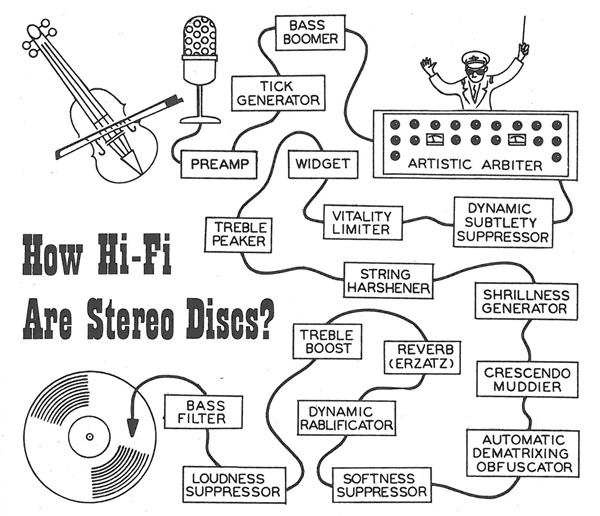
Editor's Note from 1992: This seminal J. Gordon Holt essay on how the art of recording natural sound became compromised in favor of unmusical artificiality for good commercial reasons was originally published in August 1964, in Vol.1 No.8. Though most people these days listen to classical music from CDs, not LPs, in the intervening decades, recording technology has not changed for the better as much as one might have hoped. Nevertheless, the days of wretched multimiking excess described by Gordon are past, and it's rare to find the music treated with the lack of respect typical of a mid-'60s Columbia session. Although some of the smaller companiesReference Recordings, Delos, Chesky, Mapleshade, Dorian, and Sheffield Lab in the US; Meridian, Nimbus, and Hyperion in the UKconsistently use honest, minimal miking, it is not unknown for the majors in the '90s to do likewise. And the use of time delay for spot microphones, pioneered by Denon in the mid-'80s, means that instruments that might tend to become obscured at orchestral climaxes can now be brought up in level without unnaturally time-smearing the sound. I still find it sad, however, that it is rare to hear the sheer dynamic range of a live ensemble successfully captured on a commercial recording.John Atkinson
How to Write an Ad
Everyone knows that advertising people make more money than ordinary people, but many assume that the high pay is because ad writing is so difficult. This is not true. Low-income people can write advertisements, too, so just in case somebody should accost you on the street and ask you to write an advertisement, here is how you may go about it.
I Say It's Video!
A couple of months back (March">http://www.stereophile.com/asweseeit/393awsi">March 1993, p.7), I wrote that as far as I was concerned, video was television dressed up in fancy dress, thus there was no place for coverage of the medium in Stereophile. As the magazine's founder, J">http://www.stereophile.com/interviews/66">J. Gordon Holt, has been a committed videophile for many years, I sat back and awaited a reaction from him. One was not long coming. I am running his response as this month's "As We See It" feature.—John Atkinson
In Praise of Imported LPs
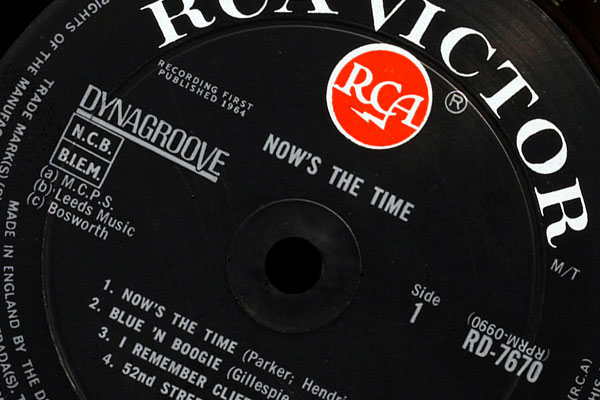
By the time you read this in late 1963 (probably a month after it is written, judging by the speed with which the US mails speed second-class matter on its appointed rounds), Capitol Records will have announced the first bit of really good news for the high-fidelity perfectionist in years: the release of imported disc pressingstaped, cut, and stamped in Europe. London has been importing for yearsall the Londons you buy are pressed by Decca in England. But this will be the first opportunity we will have of sampling the products of some of London's overseas competitors.
In Search Of The Audio Abode---The Hi-fi House
When sociologists tell us America is a highly mobile society, they don't just mean we do lot of driving. What they mean is, we do a lot of moving. The good old three-generation family homestead, immortalized in nostalgia TV and literature, is a thing of the past. According to census information, almost 20% of America's population changes its address every year. Of course, it's usually a different 20% every year, but pulling up roots and moving---to a bigger house, a better neighborhood or a nicer city, not to mention a place where your employer decides to transfer you---is almost as commonplace across the US of A as marriage, divorce, and unbridled greed.