

Electro-Voice Model Two & Model Six loudspeakers

These are two of Electro-Voice's "middle-ground" speaker systems, filling the quality (and price) range between the huge Patrician 800 and the diminutive Coronet system.
Electron Kinetics Eagle 2 power amplifier
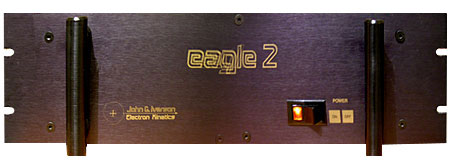
When I first heard the Eagle 2 at the 1985 Winter CES I knew this amplifier was a winner. I was eager for a chance to get my hands on it, but I also knew that J. Gordon Holt was champing at the bit to do the same. So it came as both a surprise and a delight when ye Gracious Editor gave me first crack at the Eagle 2. I wasn't disappointed; the little Eagle more than lived up to expectations. It's not the best power amplifier I've ever heard, but it's damn good. It is, in fact, better than its big brother, the Eagle 7A, in significant ways; in view of the 2's reasonable price, that's saying a lot.
Empire 880P phono cartridge
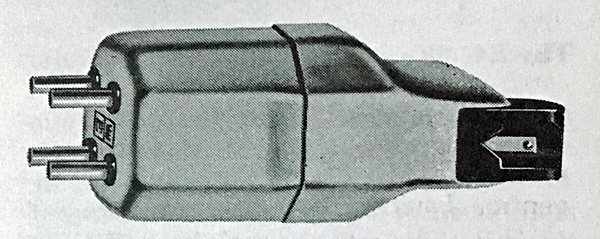
The 880P is a moving-magnet stereo cartridge for use in transcription arms and the few high-quality record changers now available, such as the Garrard Model A and the Lesa units. It has standard ½" mounting centers, and the pickup requires the 47k ohm termination provided by most preamplifiers. The 8mV output, too, is about ideal for nearly all preamps.
Eye Anchors: LaserVision Discs
Until recently, I have considered LaserVision video discs as a rather dubious medium for serious music reproduction. The only review I had read about it by a critical listener (Harry Pearson in The Absolute Sound) was I singularly unenthusiastic, and since I had not heard one myself, I was inclined to take his word for it.
Fidelity Research FR-1 Mk.3F phono cartridge
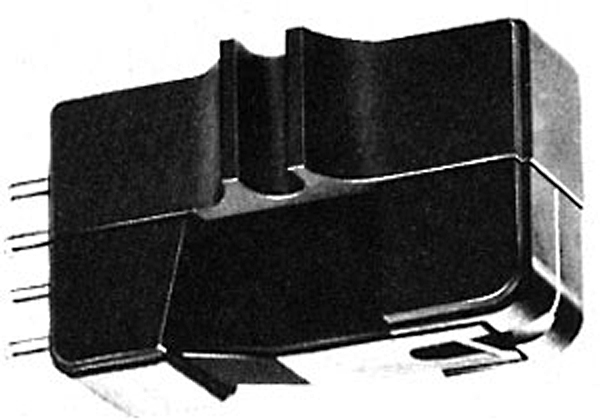
A couple of issues back, we mentioned in passing that the Fidelity Research FR-1 Mk.3F was the only moving-coil cartridge we had heard (as of then) that we would give house room to. (The others had frequency-response problems which so colored the sound that their other strong points were not worth the tradeoff.) That first observation about the FR-1 was based on a couple of hours' listening. Now that we have had an opportunity to live with one of them for a while, we can essentially confirm that first reaction, but with a few added qualifications.
Formula 4 tonearm

Not the easiest tonearm to set up (let your dealer do it if you aren't overly skilled at such things), this English-designed and Japanese-made device is the best pivoted tonearm we have tested to date, and at a very reasonable price at that. Polk Audio is importing them and distributing to dealers, most of whom sell them for around $130 to $140, and some buyers have managed to purchase them directly from stores in England for as little as $80. We received two samples of this for testing, one directly from the US distributor, Polk Audio, the other from Natural Sound, a Nebraska dealer and (naturally) one of our advertisers. Suffice it to say that both samples were identical in every perceptible manner.
Fostex M22RP/S M-S microphone
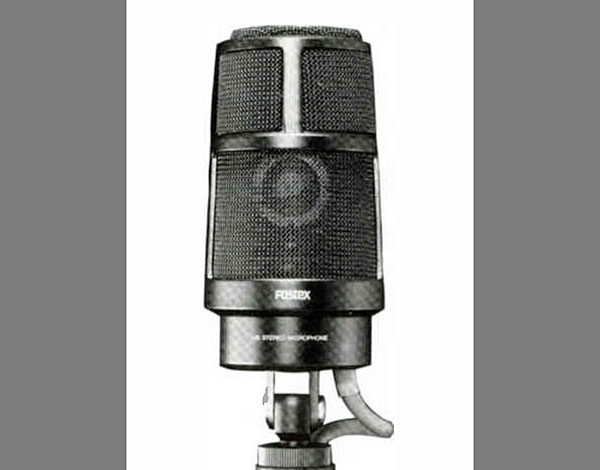
Coincident stereo miking (footnote 1) has two advantages and one disadvantage. Its advantages are that it gives the most stable, specific imaging of any mike technique, and its outputs can be summed for mono reproduction without loss of quality. Its disadvantage is that, in most of its configurations, it tends to produce an overly narrow, shallow soundstage.
Fulton Musical Industries Model 80 & "J-Modular" loudspeakers

In the last issue we published a rather enthusiastic "Quickie" report on a small, $190/pair speaker system from a new company—the FMI Model 80. It was virtually devoid of low end, even as a stereo pair (pairing effectively doubles bass output), and slightly rough as well as a shade soft at the high end, but it had a quality of "aliveness" to it that almost defied belief. Was it a breakthrough in design? A new transducing principle? No, it was neither. In fact, the Model 80 looks like any one of those hundreds of little bookshelf systems that clutter, the pages of Stereo Review's "Hi-Fi Directory" in tedious profusion.
Futterman H-3A power amplifier
It is not at all unusual these days to find manufacturers producing "matched" speakers and amplifiers that are designed specifically for one another. But it is very unusual to find this being done by an amplifier manufacturer who doesn't make loudspeakers. The Futterman H3-A is one of these raritiesan amplifier designed primarily to complement one of the best, and one of the hardest-to-drive loudspeakers on the market: the KLH Model Nine.
Gale GS402 loudspeaker
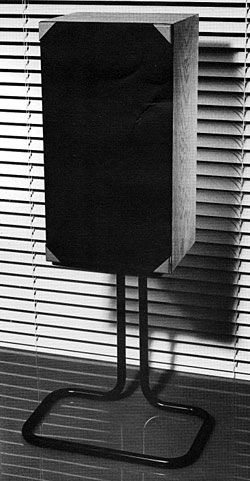 The Gale loudspeaker dates back to the early 1970s. As I understand it, the basic design resulted from a collaboration of Ira Gale and Sao Win, who were college classmates at the time. Their speaker proved very popular in England and was subsequently imported to the USA during the mid-1970s by Audio Technica. Recently, Techport (the folks who import the Perreaux line) has taken over US distribution.
While the Gales have undergone same changes through the years, their distinctive appearance and, according to some, their equally distinctive sonic "flavor," have continued to earn the respect of critical listeners all over the world. Nonetheless, these speakers have also sustained their fair share of criticism; not everybody likes them. This sort of continuing disagreement usually means that what is at issue is a "different" kind of sounda product that sounds quite unlike others, yet somehow offers a high enough degree of musical satisfaction to appeal to a lot of serious audiophiles. Of such products are cults made.
The Gale loudspeaker dates back to the early 1970s. As I understand it, the basic design resulted from a collaboration of Ira Gale and Sao Win, who were college classmates at the time. Their speaker proved very popular in England and was subsequently imported to the USA during the mid-1970s by Audio Technica. Recently, Techport (the folks who import the Perreaux line) has taken over US distribution.
While the Gales have undergone same changes through the years, their distinctive appearance and, according to some, their equally distinctive sonic "flavor," have continued to earn the respect of critical listeners all over the world. Nonetheless, these speakers have also sustained their fair share of criticism; not everybody likes them. This sort of continuing disagreement usually means that what is at issue is a "different" kind of sounda product that sounds quite unlike others, yet somehow offers a high enough degree of musical satisfaction to appeal to a lot of serious audiophiles. Of such products are cults made.