

Superphon Revelation preamplifier

Superphon's Revelation Basic preamplifier is made by Stan Warren, formerly the "S" of PS Audio, so it should come as no surprise that the Revelation Basic and the PS Audio Source sound much alike. The Revelation Basic sells for $399, assembled (no kit available). Like the Source, the Revelation has an outboard AC power transformer to minimize hum problems. But unlike the Source, the Revelation has dual volume controls (a pain) and lacks moving-coil capability.
Sutherland Engineering Timeline record weight
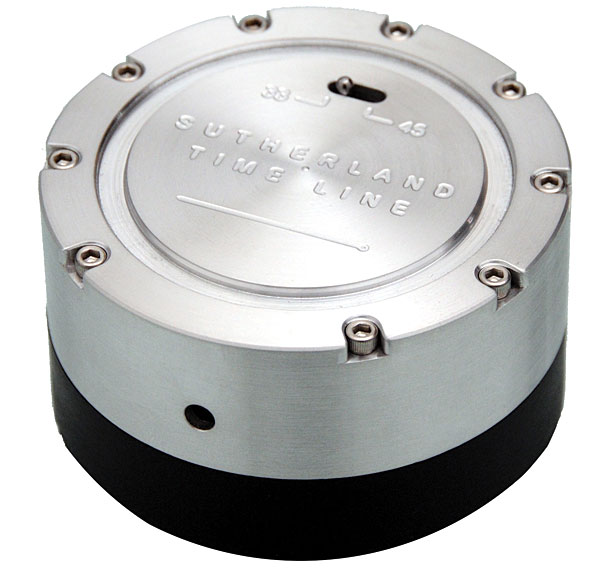
Ron Sutherland has devised the Timeline, a device for testing the 33.33 and 45rpm speeds of turntables. It's housed in a disc of aluminum and Delrin that fits over the platter spindle. Turn it on, and an LED shoots a red dash of light at the wall (if there is one) behind your turntable. If the dash doesn't move, the speed is correct. If it drifts to left or right, you'll need to adjust the 'table's speed. Unless your wall has hash marks, there's a bit of subjectivity involved, and at $399 the Timeline isn't cheap, but Sutherland says he's not making much money at that price, and that it will take a lot of sales to recoup the R&D he's put into designing something as precise as he claims the Timeline is.Michael Fremer
SVS 3000 Micro subwoofer

My incommodious room favors small standmount and panel speakers that some audiophiles would say require a subwoofer.
But I was never inspired to try one until a new category of subwoofer appeared: the "micro" (aka soccer-ball) subwoofer. The minute I saw the little KEF KC62, a 10" cube, I imagined it could do 0100Hz and back to zero in record time. I reported on the KEF microsub last month, in Gramophone Dreams #49.
SVS SB-3000 powered subwoofer
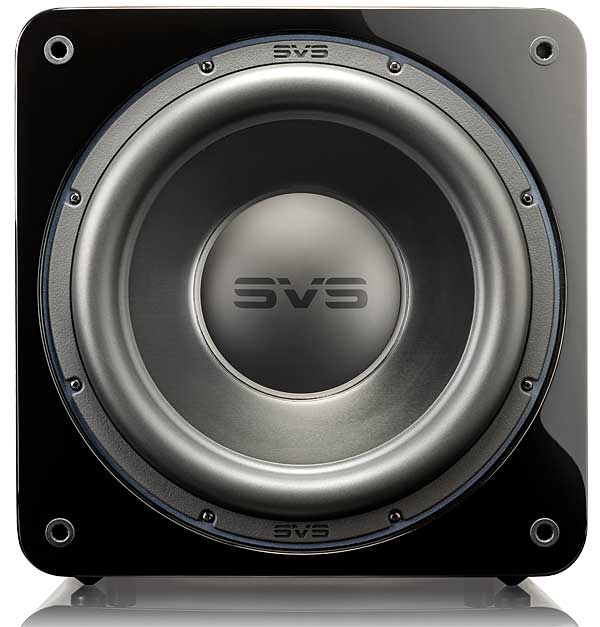
SVS's recently introduced SB-3000 is a compact powered subwoofer that's $600 cheaper, a few cubic inches smaller, and 37lb lighter than the model it replaces, the SVS SB13-Ultra. Its amplifier is less powerful (800W vs 1000W), but its rated frequency response extends lower: a stygian 18Hz, compared to the SB13-Ultra's merely stentorian 20Hz.
Tannoy E11 loudspeaker

The Tannoy E11 ($349/pair) is the company's least-expensive model in a wide range of consumer loudspeakers. Tannoy is most often known for its professional models, especially their nearfield, dual-concentric monitors that have become de rigueur on the top of recording consoles. The E11 is a two-way, ported design with a 6.5" woofer and 1" dome tweeter. Both drivers are manufactured by Tannoy, instead of being sourced from a driver manufacturer. The woofer is made from a polyolefin co-polymer, a plastic material with high rigidity and good self-damping properties. To improve power handling and increase sensitivity, the voice-coil is edge-wound on a Kapton former. The surround appears to be made of butyl rubber.
Tannoy Mercury V1 loudspeaker

The last few decades have seen dramatic improvements in the art (and science) of loudspeaker design. Tannoy's budget-priced Mercury series is now in its fifth iteration. The two-way, front-ported Mercury V1 ($320/pair) measures 11.8" high by 6.7" wide by 10" deep and weighs 9.9 lbs. My samples came in a very handsome Dark Walnut finish (Sugar Maple is available) with simple black cloth grilles. I left the grilles off to reveal the speakers' attractive front baffles and accentuate their equally attractive high frequencies (more on the latter later).
Tannoy Revolution XT 6 loudspeaker

I've been wrestling with my elders about new ways to measure loudspeakers, lobbying for methods that might correlate more directly with a listener's experience. And wouldn't you know? Right in the middle of this Socratic dialogue, I put the fresh-from-UPS, $1000/pair, Tannoy Revolution XT 6s into my reference system, plunking them down on my 24" Sound Anchor Reference stands in the same spot my Harbeth P3ESRs had been sitting. And I freaked! I was using the Rogue RP-7 preamp and the Rogue Stereo 100 (100Wpc) amplifier, and I could never adequately describe how bad the shiny white Tannoys sounded. Imagine sound that's thin, metallic, herky-jerky, dull, and rolled off completely below about 90Hz.
Tannoy TS2.12 powered subwoofer
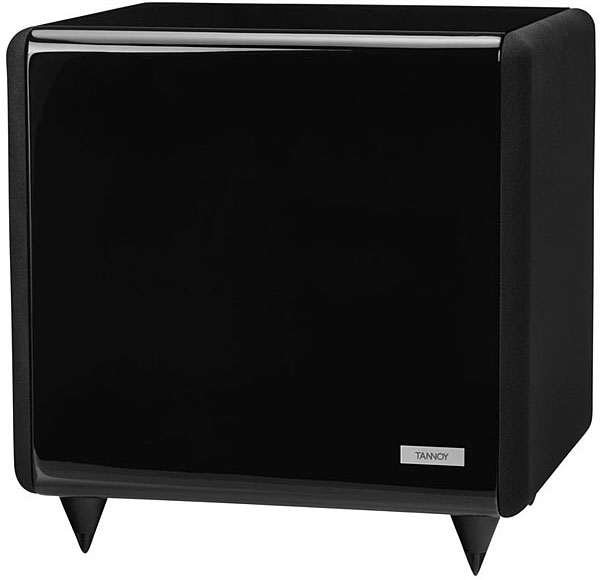
Ten years ago, our family was joined by my son-in-law, who was raised in Dublin, and spent his university years in London. I was editing this review during a recent visit with our daughter and grandchildren, and Justin became interested in the fact that I was reviewing a subwoofer made by Tannoy. He reminded me that, in the UK and Ireland, Tannoy had long been a generic term for public-address systems, just as Hoover had come to describe any vacuum cleaner, regardless of manufacturer. Although Justin admitted that this usage was probably "old school," he teased me that I was reviewing a PA speaker for an audiophile magazine!
Technics SC-CX700 active loudspeaker system
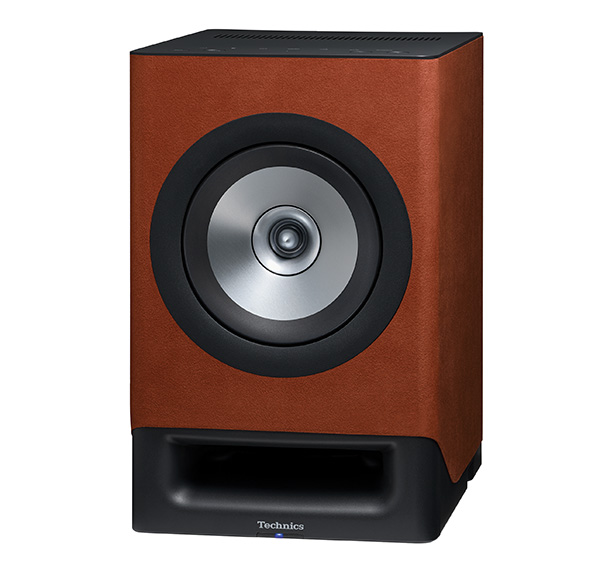
The usual Specifications sidebar in this review is a nuts-and-bolts listing of the electrical and physical properties of the Technics SC-CX700 loudspeaker ($2999.99/pair), who made it and where, and a widely varying amount of information about its electrical and acoustical performance. The information comes from the included literature, available downloads, and whatever I could find on the manufacturer's website.
Note the complete absence of the usual technical information about the design or construction of the coaxial driver or about the crossover frequency and slope. Missing, too, are performance specifications for frequency response, sound-pressure level, and distortion. That disappoints me because I like numbers, but all the really interesting stuff about these speakersthough expressed without as many numbers as I'd wishcan be found on the Technics website. These include: what Technics calls "Acoustic Solitude Construction," which isolates the electronics from the loudspeakers structurally and spatially; "Model Based Diaphragm Control," which adjusts diaphragm movement in real time; and "Space Tune," which includes four acoustical presets and two levels of measurement-based room correction.
Technics SL-50C record player

Every first love leaves a strong impression. Hopefully it's a good one. Those of us who are phonography-positive fondly remember our first good record playing system, the first turntable-cartridge combo that let the music turn us on. Maybe it was simple, maybe it was fussy, maybe it was unreliable—no matter, it had that special ability to bring the excitement, beauty, and humanity out of the vinyl grooves, through our audio systems, and into our souls.