

McCormack Micro Integrated Drive headphone amplifier
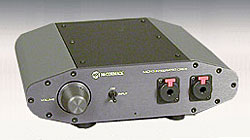
What, I hear you asking, is an integrated drive? The MID is part of McCormack's much lauded "Micro" series (see my review of their Micro Line Drive in Vol.18 No.6), which are designed to offer the same dedication to quality as McCormack's full-size components, but at a lower price (and in a smaller package). The MID was initially the Micro Headphone Drive, sporting two ½" stereo phone-jacks on the front panel, a two-position input switch, and a volume control. The rear boasted two inputs and an output (controlled by the volume pot). It was designed to be a high-quality headphone amp and a minimalist preamp. In this configuration, I ran into it at the 1995 WCES where—almost as a gag—Steve McCormack had made up a few ½" stereo phone-plug to 5-way binding post connectors. He could, he explained, run small speakers from the headphone outputs. There was a serious purpose behind the joke, of course. Showing that the MHD could drive speakers spoke volumes for its ability to drive headphones.
McIntosh MAC7200 stereo receiver

Recently, I received an email from Editor Jim Austin. "Larry, do you still use your Day Sequerra FM Reference tuner1 to listen to FM radio?" he asked.
"Jim, yes, I still listen to FM classical music in the Bay area. Why?"
Mesa Tigris integrated amplifier
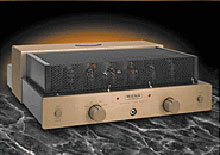
Obviously, no one wants to listen to exaggerated bass, italicized highs, or colored mids. But if you (as I have in the past few months) plug in several high-quality integrated amplifiers, each designed to a different price point, into the same basic signal chain, you'll experience a wide disparity of sound signatures.
Micromega AS-400 D/A integrated amplifier
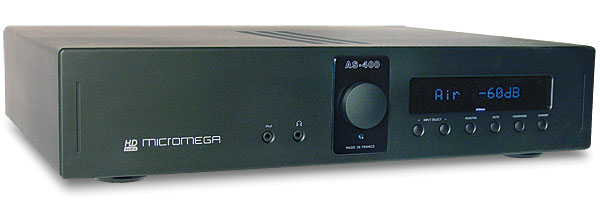
Blind though I am to the allure of blind testing, I can appreciate some degree of review-sample anonymity: Distinctive products elicit distinctive responses, but a plain black box encourages us to leave our prejudices at the door. It asks of us a certain . . . objectivity.
So it was with the Micromega AS-400 digital source/integrated amplifier ($4495), the anonymity of which was compounded, in my case, by a generous helping of forgetfulness: I suppose I was told, ahead of time, that this was a class-D amplifier, but at some point in time before my first at-home audition I apparently killed the brain cells responsible for remembering that fact. So I was innocent of conscious prejudice when I listened to this elegant cipher of a box and wrote, in my notes: "Dynamic, dramatic, and almost relentlessly exciting with some recordings. Imbued pianos with almost too much dynamism for the roomtoo much being very good!but lacked some 'purr' in the die-away. Basically fine and fun. Wish it had a little more color and spatial depth."
MOON by Simaudio 371 streaming integrated amplifier
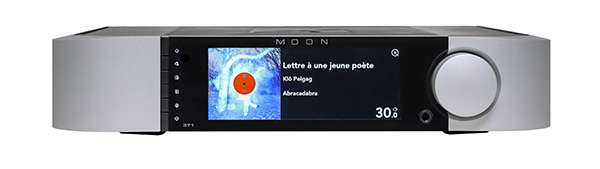
The origins of Canadian audio manufacturer MOON, from the company called Simaudio, stretch back to 1980, when audio engineer Victor Sima created his first designs. Sima's company became Simaudio Ltd. in 1990. Simaudio launched the MOON brand in 1997.
Moon by Simaudio Neo 340i integrated amplifier
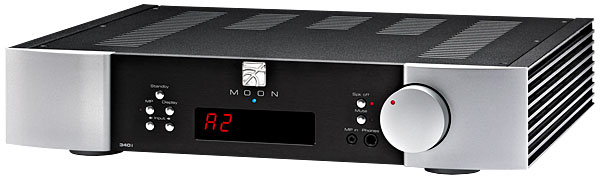
August 26, 1944: The liberation of Paris. Imagine ranks of tattered Canadian soldiers marching past the Moulin Rouge à Paris. The voice of Édith Piaf singing "Ou sont-ils, mes petits copains?" (Where are my boyfriends?). Maurice Chevalier crooning "Ça sent si bon la France" (It smells so good in France). A Canadian army tank with the words Kaput and Finito painted in white above the word Montréal, motoring past the Eiffel Tower. Remember the fresh, celebratory taste of fine Champagne.
Moonriver 404 Reference integrated amplifier
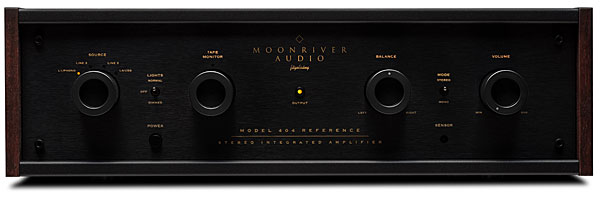
Joy. It's all about the joy.
Joy manifests during those moments when the critical mind suspends, the lens clears, and only union between you and your experience exists. When joy arises, time stands still, all sense of separation vanishes, and only wonder remains.
Many of us live for those moments. Moments of understanding that transcend verbiage and mental chatter and affirm what is real and eternal about the human condition.
Music in the Round #16
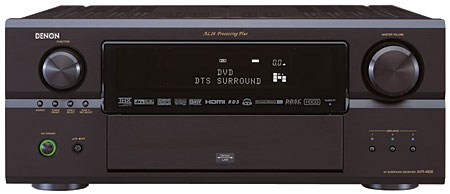
In September 2005, for the first time, I attended the Expo of the Custom Electronic Design & Installation Association (CEDIA), in Indianapolis. Although I saw many familiar faces and companies, it was apparent that the event was dominated by a spirit very different from the one that pervades this magazine or the high-end exhibitions at the annual Consumer Electronics Show (CES). That spirit, however, does suffuse the rest of CES, and is well represented at Primedia's own Home Entertainment shows. That spirit encompasses video, and a view of audio that differs significantly from that of traditional audiophiles. Multichannel surround sound is taken as read, and novel technologies are prized higher than the proverbial "straight wire with gain."
Music in the Round #42
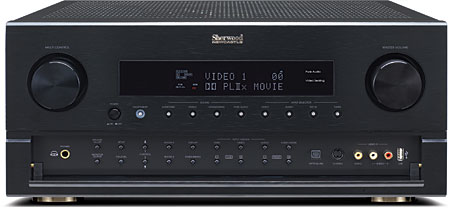
An audio/video receiver in Stereophile? Heresy!
Music in the Round #52

In my last column, in November 2011, I mentioned that preamplifier-processors are generally at a price disadvantage in comparison to the same manufacturer's A/V receivers. The economies of scale almost ensure this. Typically, to design a pre-pro, a manufacturer uses one of its AVR models as a platform; the result is most distinguished from its parent AVR by its lack of power amplifiers.