

Musical Fidelity A1 integrated amplifier
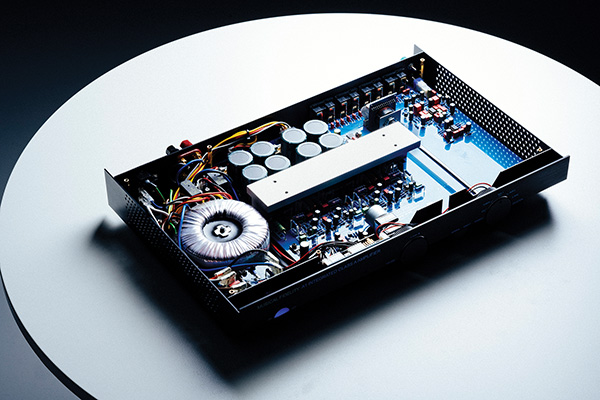
In 1989, I bought my second pair of Rogers LS3/5a's from a guy on Staten Island who had them hooked up to a Musical Fidelity A1 integrated amplifier. After playing the speakers for me, he began removing his zip-cord speaker cables and paused to show me how, at the amplifier end, his red-plastic Pomona Electronics banana plugs had partially melted from the A1's heat. We both laughed.
After it first appeared in 1985, the A1 quickly became famous for its hot top plate. The top plate got as hot as it did because it was used as a heatsink for the output transistors, which were biased highly into class-A. The A1's hot top made tabloid headlines, but for me it was its bold, sinewy, un-transistory sound and timeless, sharply drawn styling that distinguished it from cooler running Brit-fi competitors such as Audiolab's 8000A, Creek's 4040, A&R Cambridge's A60, and NAD's 3020.
Now it's back, priced at $1779, looking and feeling cooler than before.
Musical Fidelity A3.2 integrated amplifier

It was 20 years ago today that Sgt. Michaelson taught the band to play. I was living in London when Antony Michaelson launched Musical Fidelity in an attempt to make a major statement in the area of affordable, high-quality, high-value electronics. Other Brits at the time were doing the same—companies such as Creek, A&R Cambridge (now Arcam), and DNM began to compete for the destitute audiophile's dollar.
Musical Fidelity M3 Nu-Vista integrated amplifier

The old advertising jingle "Who put eight great tomatoes in that itty-bitty can?" bubbled through my head as Musical Fidelity's Antony Michaelson proudly unboxed the new $4500 M3 Nu-Vista integrated amplifier. How did they cram it all in there?
Musical Fidelity M8xi integrated amplifier
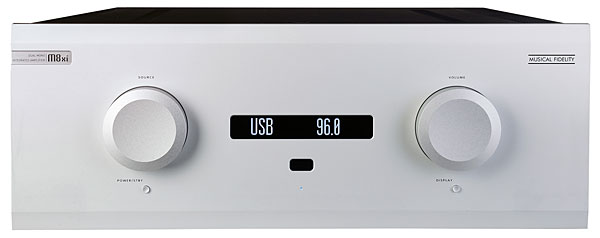
Once upon a time, reviews of Musical Fidelity components frequently filled pages in Stereophile. But in all my years covering audio shows, I can't recall blogging about any of the company's products, not even once. So, when my editor offered a review of the new M8xi ($6490), a hefty 101lb dual-mono integrated amplifier that includes a DAC, I seized the opportunity to fill a black hole in my consciousness. (Kindly cast aside thoughts that it would take more than a hunk of audio equipment to fill the black hole in my brain.) As long as I didn't break my back lifting the M8xi, solo, to the top shelf of my rackfor this I humbly beg assistance from spouses, neighbors, and friendsnew vistas were in store.
Musical Fidelity Nu-Vista 600.2 integrated amplifier
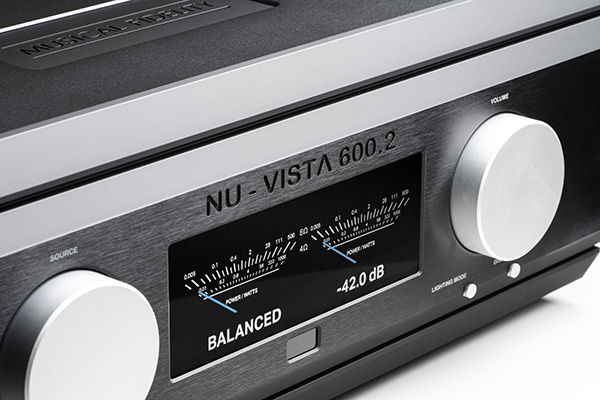
The very first Nu-Vista product was a preamplifier dubbed the Nu-Vista PRE. Launched in 1997, it was the second audio product to utilize nuvistors, small, metal-clad vacuum tubes introduced in 1959 to compete with bipolar-junction transistors. The first power amplifier to utilize nuvistors was the ovoid Nu-Vista 300.
Musical Fidelity Nu-Vista 800 integrated amplifier

Nuvistorsminiature, small-signal, vacuum tubes made of metal and ceramicwere introduced by RCA in 1959, at the dawn of the transistor revolution. RCA used them throughout the 1960s in its New Vista line of television sets, mostly in the tuner section. But by the early 1970s, solid-state devices had all but replaced tubes, nuvistors included (with a few notable exceptions). Ampex based the electronics of its well-regarded, late-'60s MR-70 open-reel tape deck on nuvistors, which were also used in microphone preamplifiersin both cases for their very low noise and reputation for reliability and long life. For a time, Conrad-Johnson used them as well. While nuvistors may seem exotic today, they're hardly rare. On eBay you can find for sale hundreds if not thousands of used and new-old stock (NOS) nuvistors, as well as nuvistor sockets, without which the tubes are less easy to implement. (But they can be, and often are, hard-wired into a circuit.)
Musical Fidelity Nu-Vista 800.2 integrated amplifier
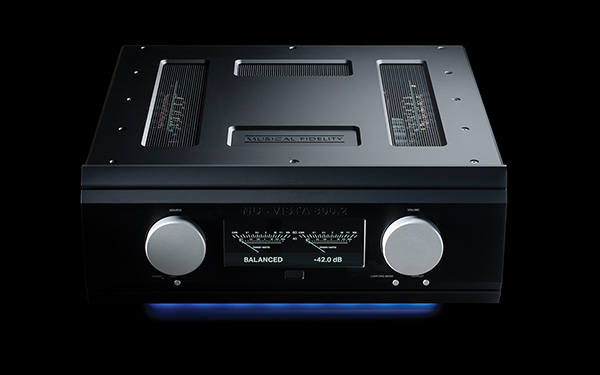
I first met Musical Fidelity's founder, Antony Michaelson, in 1978, when he was running tube amplifier manufacturer Michaelson & Austin. I still have an M&A TVA-10 amplifier, which was designed by the late, great Tim de Paravicini. Soon after Antony founded Musical Fidelity in 1982, he employed de Paravicini to design the A1 integrated amplifier.
The A1 was a slim solid state design with a class-A output stage that output 20Wpc into 8 ohms. By contrast, the massive, dual-mono Musical Fidelity Nu-Vista 800 integrated amplifier, which Michael Fremer reviewed for Stereophile in November 2015, featured nuvistor tubes for its small-signal circuitry, coupled with a solid state, class-AB output stage that could deliver 330Wpc into 8 ohms.
Musical Fidelity X-T100 integrated amplifier
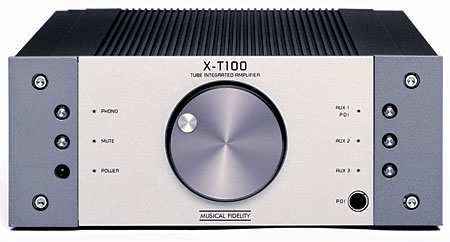
Specialization seems to be an inevitable consequence of progress: As the products of man and God become more and more complex, they're called on to do fewer things in more focused ways.
Mystère ia21 integrated amplifier

My first trip to a Consumer Electronics Show, in January 2010, was an eye-opener. Not only had I never before seen the phony glories of Las Vegas, it was the first time I'd been to a high-end audio show. Between the offerings on the top floors of the Venetian and T.H.E. Show at the Flamingo, I met some great people and heard some wonderful new products. One of those people was distributor Kevin Deal, and one of those new products was from Mystère. Though I was familiar with the PrimaLuna line that Deal also distributes, Mystère was, well, a mystery. However, after a listen to the Mystère pa21 power amplifier making a pair of MartinLogan speakers sing, and after noting the reasonable prices for some of Mystère's beautifully designed and built amps, I put Mystère in my review queue.
NAD C 3050 LE BluOS streaming integrated amplifier

Stereophile has favorably reviewed many NAD amplifiers over the decades. One of the most recent was the Master Series M10 class-D streaming integrated amplifier, which I purchased to use as my daily driver after I reviewed it in January 2020. The M10's price included a free license for Dirac Live low-frequency room equalization, which I found invaluable with my long-term reference standmounts, the KEF LS50s. So when I learned that NAD was introducing a 50th Anniversary integrated amplifier, the C 3050 LE, which also included Dirac Live, I asked for a review sample.