

Analog Corner #204: The Onedof Turntable, a Smooth Operator
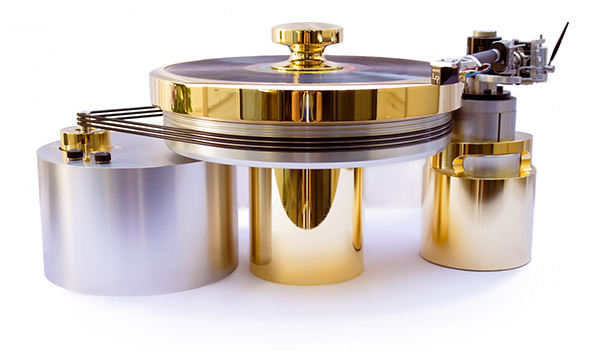
Will yet another $150,000 turntable fly in 2012? I'm speaking metaphorically, of course, but if any designer could make a turntable literally fly, it would be the Onedof's designer, Aleks Bakman.
Analog Corner #207: Wave Kinetics NVS Reference turntable & Durand Telos tonearm
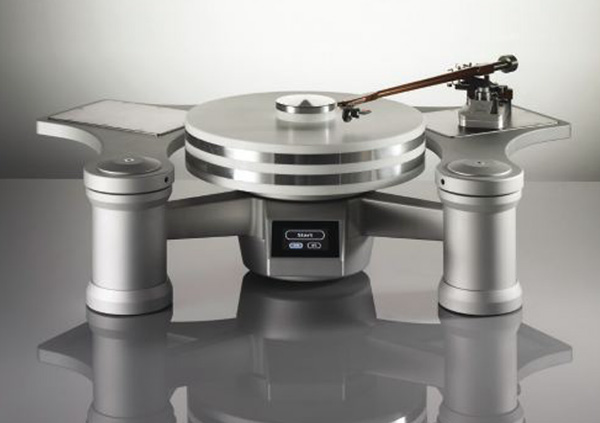
The late Jonathan Tinn of Blue Light Audio, importer of darTZeel electronics and a partner in Playback Designs with DSD expert Andreas Koch, loved vinyl. He approached Wave Kinetics' Matt Schuster and proposed that they together produce a turntable. Matt Schuster came up with the Wave Kinetics NVS Reference turntable ($45,000).
Analog Corner #224: Lyra Etna MC phono cartridge

Is the high-performance audio industry stagnating? Are designers simply repackaging the past? Cynics claim so, but to me it seems that making that case gets harder by the day, as a parade of veterans continue to produce their best work.
Analog Corner #226: VPI Classic Direct Drive Signature turntable

VPI Industries' Harry Weisfeld has tried, built, and marketed almost every known way of spinning a platter. He began in the early 1980s, before many recent turntable enthusiasts were born, with the belt-driven HW-19, and since then has produced rim-driven models, and 'tables with motors outboard or inboard, one or three pulleys, one or three belts, and platters of acrylic or aluminum alloy. But while Weisfeld has owned quite a few direct-drive 'tables, he'd never come up with his ownuntil now.
Analog Corner #239: Swedish Analog Technologies tonearm

Late in the fall of 1982, Los Angeles turned ugly for me. I'd finished my work on Tron and despite the Academy Award nomination for Best Sound (which went to the mixing team, not the sound supervisor), it was obvious that nothing else was coming my way anytime soon. To earn a living, I had to reinvent myself.
So there I was in Las Vegas, at the 1983 Consumer Electronics Show, schlepping heavy bags filled with press kits, each containing an audio cassette of a dozen radio commercials for a car-stereo store that I'd voiced and produced, along with a résumé-bio and endorsements from clients.
Analog Corner #240: Sperling-Audio L-1 turntable and TA-1 tonearm
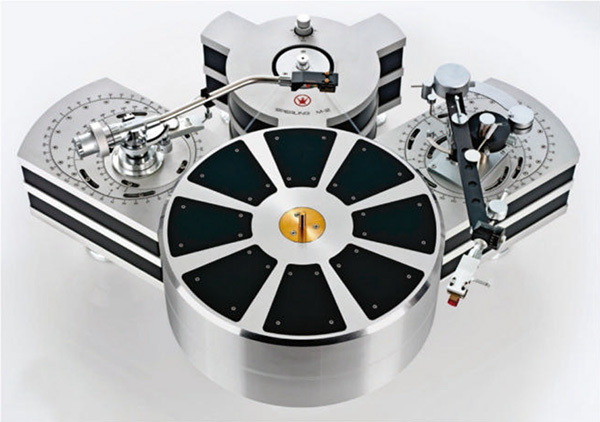
Photo: Echopark
With its swept-wing shape and platter-forward design, Sperling-Audio's L-1 turntable ($35,950, without tonearm) stands out in a crowd. This high-mass design from Germany is the result of a collaboration between Ansgar Sperling and Michael Bönninghoff, two fiftysomething engineers who began working together in recording studio construction.
Both also bring to the L-1's design and construction years of experience in signal processing. For years, Bönninghoff was the chief developer at Brauner microphones, and today is the technical director of the German pro-audio company S.E.A. Sperling worked in radio and signal processing, and has a strong interest in tubed electronics.Analog Corner #294: TechDAS Air Force One Premium turntable & Graham Engineering Elite tonearm

In 2013, when I first wrote about it (footnote 1), the TechDAS Air Force One ($105,000) was that company's best and most expensive turntable; it joined the handful of products that have earned an A+ in our semiannual Recommended Components featurea rating that remained in place for six years. But too much time has passed since the Air Force One was auditioned by a Stereophile writer, so it has now fallen from that list.
Analog Corner #300: Boulder 2108, Consolidated Audio Monster Can

The two biggest sonic jolts I've experienced involving phono preamps were from two very different ones: the Petr Mares's Connoisseur 2.0 and Boulder's 2008, which was reviewed in the July 2002 Stereophile. The first was hand-built, single-ended, housed in a wooden case, limited to 100 units, and, when I got to hear it in the mid-1990s, cost around $6000, or about $10,000 in today's dollars. The other was a feature-laden, double-chassis monument to flexibility and surface-mount high technology. It featured beautifully finished, flush-mounted mirrored buttons your fingers just wanted to press.
Analog Corner #304: SAT XD1 record player

Let's begin by discussing what SAT's XD1 Record Player System is not: It is not a Technics SP-10R in a sci-fiinspired plinthalthough the XD1's engine does begin life as the SP-10R's basic drive system, which is stripped down to a handful of essential components, reimagined, reengineered, and rebuilt to much higher mechanical standards.
Analog Corner #314: OMA K3 turntable & Schröder tonearm

If you're going to spend a year-plus in COVID lockdown, it doesn't hurt to have a million dollars' worth of turntables keeping you company, right? That's been my good fortune. Sounds like a roomful, but it's only three: the SAT XD1, the TechDAS Air Force Zero, and the OMA K3 ($360,000, footnote 1).
You'll find this issue's cover girl either strikingly beautiful or homely. Visitor reactions fall strongly into one of those two camps, with nothing in between. I love the looks. Whatever your opinion, the K3's visual distinctiveness cannot be denied. The innards are equally unique.