

Avantgarde Acoustic Uno Nano loudspeaker

A compact horn loudspeaker. Isn't that an oxymoron, like jumbo shrimp, or military intelligence? From such venerable speakers as the half century-old Altec Voice of the Theater and the Klipschorn, as well as more modern examples like the Avantgarde Acoustic Trio, horns have always been big. The original Avantgarde Uno was the smallest speaker in Avantgarde's line, but it was still visually imposing, with a big horn midrange on top, a horn tweeter below that, and a powered sealed-box subwoofer at the bottom. (I reviewed the Uno 2.0 in Stereophile in August">http://www.stereophile.com/floorloudspeakers/287">August 2000, Vol.23 No.8, and the Uno 3.0 in August">http://www.stereophile.com/floorloudspeakers/287/index11.html">August 2002, Vol.25 No.8.) The Uno and its siblings, the Duo and Trio, are perhaps the antithesis of the in-wall loudspeakers beloved by interior designers. These speakers do not fade into the background—not visually or sonically.
Avantgarde Duo SD iTRON G3 active loudspeaker

Active speakers make sense. The amplifiers, crossovers, and drivers are designed as a unit, so the design isn't compromised by the need to interface with components with unknown electrical or acoustical characteristics (except for the room, and that can't be helped). Concurrent design and testing of the various pieces can result in an integrated, through-designed system. Plus, the elegant simplicity that active speakers bring to a system just appeals to me.
Like many audiophiles, I've found myself intrigued by the variety of approaches that are taken to achieve the same goals: point source, line source, panels, horns. Whenever I've heard horns paired with a flea-powered amp, the dynamics have always impressed. I've consistently heard a jump factor that makes music feel remarkably alive. The combination of these two traits, thoughhorns plus activeis quite rare.
Ayre Acoustics DX-5 universal disc player
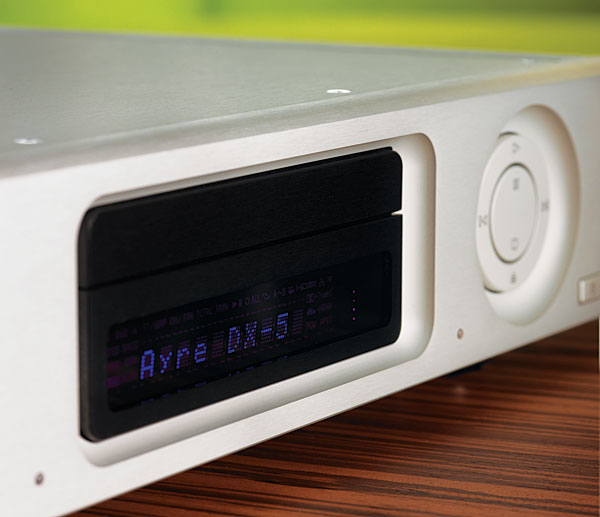
The old Saab slogan, "Find Your Own Road," was so good that the old General Motors, which once owned Saab, had to kill itjust as the newly revived GM tried, in a "Call It Chevrolet" memo, to kill "Chevy." GM did a U-turn on that one the very next day, but "Find Your Own Road" never returned, and is available for Ayre Acoustics to use. I can't think of a better slogan for a company that I admire almost as much as I do Saab.
Consider this: While Ayre calls its new DX-5 ($10,000) a "universal A/V engine," the disc player doesn't have a coaxial or a TosLink S/PDIF input. That appears crazy to me, but to Ayre, no. They've found their own road.
Ayre Acoustics KX-R Twenty line preamplifier

The experience left me doubting my ears. After I'd performed all the measurements of Ayre Acoustics' KX-R preamplifier ($18,500) to accompany Wes Phillips's review in our November 2008 issue, I spent a weekend listening to it. To my astonishment, the sound of my system with a Transporter D/A processor feeding the preamplifier was better than when the DAC fed the power amplifier directly. Through the KX-R, images sounded more tangible, and the sound was better focused, despite the signal's having been passed through not just another set of interconnects but also through the preamp's input and output socketry, switches, a volume control, printed circuit-board traces, and active and passive parts. Logically, you'd think that having nothing in the signal path would have less of a degrading effect than so many somethings. But no, that was not what I heard, much as I would have preferred otherwise.
Ayre Acoustics MX-R Twenty monoblock power amplifier
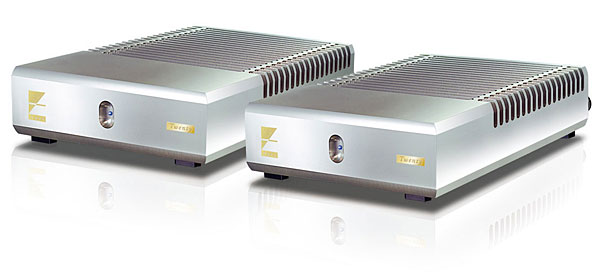
Of the hundreds of product reviews I have written over the years, it is perhaps those of power amplifiers that present the hardest task in defining their worth. This is not because power amps are unimportant. As I wrote in my review of the MBL Corona C15 monoblock, in June 2014, "it is the power amplifier that is responsible for determining the character of the system's sound, because it is the amplifier that must directly interface with the loudspeakers. The relationship between amplifier and loudspeaker is complex, and the nature of that relationship literally sets the tone of the sound quality." But because the amplifier's role is so fundamental, it can at first be difficult to determine a given amp's balance of virtues and failings. A paradox.
Ayre KX-R line preamplifier

I can't think of a product that was as eagerly anticipated as was Ayre's KX-R preamplifier ($18,500). Following in the footsteps of Ayre's MX-R">http://www.stereophile.com/solidpoweramps/407ayre">MX-R monoblock amplifier, a Stereophile 2007">http://www.stereophile.com/features/1207poty/index9.html">2007 Product of the Year, and milled, like the MX-R, from a 75-lb billet of aluminum, the KX-R also shares with its monoblock stablemate the Ayre ethos of zero feedback and fully balanced operation. But what really caused the buzz was the declaration by Ayre founder and chief designer Charles">http://www.stereophile.com/interviews/610">Charles Hansen that the KX-R, with its use of a technology he calls Variable Gain Transconductance (VGT) to control the volume, would set new standards for signal/noise ratio.
Balanced Audio Technology REX 500 power amplifier

There was a period in the 1970s when many pop ballads that should have had understated arrangements instead turned grandiose and even maudlin. Take Gilbert O'Sullivan's sensational single "Nothing Rhymed" (a track that went deep for a pop hit, referencing famine, duty, and morality). Soon after the start, O'Sullivan's piano is overshadowed by a loud, saccharine string section.
Another example is "Lotte," German singer Stephan Sulke's portrayal of a dying love affair. The devastatingly wistful chanson is burdened by a mawkish orchestral trackthe equivalent of glitterbombing an Edward Hopper painting.
Contrast this with Roberta Flack's definitive version of Ewan MacColl's "The First Time Ever I Saw Your Face." Apart from Flack's voice and her emotional delivery, the gently strummed guitar and quiet piano do all the heavy lifting. An unhurried double bass and a couple of minimally bowed string instruments leave swaths of negative space, helping to give her interpretation its hushed, reverent character.
I reflected on all this after spending several months with Balanced Audio Technology's REX 500 solid state power amplifier ($25,000), which has more in common with the Roberta Flack track than with the bombast of "Nothing Rhymed."
Balanced Audio Technology Rex II line preamplifier

A quarter-century ago, when we were just getting into wine, my wife and I took a trip to Napa Valley. At one premium vineyard, we took a taste from the $20 bottle, then, for the hell of it, a taste from the $50 bottle. The first taste was nice; the second was alarmingan explosion of flavors, a gateway to sensory delights that we hadn't known could be had from a barrel of crushed grapes. We wobbled away, concerned that high-end wine might be a dangerous hobby.
Bang & Olufsen BeoLab 90 loudspeaker
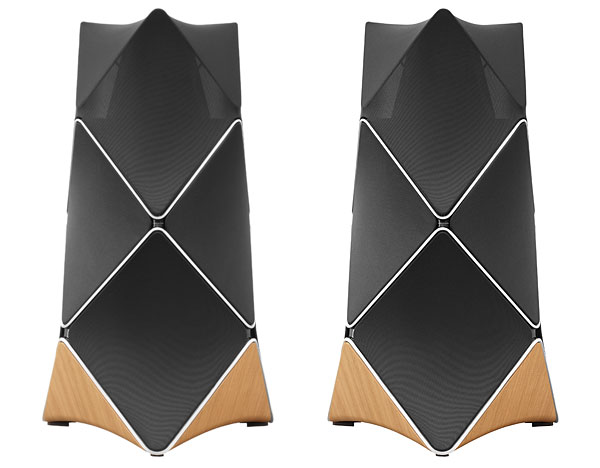
Bang & Olufsen's BeoLab 90 is not a loudspeaker to take on lightly. Though its size49.33" high by 28.9" wide by 29.4" deepand weight (302 lbs each) meant a major disruption of my listening room, which is also our living room, my wife assented. Its price of $84,990/pair puts it far beyond anything I might consider buyingand the complexity of the BeoLab 90, which has its own dedicated amplifiers and DACs, makes it impossible for a revieweror consumerto directly compare it with any other loudspeaker. So be it.
Bel Canto Design Black amplification system

Stereophile normally doesn't review audio systems. We review individual components. We've made an exception for the Bel Canto Black system because it deserves to be evaluated as such. It consists of three dense, almost identically sized cases of black-anodized aluminum. One, the ASC1 Asynchronous Stream Controller, is what in a conventional system would be called a "preamplifier." The other two, a pair of MPS1 Mono PowerStreams, would in a conventional system be called "monoblock power amplifiers."