

Wilson Audio Specialties X-1/Grand SLAMM loudspeaker system

How can a reviewer possibly put a value on a loudspeaker as costly as the Wilson Audio Specialties X-1/Grand SLAMM? When he reviewed Wilson's WATT 3/Puppy 2 system ($12,900-$16,000/pair, depending on finish) a few years back (footnote 1), John Atkinson said that it was "one of the more expensive loudspeakers around." The Grand SLAMM costs almost five times as much!
YBA CD 1 Blue Laser CD player
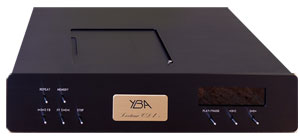 I'm about to out YYves-Bernard André as one of the great unknown tweakers of high-end audio. (My own predilection for stepping into uncharted tweakwaters is well known.) Yves-Bernard, his wife and partner Ariane Moran, and importer/distributor Daniel Jacques of Audio Plus Services seemed perfectly sanguine about letting the cat out of the bag. And why not? In a singular way, the YBA audio solution encompasses both the supertweak and the more-casual-about-equipment music lover.
The YBA CD 1 Blue Laser (or Lecteur CD 1, as it's known at home in France) breaks new ground. It is very French in that it's individualistic in the extreme, and perfectly embodies current thinking chez YBA regarding music playback in the home. Its design dates back to 1991, a point Yves-Bernard takes pains to point out in the manual.
I'm about to out YYves-Bernard André as one of the great unknown tweakers of high-end audio. (My own predilection for stepping into uncharted tweakwaters is well known.) Yves-Bernard, his wife and partner Ariane Moran, and importer/distributor Daniel Jacques of Audio Plus Services seemed perfectly sanguine about letting the cat out of the bag. And why not? In a singular way, the YBA audio solution encompasses both the supertweak and the more-casual-about-equipment music lover.
The YBA CD 1 Blue Laser (or Lecteur CD 1, as it's known at home in France) breaks new ground. It is very French in that it's individualistic in the extreme, and perfectly embodies current thinking chez YBA regarding music playback in the home. Its design dates back to 1991, a point Yves-Bernard takes pains to point out in the manual.
YG Acoustics Anat Reference II Professional loudspeaker

You've seen the ads from YG Acoustics: "The best loudspeaker on Earth. Period." It sounds arrogant. But come on—high-end audio has never been a field of shrinking violets. When Ivor">http://www.stereophile.com/interviews/1101ivor">Ivor Tiefenbrun of Linn announced that the turntable, not the cartridge or loudspeakers, dictated the sound quality of an audio system, that was a man convinced that he was right and taking on the world. And was Krell's Dan">http://www.stereophile.com/interviews/1203dagostino">Dan D'Agostino any less arrogant when, in 1980, he introduced the KSA-100 power amplifier? In a world where small size and high wattage were the norms, didn't it take a pair of big brass 'uns to bring out a honkin' huge slab of metal that put out only 100Wpc?
YG Acoustics Carmel 2 loudspeaker

For me, one of the highlights of 2013 was being able to live with the Sonja 1.3, the flagship loudspeaker model from Colorado-based YG Acoustics. I reviewed this tall, massive, three-enclosure tour de force of a design, which costs $106,800/pair, in July 2013, and was not surprised when, for the December 2013 issue, Stereophile's writers voted it one of the magazine's two Loudspeakers of the Year. So when I was asked last spring if I wanted to review the new version of the smallest and least-expensive model in YGA's lineup, the request fell on receptive ears.
YG Acoustics Sonja 1.3 loudspeaker

The advertisements run by Colorado manufacturer YG Acoustics in 2008, when it launched its flagship loudspeaker model, the Anat Reference II Professional, unequivocally claimed it to be "The best loudspeaker on Earth. Period." They caused a stir. The YGA speaker cost $107,000/pair at the time of Wes Phillips's review in the March 2009 issue. Wes didn't disagree with the claim, concluding that, "Like my pappy used to say, it ain't braggin' if you can actually do it."
Ypsilon Aelius monoblock power amplifier
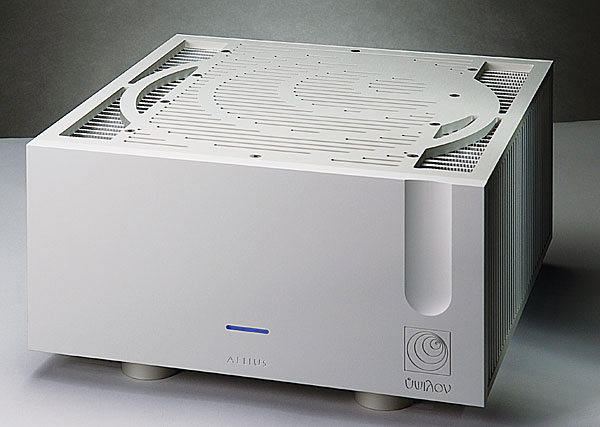
I knew nothing of Ypsilon when I first saw its products in a room at an overseas audio show. Even though the speakers in this system were complete unknowns, I was convinced that it was the electronics that were responsible for the magical balance of what I was hearing. That was confirmed when I reviewed the VPS-100 phono preamplifier in August 2009 and PST-100 Mk.II preamplifier in July 2011.
Ypsilon Electronics Hyperion monoblock power amplifier

Designers of hybrid amplifiers can use solid-state devices in an amp's input stage and tubes in its driver and output stages, as Music Reference's Roger Modjeski did in his RM-200 Mk.IIor they can use tubes in the input and transistors in the output, as Ypsilon Electronics' Demetris Baklavas prefers.
The advantage of solid-state at the input stage can be lower noise. In the RM-200 Mk.II's fully balanced design, carefully matched input devices result in high common-mode rejection and low-noise operation close to the levels achieved with the best input transformers. The RM-200 Mk.II's signal/noise ratio measured a healthy 95.4dB.
Ypsilon PST-100 Mk.II line preamplifier

Though essentially a two-man operation based in Athens, Greece, Ypsilon Electronics has been, since 1995, turning ears and eyes throughout the audiophile world with purist, hand-crafted electronics whose sound seems to defy characterization. Even under audio-show conditions in difficult hotel rooms, and often driving unfamiliar loudspeakers, the sound of Ypsilon electronics seems to evaporate in ways that few products manage, leaving behind less residue and more music.
Zanden 5000 Mk.IV/Signature D/A converter & 2000 Premium CD transport

We were driving to a friend's house to celebrate her dad's 92nd birthday. Halfway there, a bright yellow, ground-hugging insect pulled in front of my car from across street. "Wow, that's a Lamborghini Countach!" I exclaimed. You don't often see one of those in my neighborhood—or in any neighborhood.
Zesto Audio Andros Téssera phono preamplifier

Maybe you've seen the widely circulated New Yorker cartoon: Two guys stand in front of a nicely drawn, tubed audio system, under which are shelves full of LPs. One guy says, "The two things that really drew me to vinyl were the expense and the inconvenience."
If you can't laugh at that, you've lost your sense of humoreven acknowledging that, oddly, convenience is the raison d'etre of some recent phono preamplifiersincluding Dan D'Agostino Audio's Momentum and the CH Precision P1, both of which offer multiple, switchable, configurable inputs saved in memory. Today's well-heeled vinyl enthusiast might have two or more tonearms mounted on a single turntableor even two turntables, each with two arms. Zesto Audio's new Andros Téssera tubed phono preamplifier takes aim at that market segment.