

Voxativ Ampeggio loudspeaker

It wasn't so much a vow as a prediction: After selling my last pair of Ticonal-magnet drivers and the homemade horns I'd carted around to three different houses, I supposed I would never again have a Lowther loudspeaker in my humble house.
That remains literally true: The 7" full-range drivers to which I'm listening today are from a German company called Voxativ; the horn-loaded cabinets from which they play were also designed by Voxativ, and are made in Germany by the Wilhelm Schimmel piano company. And, with all due respect to Lowther, the 75-year-old English loudspeaker firm that launched a thousand DIY fantasiesnot to mention a thousand very lively wavefrontsthe Voxativ drivers and horns take the Lowther concept further than anyone else of whom I'm aware.
VTL MB-1250 Wotan monoblock amplifier
 Most reviewers look for a "hook" or angle of some kind when it comes time to write a review. After all, how many ways are there to get excited about audio equipment? Kathleen and I like to focus on the human side of the High End. So it was with some amusement that I watched the obstacles swirl around what I thought would be a fairly straightforward review of the Vacuum Tube Logic MB-1250 Wotan monoblock power amplifier. My thought was to return from single-ended to push-pull with a bang! I'll say...
It all began at the January 1996 WCES, where I found my shorts positively welded to the listening chair during a memorable musical blast at VTL. Luke Manley and his extreme audiophile wife Bea had a good thing going and they knew it. People were talking. "Did you hear those monster two-storey VTLs on the Alón Vs?"
VTL MB-450 Series III Signature monoblock power amplifier
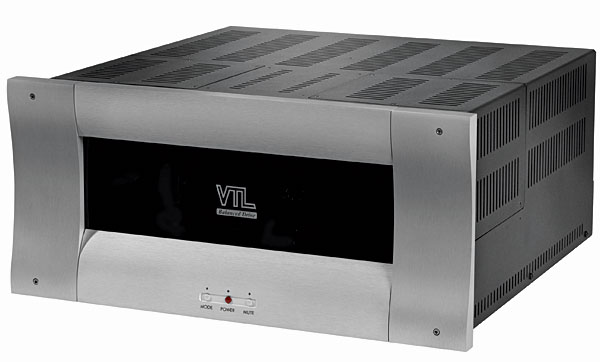
The VTL MB-450 series began life in the late 1980s as the Deluxe 300, a pair of which I once owned. Over the years the basic design has been improved and modified, in the forms of the MB-450 (1996) and the MB-450 Series II (which I reviewed in January 2008). The tube complement remains the same: eight 6550s in the push-pull output stage, a 12AT7 input tube, and a 12BH7 driver. Into a 5 ohm load, the MB-450 III is claimed to produce 425W in tetrode mode or 225W in triode, from 20Hz to 20kHz.
VTL Siegfried Series II Reference monoblock power amplifier

Big tube amplifiers were once scary monsters reserved for those who didn't mind heavy maintenance, careful tweaking, and the occasional explosion. Blown tubes required replacing, preferably with pricey matched pairs, then biasing with a voltmeter. Optimal sonic performance required regular bias monitoring and adjusting, and because of current surges on startup, you had to choose between leaving the heat-producing monoliths on, or turning them on and off for each listening session, thus shortening the life of the tubes.
Wadia 2000 Decoding Computer
Ain't technology grand! That's what I was thinking while driving to work this morning. Sure, the rain was coming down in buckets, but there I was sitting comfortably in a warm car, listening to music while making tracks at 50mph. A long way from horse-and-buggy days.
Wadia Digimaster 2000 Mk.2 digital processors
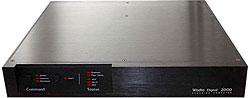 During my reviews of digital processors in the past year or so, I've made comparisons with the Wadia 2000 Digital Decoding Computer first reviewed by Arnis Balgalvis in Vol.13 No.1. I've felt that, as good as the 2000 is, other processorsmany costing less than the 2000's $8500 price tagare now superior.
However, a visiting Wadia representative looked inside our sample and used the word "ancient" to describe its circuitry in relation to current production. In addition, I was never able to audition the 2000 with a glass fiber-optical interface, standard equipment on Wadia's transports. Similarly, the $2000 Wadia X-32 had undergone a minor circuit revision, including the inclusion of the glass optical input. Consequently, a follow-up of these two excellent processors seemed in order.
Wavac SH-833 monoblock power amplifier

Leaving aside for a moment the fact that the Wavac SH-833 costs $350,000/pair—
Weiss Engineering Helios D/A processor

When standalone digital/analog processors made an appearance a quarter-century ago, they were limited to the CD medium's 16 bits of resolutionat best. These days, almost every DAC can process at least 24 bits, and many models offer between 20 and 21 bits of real-world resolution. Modern models from Benchmark, dCS, , Merging, Mola Mola, Okto, and Weiss illustrate not just the skill of the circuit designer but also that of the engineer who laid out the printed circuit board.
One of the first digital processors I encountered that offered 21 bits of resolution was the Weiss DAC202, which Erick Lichte reviewed in January 2012. Subsequent processors from this Swiss company have consistently performed well, not just on the test bench but also in the listening room.
Wilson Audio Modular Monitor (WAMM) loudpeaker system

No, we made no typos in the specifications sidebar. The weight of the Wilson Audio Modular Monitor (WAMM) speaker system is enough to make you consult a structural engineer before dropping it on your living room floorfragile, 300-year old New England frame houses are probably out. And the recent price increase from $32,000 to $35,000 is enough by itself to buy a pair of Quad ESL-63swhich is not a bad speaker system. The WAMM represents an all-out assault on both the state of the art in speaker systems and on the limits to which wealthy audiophiles will go in order to have the best.
Wilson Audio Sasha W/P loudspeaker

Before last year, I had no more than a professional interest in the products of Wilson Audio Specialties. But before last year I hadn't experienced Wilson's">http://www.stereophile.com/artdudleylistening/listening_86">Wilson's Sophia Series 2 loudspeaker ($16,700/pair)—which, like the wines I tend to order when my wife and I go out to dinner, is the second-cheapest item on their menu. Within weeks of the Sophias' arrival, respect had turned to rapture, like to love, and an entirely new appreciation for Wilson Audio was mine (footnote 1).