

Bowers & Wilkins 805 D4 Signature loudspeaker
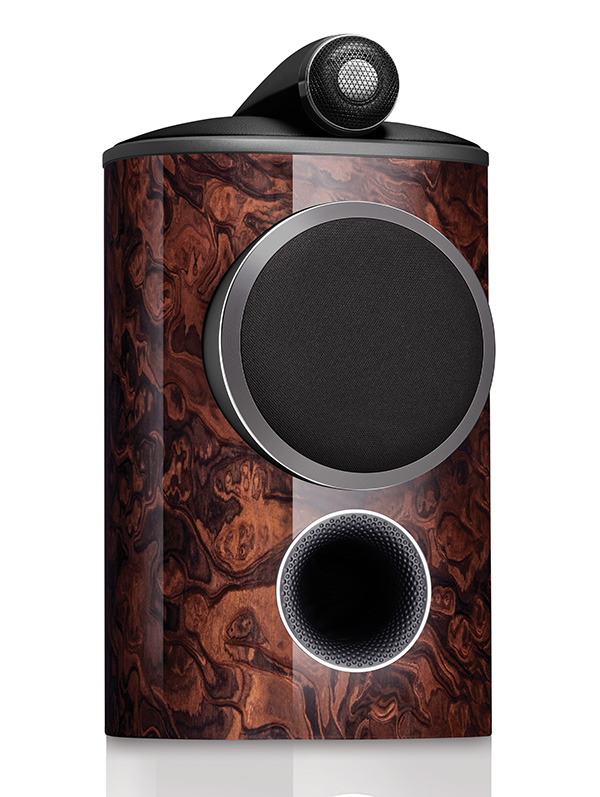
The "Bowers" in the name of British manufacturer Bowers & Wilkins (B&W) refers to founder John Bowers, whom I got to know fairly well before he passed in 1987. In recent years, I've reviewed two Bowers & Wilkins loudspeakers: the 705 Signature two-way standmount in the December 2020 issue and the Diamond Series 804 D4 three-way floorstander in the January 2022 issue. More recently, Tom Fine reviewed the three-way, floor-standing Signature Series 801 D4 in March 2024.
Currently there are two models in the Signature Series, which was launched in 2023 to pay tribute to the company's groundbreaking John Bowers Silver Signature from the early 1990s: the 801 D4 and the subject of this review, the two-way 805 D4 standmount, which B&W describes as its "highest performance standmount ever."
Bowers & Wilkins 802 D3 Diamond loudspeaker

"This is getting to be a habit."
That's how I ended the first paragraph of my review of Bowers & Wilkins' 800 Diamond speaker, in the May 2011 issue; apparently, Stereophile's habit of reviewing models from B&W's 800 series remains unbroken.
Later in that review, I said that "The 800 Diamond doesn't look radically different from its predecessors." That doesn't apply to the 802 D3 Diamond ($22,000/pair). It's still a three-way system with tapered-tube high-frequency and midrange enclosures, stacked and nestled into a generous bass enclosure that's vented on the bottom into the space between it and its plinth.
Bricasti Design M28 monoblock power amplifier

Google Bricasti and all that comes up are sites relating to Bricasti Design products. The name must be fancifulit sounds Italian, but cofounders Brian Zolner and Casey Dowdell most likely are not, and the company's headquarters are not in Milan or Turin but in Massachusetts.
While its name might be whimsical, nothing else about Bricasti is. As John Marks reported in his review of Bricasti's M1 DAC in the August 2011 issue, both founders previously worked at Lexicon: Dowdell as a DSP-software engineer, Zolner as international sales manager. Bricasti develops its products in conjunction with Aeyee Labs, formed by a group of ex-employees of Madrigal Audio Laboratories and based in New Haven, Connecticut.
Brinkmann Audio Nyquist D/A processor

What? Johnny-come-lately turntable manufacturer Brinkmann Audio now makes a DAC? Are they desperate? What sampling rates does it support162/3, 331/3, 45, and 78? I guess the vinyl resurgence is over! Why else would Brinkmann make a DAC?
If that's what you're thinking, consider that Helmut Brinkmann began designing, manufacturing, and marketing electronics well before he made the first of the turntables for which his company is best known in the US.
Brinkmann Balance turntable

Everyone's got their prejudices, and mine are against turntables with box-like plinths and big slabs of undamped acrylic. I have no problem with either in models that cost a few grand or less, but once you get into high-priced terrain, less plinth and less acrylic usually yields better performance. Generally, though, all a plinth gets you is a vibrating surface to transmit or store and release energy. Who needs that? If your high-performance 'table has a plinth, you need to heroically damp it the way SME does in its Model 30, and the way Rockport did in its System III Sirius.
Burmester 216 power amplifier
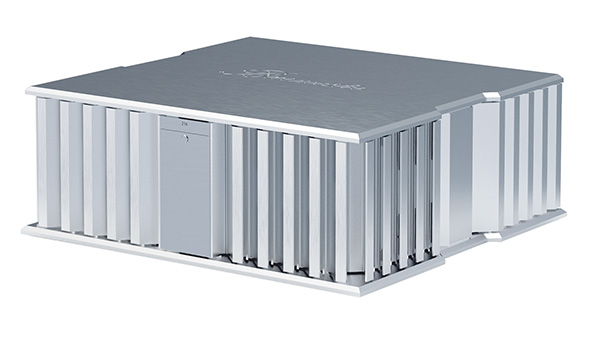
When I was offered the opportunity to review a Burmester productthe 216 stereo power amplifierI accepted immediately, mainly out of curiosity. Berlin-based Burmester is an important hi-fi brand, but I knew very little about the company and their products. What better way to learn more than to review one of their products?
Burmester 218 power amplifier

As much as I tinkered with a little crystal radio as a child and started reading stereo magazines in high school, it wasn't until my early 30s that I half-stumbled into the higher end of the hi-fi sphere. As I progressed from used Advents to used Spicas and began to experiment with speaker cables, more and more names of high-end brands entered my consciousness. Burmester (founded in 1977), and some of the other higher-priced components from overseas whose looks seemed commensurate with their prices, held an outsized fascination for me. What about them, other than their visual appearance, accounted for their vaunted reputations and cost?
Burmester 232 Classic Line integrated amplifier

My first response, upon being offered for review the new Burmester 232 Classic Line modular class-AB dual-mono integrated amplifier ($25,000), was apprehension—but not because of the product itself, and certainly not because of the Burmester brand. I had already been won over by the pair of Burmester 218 Top Line stereo power amplifiers ($50,000/each) I reviewed in the October 2024 issue.
Cabasse La Sphère powered loudspeaker

In an unfortunate coincidence, a few nights before the Cabasse team arrived to install the company's unusual-looking La Sphère powered speaker system, VOOM HD Networks, Monster HD channel, which is exclusively devoted to B horror movies, broadcast The Crawling Eye (aka The Trollenberg Terror), a 1958 black-and-white howler starring Forrest Tucker. I watched.
California Audio Labs Tempest II CD player

Snickering was heard from the major consumer electronics purveyors when California Audio Labs came out with the original">http://www.stereophile.com/cdplayers/654">original Tempest, their first CD player using tube output stages. But not from the audiophile community. It was, all things considered, an inevitable product; I'm certainly not the only one who wondered—before the emergence of California Audio Labs—who would be the first to build such a unit. The obvious candidates were Audio Research or Conrad-Johnson. But those companies apparently read the audio tea-leaves and, perhaps perceiving the early high-end hostility toward the new format, apparently decided to bide their time. (With regards to tube players, they're still biding it, though C-J has had a prototype player up and running for some time.)