

Mark Levinson No.53 Reference monoblock power amplifier

Mark Levinson founded Mark Levinson Audio Systems in 1972, but sold it, and the right to market audio gear under his own name, to Madrigal Audio Laboratories, then owned by the late Sandy Berlin, in 1984. Harman International bought Madrigal in 1995. As well as Mark Levinson, Harman's Luxury Audio Group now also includes digital processing pioneer Lexicon, speaker manufacturer Revel, and JBL Synthesis. The Mark Levinson brand is now headquartered in Elkhart, Indiana, at the Crown Audio facility, another Harman-owned brand. The No.53 ($25,000 each; $50,000/pair) is Mark Levinson's first new Reference series monoblock since the No.33, way back in 1993, when Madrigal owned the company. Like other Mark Levinson products, it is manufactured at an independent facility in Massachusetts.
Mark Levinson No.585 integrated amplifier
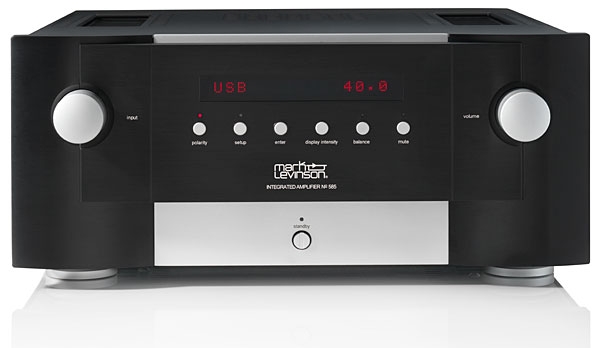
In July 2000, I reviewed the Mark Levinson company's first integrated amplifier, the No.383, and found that its sound had "clarity, transparency, liquid mids and highs, with dynamic contrasts." Also evident were the No.383's power-output limitations, the result of building large power supplies and heatsinks into a single case that had to fulfill multiple functions. Still, the No.383's price of $5900 was much less than the total cost of the equivalent in Mark Levinson separates. Later, in April 2007, I reviewed a similarly powered integrated amplifier, Bryston's B100-DA ($3195), which included a built-in DAC.
Marten Coltrane 3 loudspeaker

Marten is a small Swedish loudspeaker manufacturer with great aspirations, some of which the company has largely met. Leif Mårten Olofsson founded Marten and designs the speakers, while brother Jörgen Olofsson runs the business as CEOa division of creative and administrative labors similar to the working relationship between David and Norman Chesky, the founders of Chesky Records and HDtracks.
Marten Mingus Septet Statement Edition loudspeaker

As I prepared this review of the Marten Mingus Septet Statement Edition loudspeaker ($199,000/pair), I asked the Marten people to tell me something about the company and its values.
mbl 101E Radialstrahler loudspeaker

Back in the late 1980s, when I was writing for The Abso!ute Sound and couldn't afford any of the audio gear I was reviewing, my system consisted of an Oracle turntable with Magnepan unipivot arm, a pair of Spica TC-50 loudspeakers, and a heavily modified Hafler DH-200 power amp and DH-101 preamp. It was a fun system that imaged like hell, but my fondest audio memories of that time were of visiting fellow TAS reviewer Dr. Michael Gindi, who lived on Manhattan's West End Avenue, and listening to his mbl speakers. (With his shrink's paycheck, he could afford them.)
MBL 6010 D preamplifier

Don't be confused by the MBL 6010 D's oddly baroque, even retro looks. Behind all the glitzthe oversize, perfectly finished, black-lacquered faáade; the two big, solid brass knobs plated with 24-karat gold; the ornate lettering; and the incongruous digital volume displayresides a thoroughly modern, remote-controlled, unusually versatile, and well-thought-out solid-state preamplifier. Not that the 6010 is a new design. It's been around for a long time, and the current "D" iteration is at least five years old.
MBL Corona C15 monoblock power amplifier
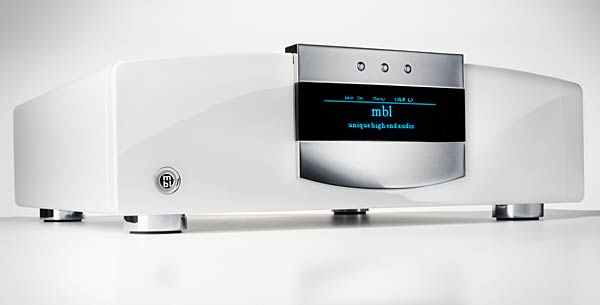
A year or so ago, in my review of the Pass Labs XP-30 preamplifier, I wrote that the heart of an audio system is the preamplifier, in that it sets the overall quality of the system's sound. But it is the power amplifier that is responsible for determining the character of the system's sound, because it is the amplifier that must directly interface with the loudspeakers. The relationship between amplifier and loudspeaker is complex, and the nature of that relationship literally sets the tone of the sound quality.
MBL Radialstrahler 101E Mk.II loudspeaker

Take a casual look at the Mk.II edition of MBL's Reference 101E Radialstrahler loudspeaker, and you won't immediately see what's new compared with the original version, which I reviewed in October 2004. But the Mk.II has a shorter, sleeker bass cabinet, designed to, among other things, slightly lower the stack of omnidirectional drivers it supports. While the many other major revisions to this familiar and fascinating loudspeaker can't be seen, it's fair to say that, from the ground up, the Reference 101E Mk.II is a new loudspeaker in design, if not in concept.
MBL Reference 9011 monoblock amplifier
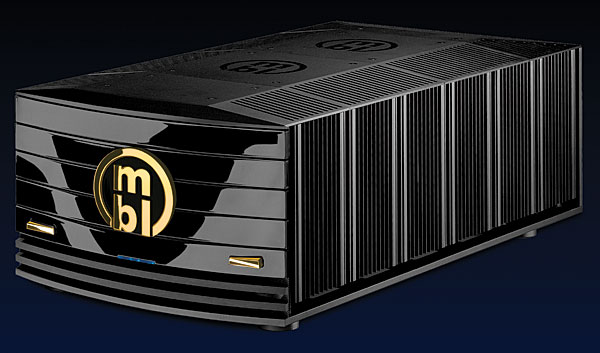
As large as a small file cabinet and weighing 223 lbs, MBL's most powerful amplifier, the Reference 9011, is a tour de force of electronics design and implementation that will set you back $53,000 if you're a single-ended stereo enthusiast, or $120,000 if you like pure balanced mono.
Meitner IDAT D/A processor
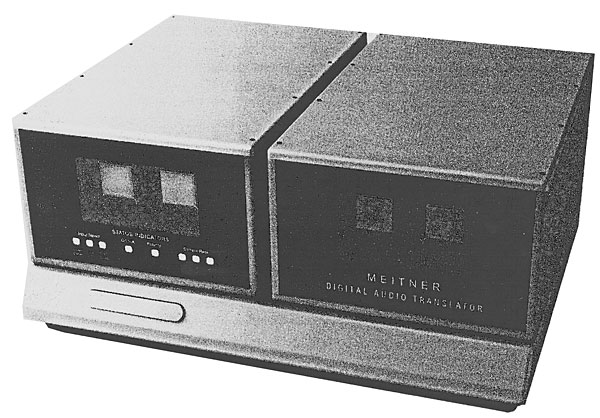
There are as many ways of designing a digital-to-analog converter as there are engineers. One approach is to select parts from manufacturers' data books and build the product according to the "application notes" provided by the parts manufacturers. This is the electronic equivalent of a paint-by-numbers kit.
A more creative engineer may add a few tricks of his own to the standard brew. Bigger and better regulated power supplies, careful circuit-board layout, tweaky passive components, and attention to detail will likely make this designer's product sound better than the same basic building blocks implemented without this care. Indeed, the vast range of sonic flavors from digital processors containing very nearly the same parts attests to the designer's influence over a digital processor's sound.