

Listening #195: Ortofon SPU Century & Grandinote Celio
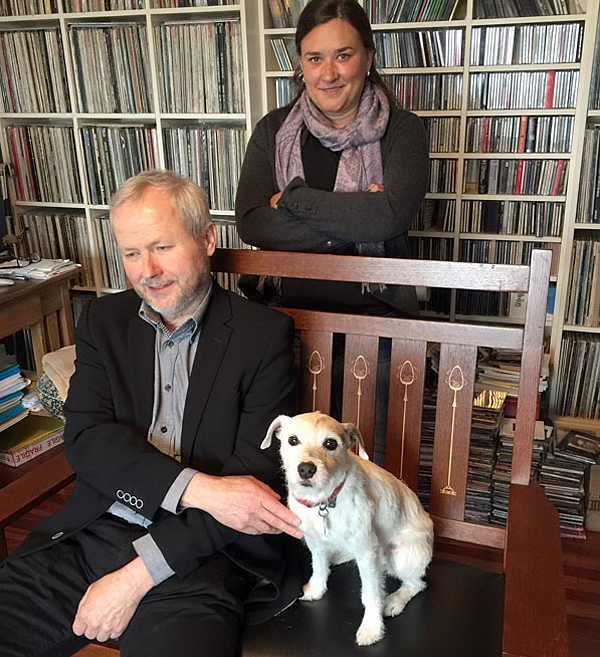
Easy pickup: Art’s Dog, Chatter, cozies up to Leif Johannsen of Ortofon A/S and Dee Hustinova of Ortofon USA. (Photo: Art Dudley)
According to the 2018 edition of the UN's World Happiness Report, Denmark is the third-happiest nation on Earth, trailing only its neighbors Finland and Norway.
I heard that yesterday afternoon, on NPR. The reporter even spelled out the word used by Danes to describe their feelings of happiness: hygge. Apparently, at present, Denmark is positively rotten with hygge.Listening #58
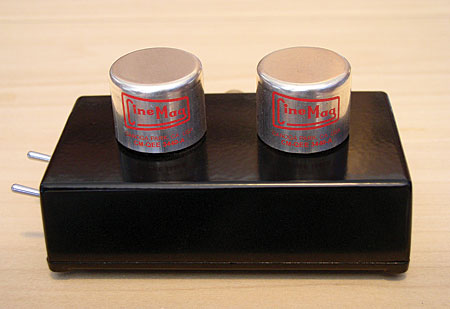
Is it my imagination, or has the low-power tube movement of the last 15 years gone hand in hand with a renewed interest in moving-coil step-up transformers? Trannies remain misunderstood or ignored by most of the audio press—requests for review samples continue to be met with genial shock, rather like tourism in the Budapest of the 1990s—but enthusiasm for the practice seems only to grow. That leaves me to wonder: Did the unquestioning use of active pre-preamps for so many years grow out of the same bad attitude that gave us all those awful-sounding high-power amps and low-sensitivity loudspeakers? You know the mindset: Parts are cheap. Gain is free. Do it because you can...
Listening #73
I was walking through the woods one day when I happened on a large, flat rock near the base of an old ash tree. Conditioned as I am from such rambles with my daughter, whose interest in wildlife echoes that of my own childhood, I bent down and lifted one end of the rock, hoping to catch a glimpse of some exotic creature or another: perhaps a delicate ring-necked snake, or a plasticky-looking red eft. The rock came loose without too much effort and teetered on its broadest edge, but before I could let it flip to one side, I recoiled in horror: There, amid the millipedes and ant larvae, was a cluster of teeny-tiny, nasty-looking old men, writhing in such a tangle that I couldn't even count them. They were bespectacled, to a one, and mostly bald—I could tell quite easily, despite the berets worn by some of them—and each pair of feet was shod in a teeny-tiny pair of off-brand Birkenstock copies, with thin, shiny black socks underneath.
Listening #90
The best result of mathematics is to not need it.—Oliver Heaviside, 1850–1925
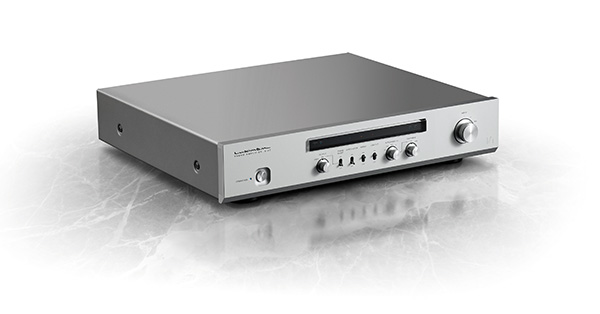
Luxman E-07 phono preamplifier
My DACs are taking naps. I have not played music from a digital source in at least 12 weeks. I'm having too much fun playing records from the '50s and '60s with period-correct phono cartridges and listening to 100-year-old 78s at the Hot Club of New York.
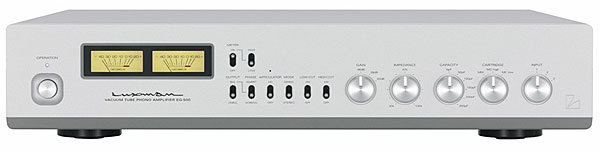
Luxman EQ-500 phono preamplifier
I still remember how difficult it was for me to transition from mass-market to high-end audio. The former, for all its flaws, gave me things to do: switches to flip, buttons to push, knobs to turn, meters to watch. I was in controland if my attention happened to stray from the music or the liner notes, I still had something to keep me busy. By contrast, the first perfectionist-quality amplifier I boughtan Amber Series 70was an oblong box with an on/off switch. Where's the fun in that?
Manley Labs Steelhead phono preamplifier

The Manley Steelhead tube MM/MC phono preamplifier was first demonstrated at the 2001 Consumer Electronics Show. Nine months later, my long-promised review sample of Eveanna Manley's new baby was delivered. While Ms. Manley may have given birth to the audacious product, it was conceived by the company's chief hi-fi designer, Mitch Margolis.
Moon 891 streaming preamplifier

No fewer than eight boxes, powered by six after-market power cables, comprise my current reference front-end. As much as separate boxes can afford superior isolation and provide far more room for visionary engineers to work their magic, the advantages of a single box, which requires a single power cable and far fewer after-market interconnects, are obvious.
Enter Simaudio's Moon 891 network player/preamplifier ($25,000; footnote 2). Also called a "streaming preamplifier,"it includes a DAC that converts PCM and MQA files up to 32/384 (with 24-bit files upconverted to 32-bit) and DSD files up to 256. It also includes what Simaudio company co-owner Costa Koulisakis describes as "a fully configurable" MC/MM phono stage. Both theoretically and practically, it's an ideal solution for someone with space and/or budget constraints.
Musical Fidelity V-LPS Phono Stage

Not being fond of self-flagellation, I don't usually do analog. I am not a fuddy-dudley, nor am I especially fremerous.
Mytek Digital Brooklyn Bridge II Roon Core preamplifier
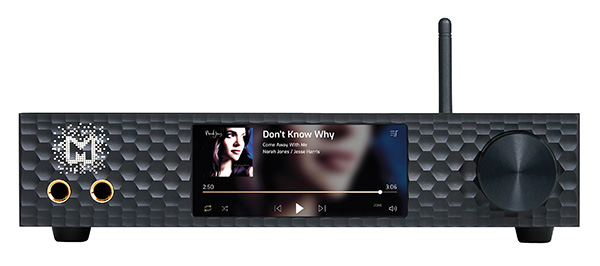
The concept of streaming digital music files over distances great (as with internet-streaming services like Spotify, Qobuz, Tidal, etc.) and small (from a home-PC hard drive, NAS, or networked music server) became mainstream only recently. But it was already brewing during the late 20th century, with people illegally downloading low-bitrate MP3 files made from CD rips and coming close to killing the recorded-music industry.
That wasn't streaming exactly, or not in the current sense, because the files needed to be downloaded, stored locally, then either played out of a computer or loaded onto a portable player, but from that point forward it was a steady march to the streaming-dominated present.
Never mind Napsterthe first subscription audio "streaming" service was one you probably wouldn't think of: Audible, the audio book service now owned by Amazon, which started up in 1995. I did beta testing and editing work for early-days Audible, and around that time, I started loading up home-ripped MP3 files on a pocket-sized Rio MP3 player (which by then had replaced Audible's proprietary player), using it in place of a portable CD player. This led to experiments with a PC music library/player running Linux, controlled by a Handspring PalmOS device connected to the stereo system via a Sound Blaster 16 card.