

Sonnet Morpheus D/A processor

Playlists embody who we are. We use musical affinities to understand (or at least categorize) others, not only as evidence of their aesthetic discernment but also of their emotional and political affiliations, which amount to an entire worldview. In other words, the database of favorite music that we carry around in our brains is no laughing matter. So, one of the most unexpectedand rewardingthings that can happen in music fandom is a complete and sudden inversion of one's beliefs. Which brings me to the perennially touchy subject of Steely Dan, a band that cleaves the ranks of listeners like a gold-plated katana.
Sonos ZP80 & ZP100 WiFi Music System

Don't get the wrong idea. I don't watch trash TV. I am not interested in the doings of people who are famous merely for being famous. I was probably the last to realize that Paris Hilton was not the name of a French hotel. But the kitchen TV just happened be tuned to Channel 4 when I switched it on while I was preparing dinner. No, I do not watch NBC's Extra, but as I was reaching for the remote I was stopped in my tracks by what I saw. The show was doing a segment on the new L.A. home of Jessica Aguilera, or Christina Simpson, or . . . well, it doesn't matter. What does matter was the host's mention of all the cool stuff the bimbette had had installed in her new pied-à-terre: "...and a Sonos audio system, of course."
Sony DTC-1000ES R-DAT recorder & Sony PCM-1630 A/D converter

With the furor over the launch of DAT (digital audio tape), it is worth remembering that commercial digital recorders have been with us for some time now: it is now nearly a decade since studio PCM converters were first successfully used for audio recording in conjunction with a VCR (which uses a helical spiral recording via a spinning drum to achieve the high writing speed).
Sony PCM F1 Digital Audio Converter

In 1978, when I reviewed Sony's first audiophile-type PCM-1 converter, I earned the undying scorn of a large segment of audiophilia by reporting that, on the basis of a rather short testing period (which did however include some live recording), I was unable to hear anything the matter with its sound. Four years later, but after substantially more testing, I am obliged to report the same thing about the PCM-l's son, the PCM-Fl.
Spectral SDR-2000 Professional D/A processor

Spectral is a bit of an enigma in the high-end audio world. Although nearly 20 years old and one of the founders of the American high-end audio industry, Spectral isn't a name that comes quickly to mind when considering the best of the best in high-end.
Spectral's low profile is of their own choosing. They advertise very little, their products are demonstrated in a small number of stores, they almost never send products to magazines for review, and they are very quiet about their accomplishments.
StormAudio ISP Evo immersive sound preamp/processor

One thing that interested me about the StormAudio ISP Evo is that, despite its obvious hi-fi function, it's more like a computer than a typical "prepro." While it does offer a few "legacy" analog inputs, it is for the most part all-digital, input to output, including network connections on both ends. Consequently, it is less likely to leave sonic fingerprints on the music than devices that convert digital to/from analog or modulate their signals with active amplification or attenuation. It is notable that, despite its audio function, the Storm completely lacks traditional audio specificationsdistortion, dynamic range, and so on.
Yes, that aspect of the product was appealing, but the real trigger for me was that when I began this review, the StormAudio ISP Evo was the only consumer device to fully incorporate the latest version of Dirac Live Active Room Treatment (ART).
Sumo Axiom CD transport & Theorem II D/A processor
Making digital audio sound good appears to be a much more difficult job than its developers first realized. When digital audio was in its infancy, there was a tendency to think that digital either worked perfectly, or didn't work at all. This belief led the engineering community to devise ill-considered and flawed standards that affect the musical quality of digitally reproduced music today.
Sumo Theorem D/A processor
The $799 Theorem was originally shown at the 1992 WCES in a very small chassis that prohibited adding features or upgrades. Sumo has since become more ambitious, putting the Theorem in a full-sized chassis and offering several upgrade options that would have been impossible in the truncated version.
Sutherland Engineering 12dAX7 USB DAC/preamplifier
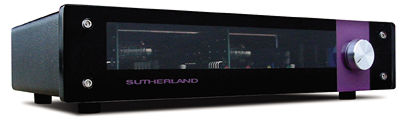
Computers and vacuum tubes go together like Trent Lott and flyaway hair, right? The last time filaments glowed in computers was during the 1960s, when a computer was a building. I remember laughing at the ponytailed computer-science dweebs back then, who spent their college days playing nursemaid to a football field's worth of electronics capable of little more than adding two plus two. Chained to a computer half the day, as most of us now are, guess who had the last laugh?
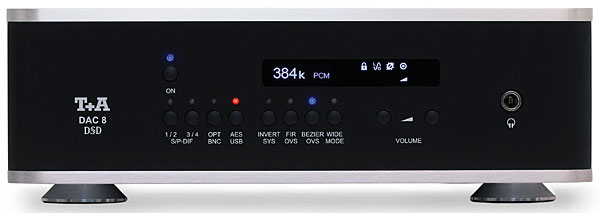
T+A Elektroakustik DAC 8 DSD D/A processor
"They're so damn hard to tell apart!"
So exclaimed my longtime pal and fellow audiophile Bruce Rowley when I revealed to him that T+A Elektroakustik's new DAC 8 DSD digital-to-analog converter ($3995) had arrived for review, just after I'd finished writing up the Ayre Acoustics Codex DACheadphone amp ($1795). Bruce had recently compared his own brand-new Codex with a DAC he'd owned for a couple years, both costing about the same but built to very different designs. He was surprised that, after carefully matching levels and working to eliminate any other variables, they sounded more alike than not, and only slightly different even after hours of listening. Technically, these were two very different animals.