

Expensive Electronics/Inexpensive Speakers?
I'd like to expand on the "expensive electronics/inexpensive speakers" discussion begun by John Atkinson in his Levinson">http://www.stereophile.com//amplificationreviews/606/">Levinson No.26 & No.20 reviews. "Perhaps because it acts as a bottleneck on the signal," he wrote, "the quality of an amplifier or preamplifier is far more important than that of a loudspeaker when it comes to preserving or destroying the musical values of the signal. This would appear to be heresy in the US where, to judge by the letters I receive, large, complicated, expensive loudspeaker systems are often driven by relatively inexpensive, modestly performing electronics, the rationale behind this being that, to quote one correspondent, 'It is the loudspeakers that produce the sound, therefore they are where the majority of the budget should be allocated.'"
God is in the Nuances
This journal has seen a number of thoughtful ruminations on what it is that attracts us to music or to a given audio component, and how we should describe that attraction. The "Letters" pages have been filled by readers who have taken us to task for not adhering to rigorous scientific methods in the evaluation of components, those rigorous scientific methods usually being equated with double-blind listening. Other readers have praised the magazine for its stance that an educated listener in a familiar, relaxed environment will be more accurate in his or her assessment than an average of trained and untrained listeners in unfamiliar, stressful circumstances. Overall, sonic descriptions from diverse reviewers in different publications show a remarkable consensus of observation (not opinion).
High-End Audio is Here to Stay!
It was 2am on January 8, 2000, and I was sitting at the bar of the Paris Hotel in Las Vegas. I'd just arrived for the Consumer Electronics Show and was recovering from a stressful day of travel. The airlines have a new computerized ticketing technology called the "electronic ticket": you get a reservation and a confirmation number, but no physical plane ticket, itinerary, or the feelings of security that accompany those pieces of paper.
High-End Co-Dependency
"I never touch the stuff," I say, totally disassociating myself from my husband's addiction. "Well," I admit, when pushed, "I do use it sometimes---but I never do the hard stuff."
High-End Democracy
It's useful to ponder the wonders of democracy in this election year—not because of elections, but despite them. Were you to judge democracy by this election year, you might conclude that it consists of judging who has the best PR people, who the best pollsters, and who can muster the nastiest, most effective "negatives" about the other guy.
Home Theater vs Two-Channel Purism
For all its excesses, high-quality audio is filled with purists. Some are committed to single-ended amplifiers, some to all-analog circuitry, to crossoverless speakers, or to recordings made with only two microphones. Purists seek simplicity in their quest for good sound. But how simple is it to scrub contacts, adjust tonearms, or meticulously clean discs before nearly every listening session? Maybe committed purists should just be committed.
How Hi-Fi are Stereo Discs?
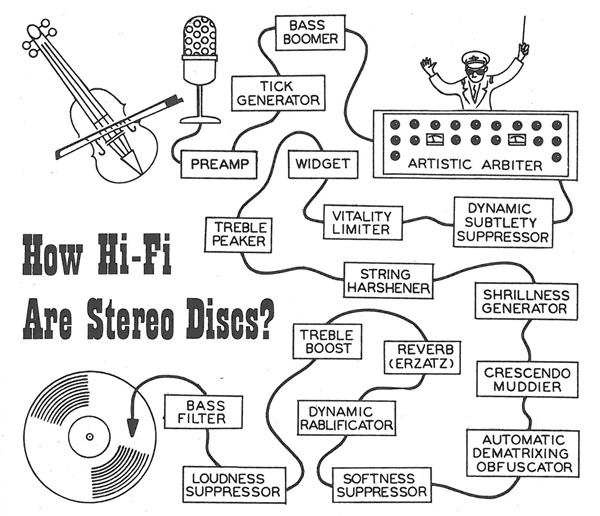
Editor's Note from 1992: This seminal J. Gordon Holt essay on how the art of recording natural sound became compromised in favor of unmusical artificiality for good commercial reasons was originally published in August 1964, in Vol.1 No.8. Though most people these days listen to classical music from CDs, not LPs, in the intervening decades, recording technology has not changed for the better as much as one might have hoped. Nevertheless, the days of wretched multimiking excess described by Gordon are past, and it's rare to find the music treated with the lack of respect typical of a mid-'60s Columbia session. Although some of the smaller companiesReference Recordings, Delos, Chesky, Mapleshade, Dorian, and Sheffield Lab in the US; Meridian, Nimbus, and Hyperion in the UKconsistently use honest, minimal miking, it is not unknown for the majors in the '90s to do likewise. And the use of time delay for spot microphones, pioneered by Denon in the mid-'80s, means that instruments that might tend to become obscured at orchestral climaxes can now be brought up in level without unnaturally time-smearing the sound. I still find it sad, however, that it is rare to hear the sheer dynamic range of a live ensemble successfully captured on a commercial recording.John Atkinson
How to Revive High-End Audio

When I became Stereophile's editor in 1986, the median age of the magazine's readership was the same age as I was then, 38; ie, half the readers were younger than 38, half older. According to our most recent reader survey, the median reader age is now 48, meaning that in the intervening 19 years, that median reader has aged at half the rate of the rest of us. A nice trick. But older that reader certainly has become, which has led to cries of doom from some quarters of the audio industry.
How To Write Manufacturers' Comments
"Equipment Reports," "Record Reviews," "Letters," "Industry Update," "Sam's Space," "As We See It," "The Final Word"---I read and enjoy them all. But the section of Stereophile I especially look forward to reading is "Manufacturers' Comments." How is the manufacturer going to respond to a review that's considerably less than 100% positive? Can they take criticism gracefully, or do they have an attitude? If I were a consumer considering purchase of one of their products, would their comments convince me that they'd be a good company to deal with? Are they uptight beyond reason, or do they have a sense of humor? Can they respond to a positive review without gloating?
Humidity, Concert Hall Sound & Spectral Tilt

I want to talk about the acoustics of live music and recordings. As I write this I'm back in Boston for a week, re-calibrating my ears with (excuse the expression) the "absolute sound" of live music in various concert halls. On Friday the Boston Symphony played symphonies by Mozart and Shostakovich, producing (as always) magnificent sound with the aid of Symphony Hall's near-legendary acoustics.