

High Fidelity at the Crossroads
101 years ago, the tinfoil cylinder started it all. Within 22 years, its heyday was done, and public support swung to favor the then-new wax-mastered disc. 1948 saw the switch to a slower speed and a finer groove, but the flat disc, traced by a stylus, has held sway for almost 80 years now. Even today, people with multi-speed turntables and a couple of arms (or plug-in cartridges) can reproduce from a single phono unit the earliest or the latest discs merely by the flip of two switches (for speed change and cartridge change). All that is about to come to an end.
How Hi-Fi are Stereo Discs?
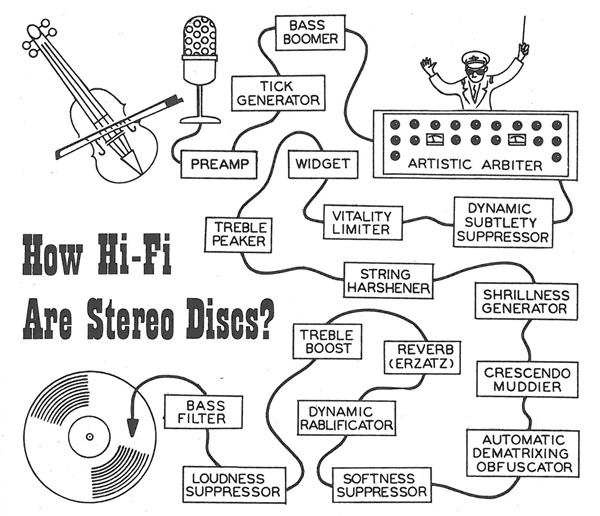
Editor's Note from 1992: This seminal J. Gordon Holt essay on how the art of recording natural sound became compromised in favor of unmusical artificiality for good commercial reasons was originally published in August 1964, in Vol.1 No.8. Though most people these days listen to classical music from CDs, not LPs, in the intervening decades, recording technology has not changed for the better as much as one might have hoped. Nevertheless, the days of wretched multimiking excess described by Gordon are past, and it's rare to find the music treated with the lack of respect typical of a mid-'60s Columbia session. Although some of the smaller companiesReference Recordings, Delos, Chesky, Mapleshade, Dorian, and Sheffield Lab in the US; Meridian, Nimbus, and Hyperion in the UKconsistently use honest, minimal miking, it is not unknown for the majors in the '90s to do likewise. And the use of time delay for spot microphones, pioneered by Denon in the mid-'80s, means that instruments that might tend to become obscured at orchestral climaxes can now be brought up in level without unnaturally time-smearing the sound. I still find it sad, however, that it is rare to hear the sheer dynamic range of a live ensemble successfully captured on a commercial recording.John Atkinson
How to Write an Ad
Everyone knows that advertising people make more money than ordinary people, but many assume that the high pay is because ad writing is so difficult. This is not true. Low-income people can write advertisements, too, so just in case somebody should accost you on the street and ask you to write an advertisement, here is how you may go about it.
I Have Heard the Future...(DSP Room Acoustics Correction)
Dateline—Chicago, May 30, 9:00pm. Exploding fireworks lit up the sky above the Chicago river as 200 leading high-end designers gathered in the Hotel Intercontinental for Stereophile's 30th Anniversary banquet. After a repast of four gourmet courses and five wines, the time came for after-dinner speeches to celebrate Stereophile's past and high-end audio's future. Publisher">http://www.stereophile.com/asweseeit/593">Publisher Larry Archibald described his adventurous transition from the high-end car business to risky publishing. Introducing J">http://www.stereophile.com/historical/712">J. Gordon Holt, he praised JGH's uniquely lucid writing and his unflinching insistence that equipment designed to reproduce music should be judged on its ability to do just that—the unconventional view that launched high-end audio.
Infinity HCA power amplifier
 Imagine if you can a power amplifier with the bass richness, midrange liquidity, and high-end accuracy of the best tube amplifiers, and the inner detail, transient attack, and bass solidity and range of the best solid-state amplifiers. If you can imagine that, you can visualize what this amplifier sounds like.
Infinity Reference Standard 1B loudspeaker
I'll say one thing right off about the Infinity RS-1B: It sure looks as if you're getting your money's worth.
Infinity RS-4.5 loudspeaker system

There are certain manufacturers for whom every new product implies the promise of countless modifications, Usually a month or so apart, culminating inevitably in a version so far removed from the original that it must be assigned a new model designation—usually a letter suffix ranging from A, to D. By the time E is envisioned, another CE Show is approaching, so the decision is made to give the unit an exterior facelift and a brand-new model number. Presto! A new product for CES.
Infinity Servo-Statik 1 loudspeaker

An equipment reviewer for one of the consumer hi-fi magazines once confided to a manufacturer that he found it hard to like electrostatics because of the kind of people who usually like electrostatics. His implication—that certain kinds of people gravitate towards certain kinds of sound—is an interesting thought, and one that might bear some further investigation. But there is no questioning the fact that electrostatic speakers in general do have a particular kind of sound, that might be characterized as "polite."
Is Analog Dead?
1950: "The ultimate in disc recording is to make the reproduced sound as near as possible to the original..." (The founder of Audio magazine, C.G. McProud, in "Recording Characteristics," Audio Engineering, January 1950, reprinted in The 2nd Audio Anthology, p.67, Radio Magazines, 1954.)
J. Gordon Holt, 1930–2009

"What about coming over for a little bit of din-din?"