

Listening Tests and Absolute Phase

The problem confronting the magazine reviewer when organising the necessary listening tests to accompany/reinforce the measured behavior of a device under test is complex. There has never been a problem with the measurement aspect; as long as someone has access to the same test gearand full knowledge of the test conditionsthen he should be able to replicate the critic's findings exactly (assuming an infinitely narrow spread of behaviour from sample to samplea rasher assumption with some manufacturers' equipment than of others). However, when it comes to determining reliably the audible (or inaudible?) effects on music program by an amplifier/cartridge/loudspeaker etc. then the going gets tough.
Magnepan Magneplanar MGIIIA loudspeaker

I must confess to a certain sentimental affection for Magnepan products. An early version of the Tympani did more to rekindle my interest in audio than any other speaker I can think of. In a world which seemed doomed to finding out just how small and dull it could make acoustic suspension boxes, the Magnepans reminded me that speakers could produce a large open soundstage, real dynamics, and musical life.
Mark Fisher
Some time ago I wrote about the need for high-end audio companies to constantly reinvent themselves: You may be receiving accolades for your latest and greatest product, but you'd also better be well along the path to developing its replacement. High-end audio is a field of constant change; no product remains supreme for long.
MartinLogan CLS loudspeaker

The quest for a full-range electrostatic loudspeaker has occupied many engineers' minds for many years. The problems are manifold: large physical size (which can lead to room placement problems and poor dispersion), the difficulty of achieving high sound pressure levels, the need for a potentially sound-degrading step-up transformer, and the unsuitability for production-line manufacture. Even so, the potential rewards are so great that one can understand why loudspeaker designers keep on attempting the apparently impossible. Epoch-making models do appear at infrequent intervals, keeping the flame burning since the appearance of the original Quad in 1955: Acoustat, Sound Lab, and Beveridge in the US, Stax in Japan, Audiostatic in Holland, Quad, of course, in England, and now MartinLogan.
Meridian's Bob Stuart
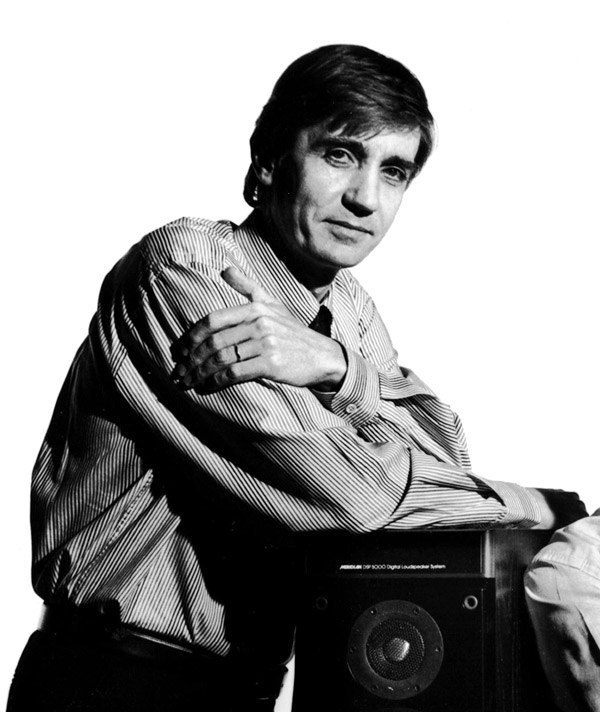
Meridian's MCD CD player was perhaps the first audiophile-quality player to be introduced in the high-end market. I met with Bob Stuart of Meridian at the Winter Consumer Electronics Show in Las Vegas, in January, 1986 (footnote 1). My first question was about the name of the company he runs with industrial designer Alan Boothroyd:
J. Gordon Holt: Meridian in England is called Boothroyd Stuart, right?
Bob Stuart: Yes, the company is called Boothroyd Stuart, Limited, and the trademark is Meridian.
Music & Fractals
"Why do rhythms and melodies, which are composed of sound, resemble the feelings; while this is not the case for tastes, colors, or smells?"---Aristotle
Must We Test? Yes, We Must!
"Test We Must," cried High Fidelity's erstwhile editor, Michael Riggs, in a January 1989 leader article condemning the growth of subjective testing. (See the sidebar for Peter Mitchell's obituary of HF magazine, now effectively merged with Stereo Review.) With the exception of loudspeakers, where it is still necessary to listen, he wrote, "laboratory testing (properly done) can tell us pretty much everything we need to know about the performance of a typical piece of electronics...We know what the important characteristics are, how to measure them, and how to interpret the results."
Naim NAIT integrated amplifier
The $395 NAIT, rated at 20Wpc, is a good-sounding little amp. It's very open and spacious-sounding, but, like the $250 Rotel RA-820BX, sometimes sounds a little hard in the upper registers.
No-Holts-Barred: 25 Years of Stereophile
Editor's Introduction: 1987 sees Stereophile celebrating its 25th anniversary of continuous—if occasionally sporadic—publication. For an ostensibly "underground" publication to have survived so long is a tribute to the skills and enthusiasm of the magazine's founder and Editor, J">http://www.stereophile.com//interviews/66/">J. Gordon Holt. I thought it fitting, therefore, to ask a contemporary of Gordon's, Ed Dell (footnote 1), himself a respected publisher and editor, to pen an appreciation of the man who defined the world of subjective reviewing.—John Atkinson
Ohm Acoustics F loudspeaker

We have still not received a pair of these for formal testing, which may be a good thing in view of our feelings these days about "updatings." (Our feelings about such are clarified in this issue's "As We See It.")