

PASC & Philips' DCC
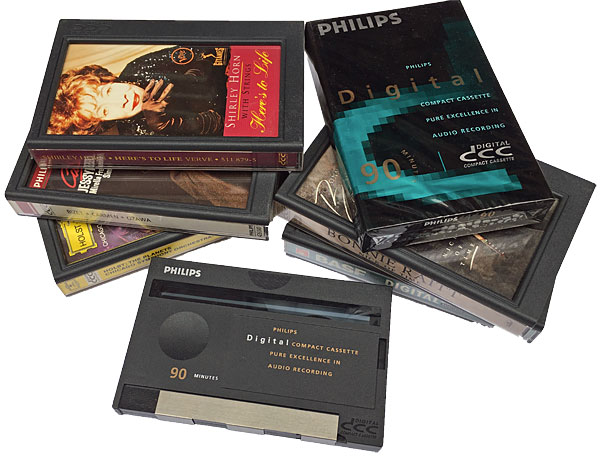
Editor's Note: In the 21st Century, lossy audio data compression, in the form of MP3 and AAC files, Dolby Digital and DTS-encoded soundtracks, and YouTube and Spotify streaming, is ubiquitous. But audiophiles were first exposed to the subject a quarter-century ago, when Philips launched its ill-fated DCC cassette format. What follows is Stereophile's complete coverage on both DCC and its PASC lossy-compression encoding from our April 1991 issue.John Atkinson
PDM, PWM, Delta-Sigma, 1-Bit DACs

Editor's Note: One-bit DAC chips in the 21st century, where the analog output signal is reconstructed from a very high-rate stream of pulses, are ubiquitous. But a quarter-century ago, those chips were only just beginning to stream from the chip foundries. In this feature, we aggregate Stereophile's 1989 coverage of the then-new technology, starting with Peter van Willenswaard on the basics.John Atkinson.
1989 may well become the year of the D/A converter (DAC). CD-player manufacturers have, almost without exception, launched research projects focusing on this problem area of digital audio; many of these projects are already a year old. This is, however, by no means the only imperfection keeping us away from the high-quality sound we have come to suspect is possible with digital audio media, and maybe not even the most important.
Plain Talk About the Unmentionable

Editor's Note: On the 52nd anniversary of Stereophile's founding in 1962 by J. Gordon Holt, we are publishing this mea culpa "As We See it" essay from 1981, in which he explains why Vol.4 No.10 was almost six months late in mailing to subscribers. Gordon had relocated from the Philadephia suburbs to Santa Fe, New Mexico in 1978, and as he had explained in the April 1978 issue, the move had not gone well. "Much of the equipment necessary for testing got damaged or destroyed in transit," he wrote, adding that "What had promised to be a superb listening room turned out to have some sticky acoustical idiosyncrasies."
Quad 405 power amplifier

This is something we don't see too often: an entirely new approach to power amplifier design. As Quad points out in its literature for the 405, class-A operation of transistors provides the lowest distortion, but drastically limits the amount of power an output transistor can deliver without overheating. (Most transistor amps use class-AB output operation, in which each of a pair of power transistors handles part of each signal cycle and shuts down during the other part. Imperfect synchronism between the two halves causes the familiar "crossover distortion," which accounts for most solid-state sound. In class-A operation, each output transistor draws current though the entirety of each signal cycle, eliminating the crossover transition but doubling the amount of time current is drawn, and thus tending to cause the transistor to heat up more.)
Quad ESL loudspeaker
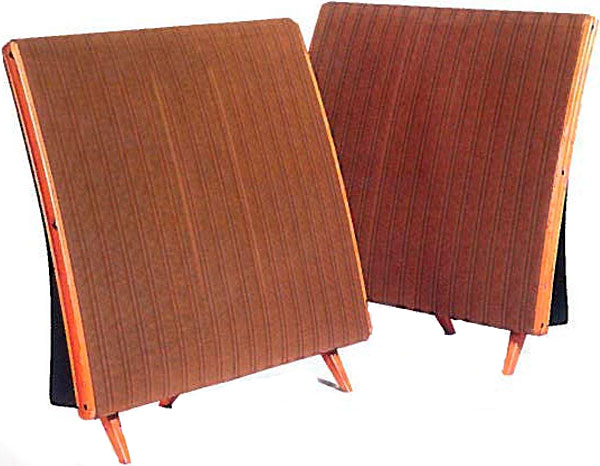
High fidelity took a giant step forward in 1956 with Peter Walker's introduction of the Quad ESL. Walker's research efforts had been motivated by his firm belief in the superiority of the electrostatic dipole over the box loudspeaker, but actually to take the economic plunge and market such a speaker was surely an act of bravery. After all, those were the pre-stereo, pre-audiophile days of the mid '50s, and the public's tastes and expectations were relatively unsophisticated. The average front end was abominable by today's standards, so that making definitive assessments of loudspeaker quality was a difficult task at best.
Quad ESL-63 loudspeaker
Warning to Purists: Despite certain qualities about the ESL-63 speakers which you will probably like, Quad equipment is not designed primarily for audiophiles, but for serious-music (call that "classical") listeners who play records more for musical enjoyment than for the sound. Quad's loudspeakers do not reproduce very deep bass and will not play at aurally traumatizing volume levels, and Quad's preamplifier is compromised through the addition of tone controls and filters, all for the purpose of making old, mediocre, and/or worn recordings sound as listenable as possible.
Ralph—The Real Dog
Ralph died last week (September 11, 1991), his great and faithful heart stopped in the aftermath of an affliction not too uncommon for older, larger dogs—a gastric torsion. He was approximately 12 years old.
Readers Review Stereophile's Poem LP
In the Fall of 1989, Stereophile magazine released its first recording, of Gary Woodward and Brooks Smith playing flute sonatas by Prokofiev and Reinecke, and a work by American composer Griffes that gave the LP its title: Poem (footnote 1). The full">http://www.stereophile.com//interviews/527/">full story was published in the September 1989 issue (p.66). We wanted to offer our readers an LP of acoustic music made with the minimum of electronics and processing—the sounds of the instruments would be as true to reality as possible. The images of the instruments were also captured with a purist microphone technique so that, with even a halfway decent system, a true soundstage would be created between and behind the loudspeakers when the recording was played back.
Recommended Components #1
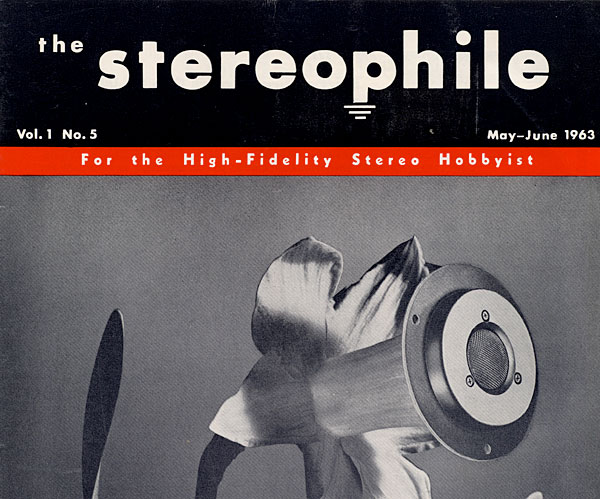
[Note - this article is from the May, 1963 issue of Stereophile]
Many readers have asked why we don't maintain a permanent listing in each issue of The Stereophile of those components that we feel to be the best available, with or without qualification.
So, we are following our readers' suggestion, and will list in each issue groups of components which, at publication time, we feel are ones from which our readers would be well advised to assemble their systems. The list will change from time to time, as new products appear, old ones are obsoleted, or manufacturers change their quality control standards. Components will be added to or dropped from the list without advance notice if we see adequate reason for doing so, but each change in the list will be explained in the magazine at the time the change is made.
Recording of February 1984: Beethoven/Enescu Violin Sonatas

BEETHOVEN: Violin Sonata in G, Op.96
ENESCU: Violin Sonata No.3, Op.25 (In Rumanian Style)
David Abel, violin, Julie Steinberg, piano
Wilson Audio W-8315 (LP). David Wilson, prod., eng. AAA. Oh, what a breath of fresh air this is! An audiophile recording of real music that isn't bombastic, overblown, or high-powered. Imagine, if you can, a private recital in your own home by two consummate artists who play these works for their own delight as much as for yours. Imagine sound so completely and disarmingly natural that after 30 seconds you're unaware it's reproduced. That's what this record is all about. I could rhapsodize endlessly about this record, but I won't. Suffice it to say that if you think there's even a remote chance you'll like this music, you will be positively mesmerized by this recording of it . . .
ENESCU: Violin Sonata No.3, Op.25 (In Rumanian Style)
David Abel, violin, Julie Steinberg, piano
Wilson Audio W-8315 (LP). David Wilson, prod., eng. AAA. Oh, what a breath of fresh air this is! An audiophile recording of real music that isn't bombastic, overblown, or high-powered. Imagine, if you can, a private recital in your own home by two consummate artists who play these works for their own delight as much as for yours. Imagine sound so completely and disarmingly natural that after 30 seconds you're unaware it's reproduced. That's what this record is all about. I could rhapsodize endlessly about this record, but I won't. Suffice it to say that if you think there's even a remote chance you'll like this music, you will be positively mesmerized by this recording of it . . .