Solid State Preamp Reviews

Sort By: Post DateTitle Publish Date

Mark Levinson ML-7A preamplifier

Before launching into Stereophile's first-ever report on a Mark Levinson product, an important point needs to be clarified. Although Mark Levinson products were originally made by Mark Levinson, they are no longer. Au contraire, Mark Levinson products are now being made by Madrigal, Ltd., which bought Mark Levinson Audio Systems' assets and trademark two years ago. Mark Levinson's products, as distinguished from Mark Levinson products, are now being manufactured by a company called Cello. But the subject of this report, the Mark Levinson ML-7A preamplifier, is a product of Madrigal, Ltd., not of Cello. Now that I've made that all perfectly clear, we may proceed.


Klyne SK-5 preamplifier

Klyne Audio Arts is such a low-profile outfit that I marvel at its continued existence. It is reliably absent from the Audio and Stereo Review annual equipment directories, and if Stan Klyne has ever run an advertisement for any of his products anywhere, I haven't seen it, Yet Klyne Audio Arts always manages to have an exhibit at CES, where they display some of the most beautiful preamps and head-amps we see there, only to go underground again for another six months.


Acoustic Research Stereo Remote Control

Prologue: The context for this review is that back in the 1980s, preamplifiers and integrated amplifiers with remote controls didn't exist. In early 1985 I borrowed a sample of Acoustic Research's Stereo Remote Control, which I believe was designed by Ken Kantor (later to find fame with NHT) and set it up in my bedroom. It drove a pair of powered loudspeakers with auto turn-on, and I very quickly grew to appreciate, not just the sound quality, but the convenience of being able to control the system from the comfort of my bed. So what did JGH think of the SRC?—John Atkinson

Superphon Revelation preamplifier

Superphon's Revelation Basic preamplifier is made by Stan Warren, formerly the "S" of PS Audio, so it should come as no surprise that the Revelation Basic and the PS Audio Source sound much alike. The Revelation Basic sells for $399, assembled (no kit available). Like the Source, the Revelation has an outboard AC power transformer to minimize hum problems. But unlike the Source, the Revelation has dual volume controls (a pain) and lacks moving-coil capability.

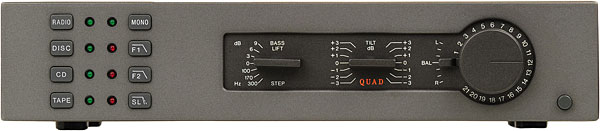
Quad 34 preamplifier

The Model 34 preamplifier is the component from English manufacturer Quad that will disenchant perfectionists, partly because of its obvious pandering to connoisseurs of old and sometimes lousy-sounding records, and partly because of its sound.


This solid-state design is supplied with a built-in moving-magnet cartridge preamplifier, and a moving-coil preamp is included with it for (easy) installation by the user if desired. (Remove two screws, pull out the old module, plug in the new one and replace the screws. The job takes about 3 minutes.) The MC preamp supplied is for 20 microvolt-output cartridges—contrary to the instruction booklet's statement that the supplied one is the 100µV version. Modules having a rated input level of 100 or 400µV are available as extra-cost options.

Great American Sound Thaedra preamplifier

Our first sample of this preamplifier was returned to the manufacturer before we had completed our tests on it, and was replaced with the latest version (ours is serial number 500108). Enough time elapsed between the time we shipped back the first sample and the time we got around to auditioning the second that we are unable to report on any sonic differences between the two.

Dynaco PAT-4 preamplifier

This review of one of the first solid-state preamplifiers was published in 1968. It includes some of JGH's first thoughts on the ongoing subject of "Accuracy vs. Musicality."


Preview, from July 1968 (Vol.2 No.6): Overall sound extremely good, but phono sounds slightly lacking in deep bass, despite impeccable measurements. Scratch filter judged very highly effective, but tone controls felt to be less than ideal be cause of excessively coarse action and marked tendency to affect midrange output. Spring-return Tape Monitor switch probably will not appeal to serious tapesters. This preamp is slated for a full report in the next issue.

Advertisement
Advertisement
Advertisement