As We See It

Sort By: Post DateTitle Publish Date

Bye Bye, Quadrifi?

"As We See It" in the Stereophile issue dated Summer 1968 (actually published in 1970) noted the idealistic, glowing claims about how four-channel sound could put you right in the concert hail, but urged readers to wait before buying, to see whether quadrisound would indeed bring higher fidelity. We predicted it wouldn't—that whatever the potential of quadrisound (footnote 1), it would not be used to increase fidelity, but rather to play ring-around-the-rosy with music.
The Silent Minority

Until about nine months ago, in the fall of 1970, FM radio station WFLN, Philadelphia, was just another one of that dying breed: the classical FM station. Like its counterparts in the few remaining classical-radio cities, it provides the major part of the high-fidelity listener's radio diet, and also like most similar classical stations, its fidelity was nothing to brag about.

The Missing Specification

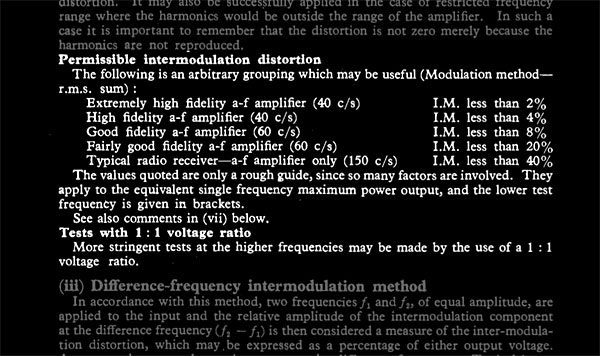
In the 1952 edition of the Radiotron Designer's Handbook, long recognized as the "bible" of the industry, the permissible level of IM distortion for a high-fidelity amplifier was given as 3%, with the alternate figure of 2% being cited as a "rather extreme" specification. We wonder what the author of that statement would think of today's solid-state amplifiers with their measured IM of 0.01% and less. And we wonder what he would think about the fact that these super-amplifiers still have audible distortion.

The Comparable Cassette


Thanks to two developments and a promise, the compact cassette has finally become, as they say, a force to be reckoned with.


Development one, perhaps the most significant factor in the changing picture, is the ready availability of B-type Dolby devices (which are single-band Dolbys, acting only on hiss frequencies). Advent makes two that can be used with any tape machine, cassette or otherwise, while Fisher, Advent, and Harman-Kardon (as of this moment) are producing cassette recorders with built-in Dolby-B. No doubt there will be others by the time this gets in print.

Universal Components

A reader who asked to remain anonymous wrote to tell us the results of some tests he saw conducted on one of our top-rated loudspeaker systems. Frequency-response checks showed that the system had virtually no deep bass, a midbass peak, a midrange slump, and a high-end rise. Further checks had shown gross distortion at input levels of over about 6W, and a definitely limited (although adequate for Row-M listening) maximum output-level capability. Said reader then went on to ask how we could possibly consider such a speaker to be one of the best available.

Outrageous Price?

Editor's Note: Approaching its ninth year of publication in 1970, the advertisement-free Stereophile was failing as a business. There was just one issue published between December 1968 and June 1970, the date when J. Gordon Holt published this plea in response to the reaction to the increased subscription price: first to $4 for four issues, equivalent to $25 in 2016, then to $5 ($31). The response from subscribers to his plea was not positive enough to enable the magazine to continue publishing—Gordon could publish just two more issues in the next two years before Stereophile had to accept advertising, first from dealers in October 1972 and from manufacturers in December 1977.—Ed.


Our recent price increase at the end of 1969 elicited numerous letters telling us the magazine was exhorbitant at $4 a subscription and is outrageous at $5, and supporting their contention with comparisons between the price per page of the Stereophile and one or another of the commercial hi-fi magazines. We will answer this once, here and now, and then let the matter drop.

Two More Channels?

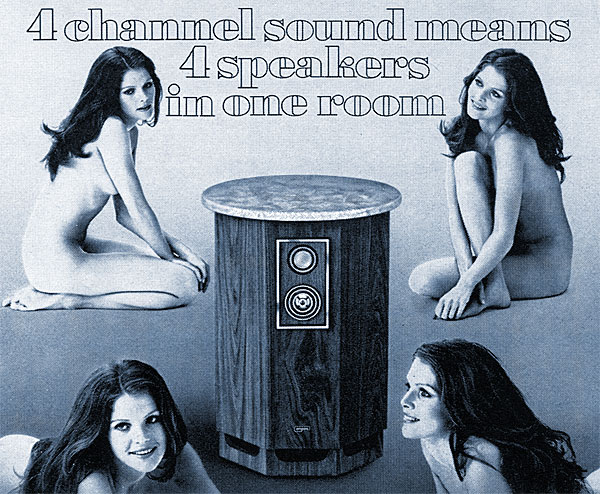
Four-channel stereo is here, but for how long? By the time this gets in print, it is extremely unlikely that any of our readers will have escaped being told that 4-channel stereo is here. "Two channels brought us direction," the announcements trumpet. "Now, four channels bring us dimension." Now, for the first time in the history of hi-fi, modern technology can bring us hall acoustics in stereo, to surround us with the sense of spaciousness that we hear in the concert hall.

Prognostications for 1969

Editor's Note: 40 years before it became a reality, J. Gordon Holt predicts music streaming and predicts the Compact Cassette will become the dominant prerecorded music medium.


Traditionally, the New Year is the time when editors light their pipes, tilt their chairs back, fold their hands and shut their eyes, and make bold predictions about The Future. It is said that prognostications are always risky, because events have a nasty habit of making fools of those who prognosticate. It has been our observation, though, that the only prognosticators who are remembered are those who were proven right, so we are going to do some fearless limb-climbing about something that is coming to worry increasing numbers of stereophiles: Namely, which of all the current recording media is going to become The Standard for home use, and which are going to be left stranded on the shoals of obsolescence?

Why Argue?

While we were preparing our list of specifications for our perfectionist's tape recorder discussed elsewhere in this issue, we suddenly came to a screeching halt at the spec which started "Scrape flutter less than . . ."


What, we wondered, was the scrape flutter percentage in a recorder in which scrape flutter is audible? Would it be 0.5%? Or 1%? Or even 5%? We perused the readily available literature, and were informed that "scrape flutter is caused by the tape's tendency to move past the heads in a series of tiny jerks in stead of in a smooth gliding motion." We were also told that scrape flutter is due to friction between the tape and the head surfaces, plus the slight elasticity of the tape that allows it to stretch slightly before being dragged along by another silly millimeter, and that it sounds like a rough edge riding on all signal frequencies between about 3kHz and 8kHz.

Advertisement
Advertisement
Advertisement