Audacious Audio

Sort By: Post DateTitle Publish Date

Gryphon Ethos CD player-D/A processor

What kind of creature is this? Gryphon Audio Designs' new Ethos ($39,000)—pronounced EE-toss by its Danish manufacturers—is marketed as a CD player and digital-to-analog converter. It's decidedly au courant in that it includes two 32-bit/768kHz ES9038PRO Sabre DAC chips—one for each channel—with each holding eight individual DAC chips; offers optional upsampling to either 24/384 PCM or DSD128; and decodes up to 32/384 PCM and quadruple DSD (DSD512) via its USB input, or up to 24/192 (and no DSD) via AES/EBU or S/PDIF.

darTZeel NHB-468 monoblock power amplifier

What's the point of reviewing a pair of monoblock amplifiers that costs more than most people spend on two or even several cars— and far more than most audiophiles spend on an entire music system? That's a good question. Another is: Why should I write this review when, just seven years ago, I reviewed a pair of darTZeel monoblocks that look exactly like this new pair?


I realize that products such as the darTZeel NHB-468 ($170,000/pair) are for the very few, but the very few include far more people throughout the world than you may realize— people who can afford such costly audio products and who do buy them. I know, because in my travels I've met a lot of them, and they deserve to read reviews of products they're considering buying—things most of us can only dream of owning.

Listening to the Wilson WAMM Master Chronosonic

Earlier this year, I had the opportunity to spend a couple of afternoons listening to a system built around the late David Wilson's magnum opus, the Wilson Audio WAMM Master Chronosonic loudspeaker ($685,000/pair), which Jason Victor Serinus reported on in December 2016. In addition to the joy of simply listening to music on such exotic speakers, the experience provided insight into just how well the Master Chronosonics would work in a relatively normal-sized listening room—in this case, one measuring 21.5 feet long by a little over 18 feet wide, with a ceiling height of a little over 9.5 feet: not small in an absolute sense, but a lot smaller than the sort of space usually associated with speakers this large.

Verity Audio Monsalvat Amp-60 power amplifier

I first encountered Verity Audio's Monsalvat Amp-60 stereo power amplifier ($58,000) in October 2017, in one of the largest single-system rooms at the Rocky Mountain Audio Fest. After hearing the Amp-60 and Verity's Monsalvat Pre-2 preamplifier drive Verity's Lohengrin IIS loudspeakers ($133,000/pair), I enthused about the "most impressive range of colors and supreme sense of spaciousness" that contributed to the system's "absolutely beguiling" sound.

Cary Audio CAD-805RS monoblock power amplifier

There's no place for fashion in epidemiology, aeronautical engineering, or the mining and storage of uranium. Fortunately, domestic audio is less serious, its goals more scattered and ambiguous, than those and a thousand other pursuits.


And so, throughout the 20th century, any number of trends in domestic audio popped up their heads, some remembered as fads, others as legitimate approaches to playback. Among the latter are amplifiers whose output sections operate in single-ended mode, in which the entire signal waveform is amplified by a single device.

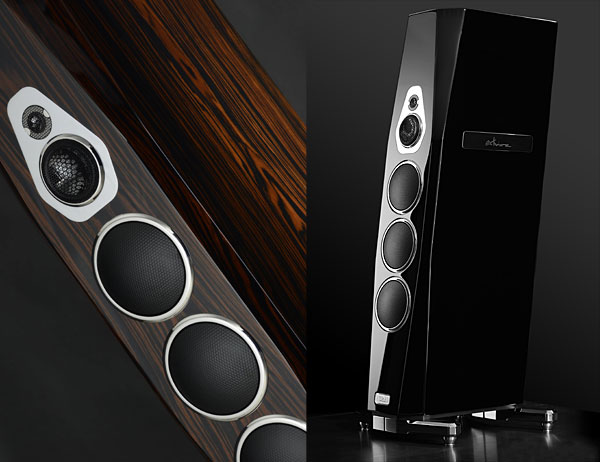
Tidal Audio Akira loudspeaker

Doug White, of Philadelphia-area retailer The Voice That Is, has been a fixture at US audio shows the past few years, where he always gets great sound using loudspeakers from Tidal Audio. (There is no connection between the German audio manufacturer and the music-streaming service owned by Jay Z and Sprint.) In early 2017, Herb Reichert, Jana Dagdagan, and I visited White and spent a delightful afternoon listening to Tidal's then-new Akira loudspeakers. I promised myself to review the Akira, which costs a wallet-straining $215,000/pair, when my schedule opened up. As things turned out, it was more than a year before that opportunity presented itself.

Constellation Performance Centaur II 500 power amplifier

I am finding hard to grasp that it is almost 50 years since I first went to a hi-fi show. That show, held at London's Olympia exhibition center, was notable both for Yamaha's launch of a loudspeaker with a speaker diaphragm shaped like a human ear, and for being the first time I saw the drop-dead gorgeous Transcriptors Hydraulic Reference turntable, which was later featured in the film A Clockwork Orange. The most recent show I attended was AXPONA, held last April in the Chicago suburb of Schaumburg. There I saw no ear-shaped drive-units, but the final room I visited featured sound that the 1969 me could have only fantasized about.

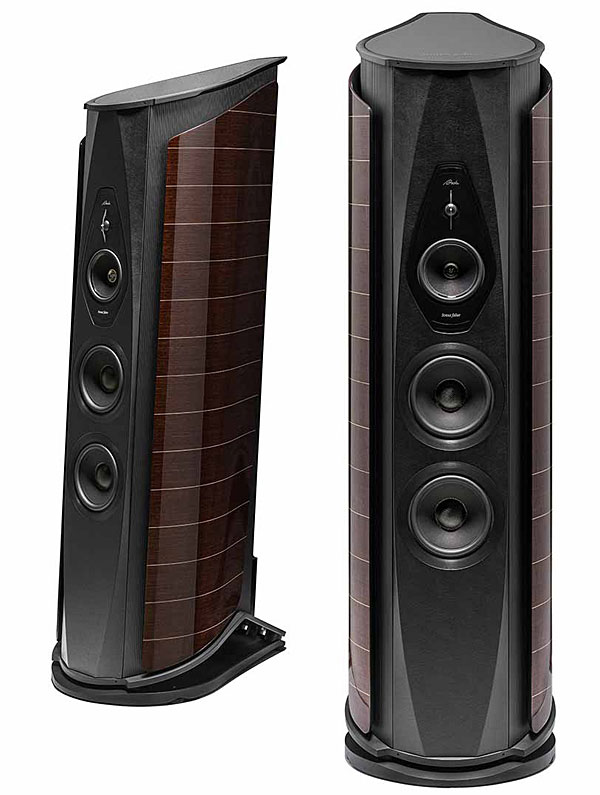
Sonus Faber Aida loudspeaker

In 1959, in their musical revue At the Drop of a Hat, the British musical-comedy team of Flanders and Swann sang their "Song of Reproduction." It's not about sex. The song mocks audiophiles (you thought this was something recent?) for how we spend "all of that money to get the exact effect of an orchestra actually playing in their sitting room." Before launching into the song, Flanders quips, "Personally, I can't think of anything I should hate more than having an orchestra playing in my sitting room!"

Kalista DreamPlay One CD player

Some of my reviewer colleagues would have you believe that negative reviews are the most difficult of all to write, and that positive reviews fairly write themselves. What nonsense!


As I write this, my copy deadline is three days away, yet I've succeeded at crafting little more than my heading (easy enough: it's just the product's name, followed by my name) and my Associated Equipment sidebar (also easy), leaving a great expanse of nothing in between. That's mostly because the Kalista DreamPlay One, a two-box CD player whose $43,000 price might once have kept me from even considering it as a real-world product, has stunned me into a sort of paralysis: I feel that anything I write will be inadequate to the task.

Advertisement
Advertisement
Advertisement