
Historical

Sort By: Post DateTitle Publish Date

Audio Research SP9 preamplifier

Following the introduction of their very expensive, tube/FET hybrid SP11 preamplifier, there were rumors that Audio Research was working on a hybrid tube/transistor preamplifier targeted to cost less than $2000. The rumors were confirmed when ARC showed a black-and-white photo of the SP9 at the 1987 Winter CES. Obviously, like all magazines, we were impatient to receive a review sample, but the first review of the SP9 actually appeared in the summer '87 issue of Peter Moncrieff's IAR Hotline. Peter's review was almost intemperately enthusiastic, comparing the SP9 positively with early samples of the SP11 and suggesting that its sound quality was considerably better than would be expected from its $1695 asking price. Naturally, we were anticipating good things when our review sample arrived in Santa Fe in late July.
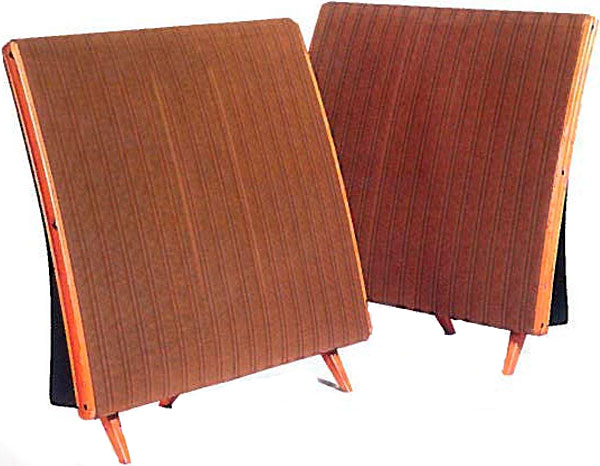

Quad ESL loudspeaker

High fidelity took a giant step forward in 1956 with Peter Walker's introduction of the Quad ESL. Walker's research efforts had been motivated by his firm belief in the superiority of the electrostatic dipole over the box loudspeaker, but actually to take the economic plunge and market such a speaker was surely an act of bravery. After all, those were the pre-stereo, pre-audiophile days of the mid '50s, and the public's tastes and expectations were relatively unsophisticated. The average front end was abominable by today's standards, so that making definitive assessments of loudspeaker quality was a difficult task at best.

Sony DTC-1000ES R-DAT recorder & Sony PCM-1630 A/D converter

With the furor over the launch of DAT (digital audio tape), it is worth remembering that commercial digital recorders have been with us for some time now: it is now nearly a decade since studio PCM converters were first successfully used for audio recording in conjunction with a VCR (which uses a helical spiral recording via a spinning drum to achieve the high writing speed).

dbx 700 digital audio processor

As ALF would say, "There's more than one way to cook a cat." We've been so overwhelmed with linear pulse-code modulation (PCM) recording, we forget there are other ways to pass from the analog domain to the digital.


One of these is delta modulation. The Greek delta (which in its upper-case, block-letter form, looks like an equilateral triangle) is the mathematical symbol for the difference between two quantities; accordingly, in delta modulation, we record not the absolute value of a signal sample, but the difference between successive samples.

Who Stole The Bass? / No One Stole The Bass

Editor's Introduction: Stereophile's "Recommended Components" feature is, as I am sure you will have guessed, produced by a committee. The reviews are studied, the reviewers polled to verify the continued validity, the merits and demerits of specific pieces of equipment are discussed or, rather, argued over at length by JGH, JA, and LA, and out of the whole business emerges the "truth." But, as with the findings of any committee, what is presented as a consensus will have significant undertows and countercurrents of opinion; if these are very strong, a "Minority Report" is often also produced. Such has been the case this time, concerning loudspeakers.

The Blind leading the Deaf

As the person who "invented" subjective testing, I have followed with great interest the many articles in the mainstream audio press which purport to prove that none of us can really hear all the differences we claim to hear, particularly those between amplifiers. My reaction has usually been: "Why didn't they invite me to participate? I would have heard the differences under their double-blind listening conditions." I could make that assertion with supreme confidence because I had never been involved in any such test.

The Musician in the Middle

Ask most professional symphony musicians for their views concerning recording sessions, and you might be greeted with seemingly nonchalant and cavalier responses. You will probably be told that although recording can be quite lucrative, it is almost always an exercise in futility. If you press further, and inquire as to why these "artists" display such negative attitudes, they would treat you to both a lecture concerning the shortcomings and gross musical distortions usually involved in the recording process, and to a tirade on the incompetence and arrogance of many recording engineers and producers. And once you have opened this can of worms, you will undoubtedly be told about the frustrations of having to deal with inaccurate and distorted representations of their art at the hands of the musically inept.


No-Holts-Barred: 25 Years of Stereophile

Editor's Introduction: 1987 sees Stereophile celebrating its 25th anniversary of continuous—if occasionally sporadic—publication. For an ostensibly "underground" publication to have survived so long is a tribute to the skills and enthusiasm of the magazine's founder and Editor, J">http://www.stereophile.com//interviews/66/">J. Gordon Holt. I thought it fitting, therefore, to ask a contemporary of Gordon's, Ed Dell (footnote 1), himself a respected publisher and editor, to pen an appreciation of the man who defined the world of subjective reviewing.—John Atkinson


Advertisement
Advertisement
Advertisement