I want to start this year's gift recommendations by briefly revisiting the results of my Musical Cultural Literacy for Americans write-in competition, which ran in the April issue. All 12 winning entries of 12 selections each are posted online (footnote 1).
I thought a few entries included one or two selections that were a cut above some of the selections on my original list. So I've harvested those recommendations, from both winning and non-winning lists, with a mind toward helping your holiday gift-list making.
One problem I had with some entries was that the lists were full of works or recordings that were undoubtedly important and influential, but that did not strike me as things people would listen to simply for pleasure today. So, although my picks might not be the same ones you'd encounter in a music-history course, I think that you can buy any of the following 12 recordings unheard and have a very rewarding experience. To restate that: This meta-list is not the master list of musical cultural literacy for Americans, it's merely a list of nifty little inglenooks you can discover along the way. Just for fun, I tried to line up complementary pairs.
The first two selections are distinctly American, extreme workouts for the fingers:
1) Scott Joplin: Piano Rags; Joshua Rifkin, piano
2) Eric Johnson: Ah via musicom. The next selections contrast music for empires of space with music for a land of ideals—with narration by Darth Vader:
3) John Williams: Film music for Star Wars and Close Encounters of the Third Kind
4) Aaron Copland: A Lincoln Portrait; James Earl Jones, narrator; Gerard Schwarz, Seattle Symphony The next two are both about raising (trained) voices to get in touch with God:
5) Take 6: Take 6
6) Morten Lauridsen: O Magnum Mysterium
Evergreens from the Great American Songbook, interpreted first by a woman and then by a man, both from the younger generation:
7) Linda Ronstadt: Lush Life
8) Harry Nilsson: A Little Touch of Schmilsson in the Night Great piano playing that can only be American:
9) Errol Garner: Concert by the Sea
10) Bill Evans: Conversations with Myself Great orchestral music that can only be American:
11) Samuel Barber: Adagio for Strings
12) Alan Hovhaness: Symphony 2, "Mysterious Mountain"
I know—12 picks go by so quickly. Again, I've put together a list with no Sinatra and no Dylan, and the only rock is Eric Johnson's largely instrumental work. Ah me.
If I had to ber-recommend only two recordings from this list, they would be Bill Evans' Conversations with Myself and Hovhaness' "Mysterious Mountain" (with a preference for the recent recording by Gerard Schwarz and the Royal Liverpool Philharmonic, Telarc SACD-60604).
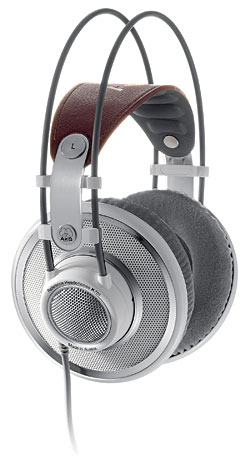 AKG 701 headphones
Well, I finally got a chance to try out these excellent 'phones, and the virtues that have made Sam Tellig and Wes Phillips confirmed fans were immediately apparent. (Wes's coverage can be found here.) Driven by Grace Design's m902 DAC-linestage-headphone amplifier, the 701s exhibited clarity and detail in abundance, as well as bass that was powerful and well defined. Mechanical noises and stray buzzes and rattles deep within my organ recording Pipes Rhode Island (RIAGO CD 101) were annoyingly apparent, while the majesty of Master Tallis's Testament was gratifyingly present. The 701s' appearance and build quality are first-rate, and I found them easy to wear. They really are "open-ear" headphones, by the way. Sounds from the outside world could be heard to a degree I can't recall with any other headphones. Perhaps this is related to design features that give them their clarity and agility.
The 701s come at a price advantage over the professional-market fave Sennheiser siblings, the 600 and 650, but to my view the AKG 701s are on the same level of quality—though with a distinctly different sound. Which of the three will appeal most strongly to you will be a result of personal preference and associated equipment. Relying on auditory memory, I'd say that the Sennheiser 650s have the most subtle treble, the 600s have more pronounced treble, and the 701s the most pronounced treble. Highly recommended.
Pioneer Pure Malt Speakers
And now for something completely different. Pioneer is offering a limited edition of small two-way loudspeakers, the cabinets of which are made entirely from recycled Suntory whisky barrels. The loudspeakers are called Pure Malt Speakers, which is less unwieldy than their model number of S-A4SPT-PM. The Pure Malt Speaker ($598/pair) is about 9.75" tall, 6" wide, and 7" deep, not including grilles or binding posts—a size smaller, so to speak, than the BBC LS3/5a and its descendants. Each speaker weighs about 8 lbs.
The drivers are a 4" woven-fiber woofer-mid that appears to be made of Kevlar, and a 0.75" soft-dome tweeter. The nominal impedance is 6 ohms, with a claimed sensitivity of 84dB. The owner's manual claims a frequency range of 50Hz–40kHz, which strikes me as a bit generous at both ends. (Someone must at least partially agree; the bass-extension figure listed on Pioneer US's website is 60Hz.) Bass loading is via a small port on the rear panel, about the size of the thumbhole on an artist's palette. The speakers are said to be magnetically shielded.
The Pure Malt sure is purty. All surfaces, including the rear panel, are made up of narrow, short fillets of solid North American White Oak, each about 1" wide and 4–8" long. I had been expecting the wood pieces to be more stave-like, but it would appear that, to prevent warping, smaller fillets were used. The fillets appear to be butt-joined. It's impossible to tell how thick the panels are, but the rear panel feels about 1" thick at the port. The fillets vary slightly in shade, giving something of a muted butcher-block look.
The design of the cabinet is, in typical Japanese fashion, subtle. (The design is Japanese, but the speakers themselves, like nearly everything nowadays, from bowling balls to Buicks, are made in China.) The sides and top are slightly chamfered at the front, back to a distance of about 1" or so, which gets the shape away from that of a plain shoebox. The side panels flank the top and bottom panels to the extent of about 3/8", separated by a dado reveal the width of a saw blade, as you can see in the photo. The front panel, flanked at sides and top to about 3/8" and 1/2" at the bottom, is of solid oak, and carries four metal posts or dowels for mounting the plastic-framed grilles, which are of an extremely dark green cloth. In addition to a multilingual owner's manual, Pioneer provides 2.5m speaker cables of the same specification as the speakers' internal wiring, and self-adhesive, nonskid pads.
The Pure Malt Speaker ($598/pair) is about 9.75" tall, 6" wide, and 7" deep, not including grilles or binding posts—a size smaller, so to speak, than the BBC LS3/5a and its descendants. Each speaker weighs about 8 lbs.
The drivers are a 4" woven-fiber woofer-mid that appears to be made of Kevlar, and a 0.75" soft-dome tweeter. The nominal impedance is 6 ohms, with a claimed sensitivity of 84dB. The owner's manual claims a frequency range of 50Hz–40kHz, which strikes me as a bit generous at both ends. (Someone must at least partially agree; the bass-extension figure listed on Pioneer US's website is 60Hz.) Bass loading is via a small port on the rear panel, about the size of the thumbhole on an artist's palette. The speakers are said to be magnetically shielded.
The Pure Malt sure is purty. All surfaces, including the rear panel, are made up of narrow, short fillets of solid North American White Oak, each about 1" wide and 4–8" long. I had been expecting the wood pieces to be more stave-like, but it would appear that, to prevent warping, smaller fillets were used. The fillets appear to be butt-joined. It's impossible to tell how thick the panels are, but the rear panel feels about 1" thick at the port. The fillets vary slightly in shade, giving something of a muted butcher-block look.
The design of the cabinet is, in typical Japanese fashion, subtle. (The design is Japanese, but the speakers themselves, like nearly everything nowadays, from bowling balls to Buicks, are made in China.) The sides and top are slightly chamfered at the front, back to a distance of about 1" or so, which gets the shape away from that of a plain shoebox. The side panels flank the top and bottom panels to the extent of about 3/8", separated by a dado reveal the width of a saw blade, as you can see in the photo. The front panel, flanked at sides and top to about 3/8" and 1/2" at the bottom, is of solid oak, and carries four metal posts or dowels for mounting the plastic-framed grilles, which are of an extremely dark green cloth. In addition to a multilingual owner's manual, Pioneer provides 2.5m speaker cables of the same specification as the speakers' internal wiring, and self-adhesive, nonskid pads.
Footnote 1: Previous years' gift-suggestion lists were published in December 2006 and December 2002. Those recommendations remain valid.
1) Scott Joplin: Piano Rags; Joshua Rifkin, piano
2) Eric Johnson: Ah via musicom. The next selections contrast music for empires of space with music for a land of ideals—with narration by Darth Vader:
3) John Williams: Film music for Star Wars and Close Encounters of the Third Kind
4) Aaron Copland: A Lincoln Portrait; James Earl Jones, narrator; Gerard Schwarz, Seattle Symphony The next two are both about raising (trained) voices to get in touch with God:
5) Take 6: Take 6
6) Morten Lauridsen: O Magnum Mysterium
7) Linda Ronstadt: Lush Life
8) Harry Nilsson: A Little Touch of Schmilsson in the Night Great piano playing that can only be American:
9) Errol Garner: Concert by the Sea
10) Bill Evans: Conversations with Myself Great orchestral music that can only be American:
11) Samuel Barber: Adagio for Strings
12) Alan Hovhaness: Symphony 2, "Mysterious Mountain"
AKG 701 headphones
Well, I finally got a chance to try out these excellent 'phones, and the virtues that have made Sam Tellig and Wes Phillips confirmed fans were immediately apparent. (Wes's coverage can be found here.) Driven by Grace Design's m902 DAC-linestage-headphone amplifier, the 701s exhibited clarity and detail in abundance, as well as bass that was powerful and well defined. Mechanical noises and stray buzzes and rattles deep within my organ recording Pipes Rhode Island (RIAGO CD 101) were annoyingly apparent, while the majesty of Master Tallis's Testament was gratifyingly present. The 701s' appearance and build quality are first-rate, and I found them easy to wear. They really are "open-ear" headphones, by the way. Sounds from the outside world could be heard to a degree I can't recall with any other headphones. Perhaps this is related to design features that give them their clarity and agility.
And now for something completely different. Pioneer is offering a limited edition of small two-way loudspeakers, the cabinets of which are made entirely from recycled Suntory whisky barrels. The loudspeakers are called Pure Malt Speakers, which is less unwieldy than their model number of S-A4SPT-PM.
The Pure Malt Speaker ($598/pair) is about 9.75" tall, 6" wide, and 7" deep, not including grilles or binding posts—a size smaller, so to speak, than the BBC LS3/5a and its descendants. Each speaker weighs about 8 lbs.
Footnote 1: Previous years' gift-suggestion lists were published in December 2006 and December 2002. Those recommendations remain valid.