Features

Sort By:  Post Date TitlePublish Date

The Great Record-Club CD Conspiracy?

For a while, I've been hearing rumors that the record-club editions of popular compact discs differ from the original versions produced by the record companies. I've met listeners who claim their club versions are compressed in dynamics, and some have reduced bass. Perhaps the clubs, in their infinite wisdom, think the typical member has a lower-class stereo system (in fact, the opposite may be true). Maybe these lower classes could benefit from some judicious dynamic compression, equalization, and digital remastering.

The Silverman Concert

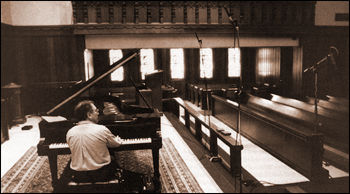
"What's that noise?" Bob Harley and I looked at each other in puzzlement. We thought we'd debugged the heck out of the recording setup, but there, audible in the headphones above the sound of Robert Silverman softly stroking the piano keys in the second Scherzo of Schumann's "Concerto Without Orchestra" sonata, was an intermittent crackling sound. It was almost as if the God of Vinyl was making sure there would be sufficient surface noise on our live recording to endow it with the Official Seal of Audiophile Approval. Bob tiptoed out of the vestry where we'd set up our temporary control room and peeked through a window into the church, where a rapt audience was sitting as appropriately quiet as church mice.

Balance: Benefit or Bluff?

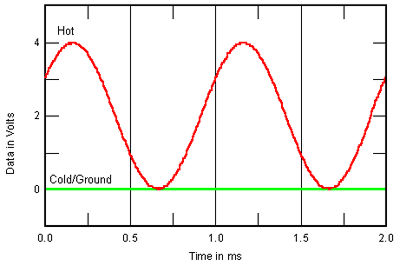
If you read much promotional literature for recently introduced high-quality equipment, you'll notice a common theme emerging: balanced connection. Balanced inputs and outputs are becoming a must for any audio equipment that has any claim to quality. The word itself has promotional value, suggesting moral superiority over the long-established "unbalanced" connection (for the purpose of this discussion, I will call this "normal"). What's my problem with this? Simply this: The High End could be paying dangerous, costly lip service to the received wisdom that balanced operation is the goal for an audio system.

Space...the Final Frontier

High-end audiophiles are space freaks---we relish the warmth and spaciousness of a fine, old performing hall almost as much as we do the music recorded in it. But my attendance at a series of orchestral concerts held last summer brought home to me---as never before---the sad fact that our search for the ultimate soundstage is doomed to failure: we're trying to reproduce three-dimensional space from a two-dimensional system, and it simply can't be done.

A Transport of Delight: CD Transport Jitter

Not that long ago, digital audio was considered perfect if all the bits could be stored and retrieved without data errors. If the data coming off the disc were the same as what went on the disc, how could there be a sound-quality difference with the same digital/analog converter? This "bits is bits" mentality scoffs at sonic differences between CD transports, digital interfaces, and CD tweaks. Because none of these products or devices affects the pattern of ones and zeros recovered from the disc, any differences must be purely in the listener's imagination. After all, they argued, a copy of a computer program runs just as well as the original.

How To Write Manufacturers' Comments

"Equipment Reports," "Record Reviews," "Letters," "Industry Update," "Sam's Space," "As We See It," "The Final Word"---I read and enjoy them all. But the section of Stereophile I especially look forward to reading is "Manufacturers' Comments." How is the manufacturer going to respond to a review that's considerably less than 100% positive? Can they take criticism gracefully, or do they have an attitude? If I were a consumer considering purchase of one of their products, would their comments convince me that they'd be a good company to deal with? Are they uptight beyond reason, or do they have a sense of humor? Can they respond to a positive review without gloating?

The Listeners' Manifesto

Editor's Note: This article is now only available as an Audio Engineering Society preprint, under the title "The Role of Critical Listening in Evaluating Audio Equipment Quality," preprint number 3176. The price is $4.00 for AES members, and $5.00 for non-members; it can be ordered (currently on paper only, not as a downloadable pdf) by entering the number in the appropriate field on the preprint">http://www.aes.org/publications/preprints/search.html">preprint search page at the AES">http://www.aes.org">AES website.

Advertisement
Advertisement
Advertisement