Integrated Amp Reviews

Sort By:  Post Date TitlePublish Date

Creek Audio Destiny integrated amplifier

The one thing I've liked about designer Mike Creek of Creek Audio as much as his design talent is his predictability. I've been following his integrated-amplifier designs for nearly 20 years now, having reviewed, in sequence, the CAS4140s2 (for another magazine), the 4240SE (Stereophile, December 1995, Vol.18 No.12), and the 5350SEhttp://www.stereophile.com/integratedamps/327">5350SE; (March 2001, Vol.24 No.3). In each case, I was sufficiently impressed with the review sample that I bought it and made it my new reference in my second, affordable system. The predictable part comes from Creek's traditional nomenclature: an "s2" or "SE" (Special Edition) designation has always denoted a modest upgrade, and a numerical uptick in the model number a more significant upgrade, the level of significance denoted by the specific digit being increased. Hence, the update from 4240 to 5350 is intended to indicate a greater improvement in sound than the update from 4140 to 4240.


NAD Master Series M3 integrated amplifier

Older audiophiles remember the splash NAD made in the late 1970s with the introduction of their 3020 integrated amplifier ($175). Ridiculously cheap, it looked graceful and sounded warm, inviting, and holographic. Removable jumpers between the 3020's sections permitted enthusiasts to determine whether the magic resided in its preamp, its power amp, or in some synergy of both.

NAD C 372 integrated amplifier

At the extreme high end—Halcro, VTL, Boulder, etc.—reviewers gush about a lack of character. If you're paying $20,000, you want a preamplifier or power amp to disappear. At those price points we also want extreme, unfatiguing resolution, and noise that's well below what most people would consider audible. But at those prices, an absence of character is definitely something most people aspire to.

EICO HF-81 integrated amplifier

If you spotted an EICO HF-81 at the local Goodwill, you'd think nothing of this plain-Jane integrated amplifier in its nondescript gray case. But if you kept on walking, you would have passed up one of the best-kept audio secrets of all time. The HF-81 hails from hi-fi's pioneer days, before chromed chassis and slick Mac transformers. It isn't ultracool-looking, like early Marantz or McIntosh gear. It doesn't have the nostalgia factor of a Fisher. It's not a supercheap eBay steal like a Stromberg-Carlson or a Heathkit. So what's the deal?

DK Designs VS.1 Reference Mk.III integrated amplifier

Each time I attend Stereophile's annual Home Entertainment Show, I look forward to two things. The first is the opportunity to performhttp://blog.stereophile.com/he2006/060406reina/">perform; classic and original jazz music with John">http://blog.stereophile.com/he2006/060406rayjazzed/">John Atkinson and Immedia's">http://blog.stereophile.com/he2006/060406perkins/">Immedia's Allen Perkins. The second is to seek out the most exciting new, affordable speakers to review over the following year. Both buttons were pressed for me quite admirably during HE2005 at the New York Hilton, but this time it was not an affordable speaker that most impressed me.

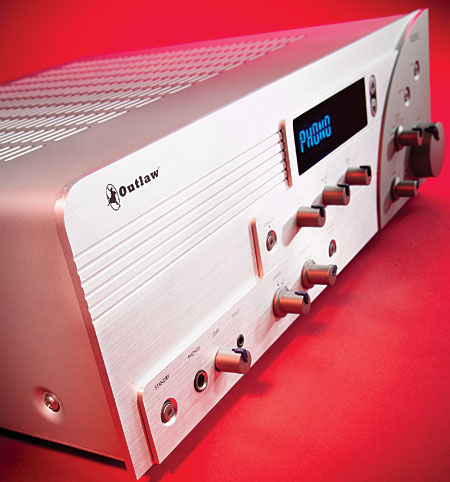
Outlaw Audio RR2150 stereo receiver

Wilson Audio Specialties' David Wilson likes to say that you should build a stereo system from the speakers down. Of course he does—he sells speakers. But that doesn't mean he's wrong. So recently, when offered an inexpensive new product for review, I decided it would be a good test of Wilson's theory. I tried driving Wilson's $45,000/pair MAXX2http://www.stereophile.com/floorloudspeakers/805wilson">MAXX2; speakers with Outlaw Audio's RR2150, a $599 stereo receiver.

PS Audio GCC-100 integrated amplifier

Lovers of Italian wine, travelers to Italy, and, of course, Italians, may be familiar with this story. It seems that in the year 1111, Henry V was traveling to Rome to be crowned Holy Roman Emperor. A member of his entourage, one Giovanni Defuc, was very fond of wine, and had the practice of sending ahead one of his servants to sample the wine in each place. When the servant found a wine that he particularly liked, he would write "Est!" on the door of the establishment, which was a signal to his master that the wine is (est) good. Having arrived at Montefiascone, the servant found a wine he thought so superb that he wrote on the door of the inn "Est! Est!! Est!!!"

Advertisement
Advertisement
Advertisement