Recording of the Month

Sort By:  Post Date TitlePublish Date

Recording of January 1988: Renaissance

Branford Marsalis: Renaissance
Branford Marsalis, tenor & soprano sax; Kenny Kirkland & Herbie Hancock, piano; Bob Hurst & Buster Williams, bass; Tony Williams, drums
CBS FC 40711 (LP). Dennis Ferrante, Bob Margoleff, Howard Siegel, engs.; Delfeayo Marsalis, prod. DDA. TT: 57:09

These are heady days for those who believe that jazz may have reached its height in the mid- to late '60s, before its disastrous 15-year romance with fusion. With such strong new talents as the Marsalis and Brecker brothers and Chico Freeman embracing the spirit of that time, and fusion-scarred veterans like Freddie Hubbard and Joe Henderson returning to the basics of acoustic trios, quartets, and quintets in recent recordings and concerts, jazz has attained a new and cherished seriousness valued all the more for its unexpectedness.

Recording of April 2012: The Well

Tord Gustavsen Quartet: The Well
Tord Gustavsen, piano; Tore Brunborg, tenor saxophone; Mats Eilertsen, bass; Jarle Vespestad, drums
ECM 2237 (CD). 2012. Manfred Eicher, prod.; Jan Erik Kongshaug, eng. DDD. TT: 53:19
Performance *****
Sonics *****

The first time I heard J.S. Bach's Well-Tempered Klavier, I heard an endless sameness, lovely but undifferentiated. Only over many hearings did each pairing of prelude and fugue begin to emerge from the background, as what Bach did in each iteration of the same received form began to be revealed as an inexhaustible richness of difference. Gradually, I was learning Bach's musical language; only then did I begin to get an idea of what he might be saying.

Recording of February 1988: The Moscow Sessions

The Moscow Sessions
Barber: First Essay for Orchestra; Copland: Appalachian Spring; Gershwin: Lullaby (for string quartet); Glazunov: Valse de Concert in D; Glinka: Russlan and Ludmilla Overture; Griffes: The White Peacock; Ives: The Unanswered Question; Mussorgsky: Khovanshchina Prelude; Piston: The Incredible Flutist (ballet suite); Shostakovich: Symphony 1, Festive Overture; Tchaikovsky: Symphony 5
Lawrence Leighton Smith, Dmitri Kitayenko, Moscow Philharmonic Orchestra
Sheffield Lab CD-1000 (3 CDs); TLP-1000 (3 LPs). CDs DDD. LPs AAA. TT: 180:40

The ecumenical collaboration between Sheffield Lab, the Moscow Philharmonic Orchestra, conductors Lawrence Leighton Smith and Dmitri Kitayenko, an imposing gaggle of businessmen and bureaucrats, and partial sponsorship by The Absolute Sound's Fund for Recorded Music, if somewhat short of epoch-making, is, nonetheless, a positive example of free enterprise and socialism bedding down together, liberally (pardon the expression) lubricated with glasnost. Art, we are told, is universal. It transcends philosophical, racial, political, and religious differences of opinion. Yet, despite the implied altruism of this international cooperative effort, the actual genesis of the project was essentially pragmatic, fundamentally bottom line.

Recording of March 2012: Seasons

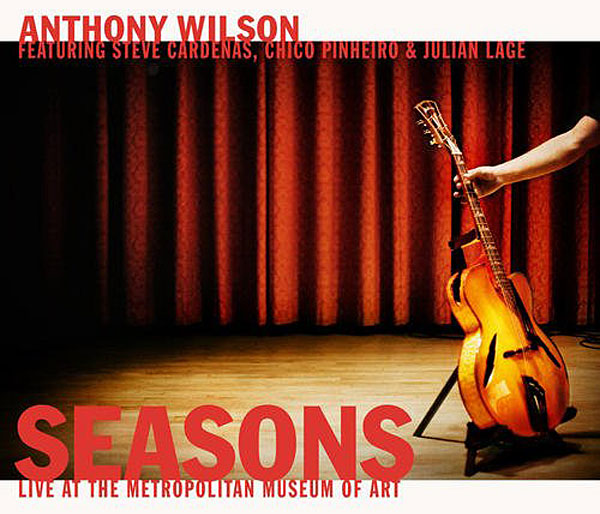
Anthony Wilson: Seasons Anthony Wilson, Steve Cardenas, Julian Lage, Chico Pinheiro, guitars
Goat Hill Recordings 003 (CD/DVD). 2011. Anthony Wilson, prod.; Todd Whitelock, eng.; Damon Whittemore, asst. eng.; Kevin Gray, mastering; George Petit, live sound assistance; Steve Becker, Chris Scarafile, cameras. AAD? TT: 63:35
Performance ****½
Sonics ****½

Halfway into the interview in his management company's offices, as Steve Earle literally squirmed in his seat, I got the distinct impression that he had somewhere else to go, something more important to do. Turned out he was anxious to get to the Metropolitan Museum of Art to see the exhibition Guitar Heroes: Legendary Craftsmen from Italy to New York. Suddenly, instead of talking about his career, he was rhapsodizing about the jazz-guitar luthiers—John D'Angelico and James D'Aquisto—whose work was being exhibited, and a display that featured one of the four guitars known to have been made by Antonio Stradivari.

Recording of March 1988: Wagner: Lohengrin

Wagner: Lohengrin
Placido Domingo, Lohengrin; Jessye Norman, Elsa; Eva Randova, Ortrud; Siegmund Nimsgern, Telramund; Hans Sotin, Heinrich; Dietrich Fischer-Dieskau, Heerrufer; Vienna State Opera Chorus; Georg Solti, Vienna Philharmonic Orchestra
London 421 053-1 (4 LPs), 421 053-2 (4 CDs). James Lock, John Pellowe, engs.; Christopher Raeburn, prod. DDD. TT: 222:54

It's always surprised me that Lohengrin, Wagner's most awkward, transitional, and static opera, was, for its first 100 years, his most popular. It didn't help, I suppose, that I began my study of things darkly Teutonic with The Ring and Tristan, working forward and backward from there. In Lohengrin we can hear the last reluctant pullings away from operatic conventions—especially choral—of the first half of the 19th century, and the gropings toward full-blown musikdrama—especially in Act II, scene i.

Recording of February 2012: Dusty in Memphis

Dusty Springfield: Dusty in Memphis
Atlantic/Analogue Productions APP 8214-45 (two 45rpm LPs). 1969/2011. Jerry Wexler, Tom Dowd, Arif Mardin, prods.; Ed Kollis, eng.; Kevin Gray, 45rpm mastering. AAA. TT: 76:40
Performance *****
Sonics *****

Coaxing a singer to "stretch" always sounds like a good idea—that is, until the singer is standing in the same recording booth used by Aretha Franklin and Wilson Pickett, and suddenly her confidence, never brimming to start with, drops through the floor and she can't or won't sing a note. Add to this that Dusty Springfield was already a sticky perfectionist who'd self-produced most of her records and wasn't happy with the songs to be recorded—despite the fact that most of them were straight out of the Brill Building—and you have the recipe for an all-time classic record, right?

Recordings of April 1988: The First Colossus Recordings

Beethoven: Sonata No.32, Op.111; Sonata No.21, Op.53 ("Waldstein")
Tibor Szasz, piano
Bainbridge BCD-6275 (CD). Leo de Gar Kulka, eng. & prod. DDD. TT: 58:03

Mozart: Piano Concerto No.13, K.415; Overture to Lucio Silla, K.135
Jeremy Menuhin, piano; George Cleve, 1987 Midsummer Mozart Festival Orchestra
Bainbridge BCD-6273 (CD). Leo de Gar Kulka, eng. & prod. DDD. TT: 36:58

Prokofiev: Alexander Nevsky, Lieutenant Kije
Andre Previn, Los Angeles Philharmonic
Telarc CD-80143 (CD). Jack Renner, eng.; Robert Woods, prod. DDD. TT: 63:37

Rachmaninov: Sonata for Cello and Piano, Op.19
Steven Kates, Montagnana cello; Carolyn Pope Kobler, Bösendorfer piano
Bainbridge BCD-6272 (CD). Leo de Gar Kulka, eng. & prod. DDD. TT: 40:42

The Sounds of Trains, Vols.1 & 2*
Bainbridge BCD-6270, -6271* (CDs). Brad Miller, eng. & prod. DDD. TTs: 60:45, 50:14*

If you read my article in these pages about recording the Cumbres and Toltec Scenic Railway steam trains (January 1987, Vol.10 No.1), you may recall the mention of Colossus. Colossus is the name of a new digital recording system which designer Lou Dorren claims to be different from every other digital system in several ways, none of which has ever been disclosed to us. I had a chance to listen to some tapes made on it shortly after writing the C&TSRR article, but since they were made with a completely unfamiliar microphone (Mobile Fidelity Productions of Nevada's own design) and featured mainly the sounds of trains, airplanes, and other sources of potential ear damage, I couldn't really tell anything about the recording system, except that it had the kind of low end I expect from any respectable digital audio. A sonic evaluation had to wait until I heard Colossus on more familiar terms—that is, with music recordings. Now, that time has come.

Recording of January 2012: Bad As Me

Tom Waits Bad As Me
Anti- 87151-1 (LP). 2011. Tom Waits, Kathleen Brennan, prods.; Julianne Deery, prod. coord.; Karl Derfler, eng.; Zack Summer, asst. eng. ADA? TT: 44:37
Performance *****
Sonics ****½

They only come out at night. Or when recession, wars, and gridlock rule. On Bad As Me, Tom Waits's first record of new material since 2004's Real Gone, things having gone bad all over gives his uniquely American narratives a fresh resonance: "Well we bailed out all the millionaires / they got the fruit, we got the rind / and everybody's talking at the same time / everybody's talking at the same time." ("Talking at the Same Time"). But lest anyone get the idea it's all politics and no licentiousness, the next track, "Get Lost," dives deep into loopy rockabilly slap beats as two of the three stellar guitarists who dominate this album, Marc Ribot and David Hidalgo (Los Lobos), conjure a twitchily convincing froth over which Waits revels in the simpler pleasures of Wolfman Jack and "real tight sweaters."

Joint Recordings of May 1988: Get Rhythm & Bring the Family

Ry Cooder: Get Rhythm
Warner Bros. 25639 (LP). Ed Cherney, eng.; Ry Cooder, prod. TT: 40:43
John Hiatt: Bring the Family
A&M SP5158 (LP). Larry Hirsch, eng.; John Chelew, prod. TT: 45:26

There are a few white men in American music—Delbert McClinton, Jerry Jeff Walker, John Fogarty, Van Morrison, Joe Ely, and Steve Earle all come to mind—whose music is consistently true, believable, honorable, and unpretentious. Ry Cooder has been one of those names since his solo debut in 1970; with Bring the Family, John Hiatt's must now be added to the list.

Bring the Family is what Robbie Robertson's overrated new album should have been (sorry, Gary Krakow): simple, strong, mature, its feet rock-solid on the ground. "Thing Called Love," in fact, sounds much like the album The Band might have made between The Band and Stage Fright.

Recording of December 2011: All We Are Saying . . .

Bill Frisell All We Are Saying . . .
Bill Frisell, guitar; Jenny Scheinman, violin; Greg Leisz, pedal steel guitar; Tony Scherr, bass; Kenny Wollesen, drums
Savoy Jazz SVY17836 (CD). 2011. Lee Townsend, prod.; Adam Blombert, prod. asst.; Adam Munoz, eng.; Greg Calbi, mastering. AAD? TT: 68:12
Performance ****
Sonics *****

How do you escape the pressures that come with making a record of well-known John Lennon tunes, many of them from archetypal Beatles songs? Convene a quartet of longtime bandmates, each a skilled instrumentalist with whom you've played this material before—albeit not in a while—and just hang loose, let the ideas flow, and jam up beautifully recorded, feel-no-heat-from-the-classic-originals versions whose rough charms somehow seem exactly right. Oh yeah, and bring in pedal-steel wizard Greg Leisz to put an evocative, legato tang on the whole thing.

Advertisement
Advertisement
Advertisement