

Audience ClairAudient The One loudspeaker

As the years pass and I turn into a crotchety old man, I'm reminded of those old TV ads for the Honda Accord: "Simplify." Even though I now have more things going on than at any other point in my life, I try to eliminate complications everywhere I can. I now can't believe that, for over 15 years, I used the Infinity RS-1B as my reference loudspeaker. Sure, I loved itthe RS-1B was the first speaker I'd owned that produced a wide, deep soundstage, the full dynamic range of an orchestra, and bass extension down to 25Hz. But it was ridiculously complex: a five-way design with three different driver types and a servomechanism for the woofers. It also required biamplificationI got the best sound with a combination of high-powered tube amp and high-current, solid-state amp.


 Silicon Valleybased Velodyne was founded in 1983 to develop a range of subwoofers that used servo-control to reduce non-linear distortion to vanishingly small levels. They succeeded in this goal to the extent that Velodyne is now perhaps the best-known subwoofer company in the US, currently employing 65 people. At the 1994 Winter CES, Velodyne launched the subject of this review: the DF-661 ($1800$2600/pair), their first full-range loudspeaker (the "DF" stands for "Distortion-Free").
The three-way DF-661 was designed from the ground up to continue the Velodyne tradition of ultra-low distortion. "We had developed the technology and resources to attack distortion elsewhere in the audio chain," wrote company President David Hall, "and started with the premise that, by definition...distortion in loudspeakers is wrong." (His italics.) "We went to the laboratory for a solution, with the living room as the ultimate goal." Velodyne calls this attention to technological detail "The Silicon Valley approach to sound."
Silicon Valleybased Velodyne was founded in 1983 to develop a range of subwoofers that used servo-control to reduce non-linear distortion to vanishingly small levels. They succeeded in this goal to the extent that Velodyne is now perhaps the best-known subwoofer company in the US, currently employing 65 people. At the 1994 Winter CES, Velodyne launched the subject of this review: the DF-661 ($1800$2600/pair), their first full-range loudspeaker (the "DF" stands for "Distortion-Free").
The three-way DF-661 was designed from the ground up to continue the Velodyne tradition of ultra-low distortion. "We had developed the technology and resources to attack distortion elsewhere in the audio chain," wrote company President David Hall, "and started with the premise that, by definition...distortion in loudspeakers is wrong." (His italics.) "We went to the laboratory for a solution, with the living room as the ultimate goal." Velodyne calls this attention to technological detail "The Silicon Valley approach to sound."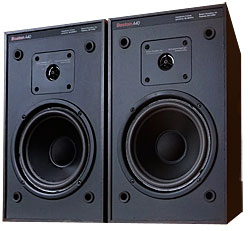 The Boston Acoustics A40 loudspeaker ($150/pair) has become "legendary" (ie, it's stayed around for a while), probably because a pair of them images as well as

 I know, I know"NOT ANOTHER $%#$ SONUS $%#$# FABER REVIEW IN $%#$# Stereophile!!" In just the past two years or so alone we've spilled a pretty fat bottle of ink on this Italian speaker line: Martin Colloms reviewed the $12,500/pair Extrema (