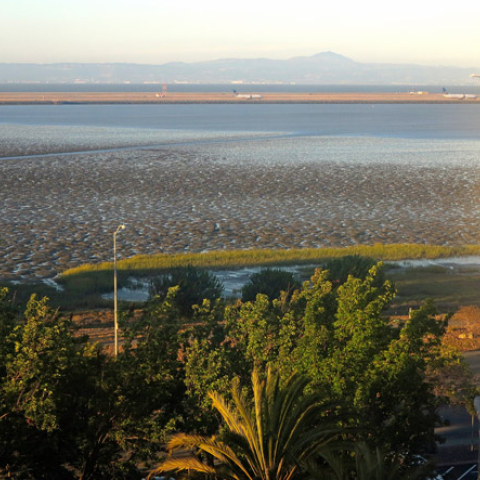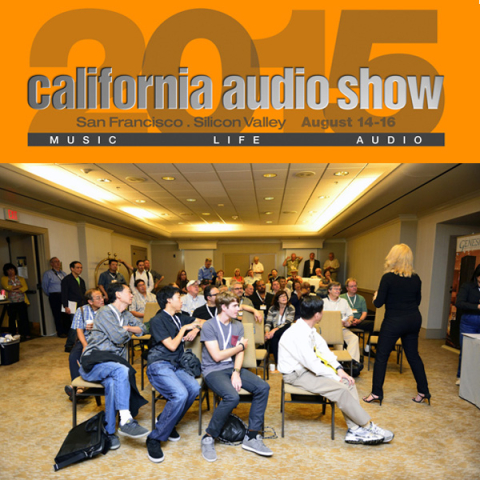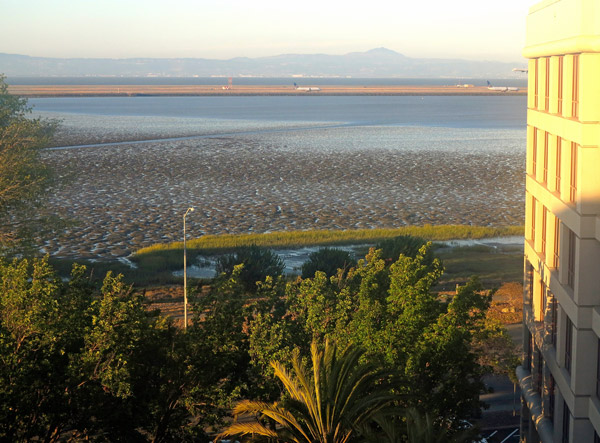
The California Audio Show may have been smaller than in years past, but its proportion of excellent sounding systems—6 out of 32 or so, if you count exhibit rooms that had more than one system in play—was quite high. For this reason alone, I believe the show offered great value for attendees. And it also offered some great views of San Francisco International Airport, as this shot, taken through my 7th-story hotel window, attests.
Here is the word on show attendance from show organizer, Constantine Soo:
The final number is 2300 attendees.
This year, with PonoMusic helping us spread the word, attendees came out in troves. We have long wanted to capture the Millennials in the Bay Area, and the sponsorship of PonoMusic made it a reality.
Next year, we will continue on our success and double our efforts to bring more new blood in. We hope to hit the 4000 attendees mark.
Back to me. Despite the large proportion of excellent sounding systems, the absence of participation by many major local dealers, including, for starters, Music Lovers Audio of San Francisco and Berkeley, Audio High of Mountain View, AVS Marin, and Tone of Music in San Francisco, was lamentable. Equally MIA, except perhaps in passing (eg a Clearaudio cartridge or Shunyata Hydra), were a host of major and lesser known brands, not the least of which were Wilson, VTL, VAC, Focal, Soulution, TAD, PS Audio, Synergistic Research, Shunyata (except in passing), Parasound, Emotiva, KEF, Vandersteen, Bowers & Wilkins, Sony, Ayre, dCS, Harbeth, Aesthetix, AudioQuest, Grand Prix, Vivid, Clearaudio, MBL, MSB, McIntosh, Kubala-Sosna, Emerald Physics, WyWires, Zesto, Rockport, Paradigm, Transparent, Von Schweikert, and many more whose owners and manufacturers are now feeling slighted and contemplating angry emails to John Atkinson.
Even though not all major and trend-setting brands are available in Bay Area dealerships, by a long shot, they often find their way to shows, regardless of local representation. In this case, a host of dealers and manufacturers did not feel impelled to haul their gear to Millbrae. Which means that CAS's particular snapshot of our industry, while of great value, was nonetheless narrowly focused and somewhat incomplete. (I regret that I could not cover the small Headmasters assemblage, which provided another valuable, albeit incomplete, snapshot of our industry.)
Everyone hopes that audio shows will attract new, potential audiophiles and give our industry a boost. In that regard, I was delighted to discover, among Friday's attendees, George Oaker, whose email address, operaphile@..., will give you a sense of where his heart lies. George not only took at least one of my "Voices to Die For" classes at Osher Lifelong Learning at UC Berkeley, but also showed up frequently at the opera and song recitals I reviewed before we fled East Oakland, CA for Port Townsend, WA.
After the show, George sent the following report about his sole day at the show:
Ah, a multiplicity of impressions! I have two primary ones. In one of the very first rooms I visited, I heard the Tannoy Westminster Royal Gold Reference. I was extremely taken, not by any of the usual aspects that I commonly see in reviews, but simply in the fact that the sound seemed to have no trouble at all getting out of the speakers. The music was dramatically "easy," effortless, and spacious. It reminded me of the few times that I got to hear Luciano Pavarotti live at San Francisco Opera. It was as if all he had to do was to open his mouth, and all this glorious sound poured forth, seemingly without effort. When I saw the price, $40,000/pair, I was hardly surprised. At that price, it had better sound extraordinarily fine.
The other primary experience is from the other end of the price spectrum. The tiny little $395/pair Serene Talisman speakers had a clarity that was simply amazing for their size and their price point. I'm going to order a pair, along with a Fostex volume control (which includes a 24/96 DAC) so that I can have a volume control next to my keyboard rather than on the back side of the speaker.
As I wandered through the show, I was mostly quite pleased with what I heard, but it got to the point of "Yes, another fine speaker, but nothing surprising." Well, the Kharma Elegance was a cut above the crowd, as was the Lansche plasma speaker.
But the question kept nagging me: I heard music; I attributed it to the speakers. But behind the speakers were a cartridge, a tonearm, a turntable, a preamp, a power amp, and various cables-not to mention the original source disc. How much of what I was hearing could I attribute to each component? I have no idea. The Tannoys were being driven by nearly $100,000 worth of amplification. What would they sound like when mated to substantially more modest electronics?
I was curious about the manufacturers who chose to exhibit at the show. I saw remarkably little in the way of brand names that I had even heard of. It was gratifying to see so many rooms using the Oppo player, as I treated myself to one recently. Perhaps a show is an effective way for a startup to get its name in front of the public.
It was interesting to see The Tape Project, with its 15ips ½-inch tape. That got me to wondering: how does the price of an exceptional tape recorder compare to the sky-high prices that I see for turntables, tonearms, and cartridges? http://tapeproject.com/ was no help.
Musically, I didn't hear much classical, though I heard more than I expected to—but no opera. I neglected to bring along a disc of my own.
Overall, quite an enjoyable and informative day.
Even if some of my observations may differ from George's, I believe his report is exceptionally valuable. Not only does it make absolutely clear that CAS was a worthwhile experience for a first-timer, but that it also led him to make a purchase. It also suggests that a daily "Newcomers to the High-End Orientation," led by a combination of press and industry, might prove of supreme importance. It's not that I don't think that Ask the Editors and other panels are worthwhile—I love being on them, and valuable stuff always comes out—but I do sense that the nature of questions asked by veteran audiophiles often intimidates first-timers. Newbies need a 101 all their own. Come to think of it, it's something I'd love to offer.
Speaking of seminars, the line-up at CAS6 was tops. Nelson Pass (see separate report), Andrew Jones, Bob Hodas, Keith O. Johnson, Mark Waldrep, and others from PureAudioProject/Mundorf, High Fidelity Cables, LRE Audio, and ASC gave presentations. Of special interest were seminars on music and healing and room acoustic measurement by Dr. Craig Allison and Nyal Mellor. The Digital Audio seminar included Cookie Marenco, Brian Zolner, and a representative from Oppo/Pono Music. I can't comment on the two entertainment offerings, because I missed them, but they sure looked enticing on paper.
But questions still remain. What if CAS moved to September, when so many people are back from vacation, and students are in town? Would it also benefit by switching locations to downtown San Francisco, which lies central to the Bay Area? Might either or both of those switches mean that lots more people would attend, and many more potential audiophiles of all ages would discover the high-end for the first time?
Finally, would either of those major changes convince more dealers to participate? (One reason that dealers skipped this show is because they did not believe that all the money and effort they had to spend to exhibit would pay off in sales.) True, a switch to a Big City hotel does not mean that rooms will sound better, but it almost certainly means higher prices for exhibitors. Nonetheless, showing in San Francisco does afford a level of prestige that, bless its semi-Silicon heart, a Millbrae location, even one accessible by both freeway and BART, does not.
Stereophile's job at shows, however, is not prognostication, but critical observation. In this respect, I honestly feel that this was a very good show, and deserving of our and your attention. I'd love to hear what more attendees think. The Comments section is open to one and all.

Chance encounters—seen in the corridor (left-to-right): Reference Recordings' Keith O. Johnson, Bricasti's Brian Zolner, and show organizer Constantine Soo.