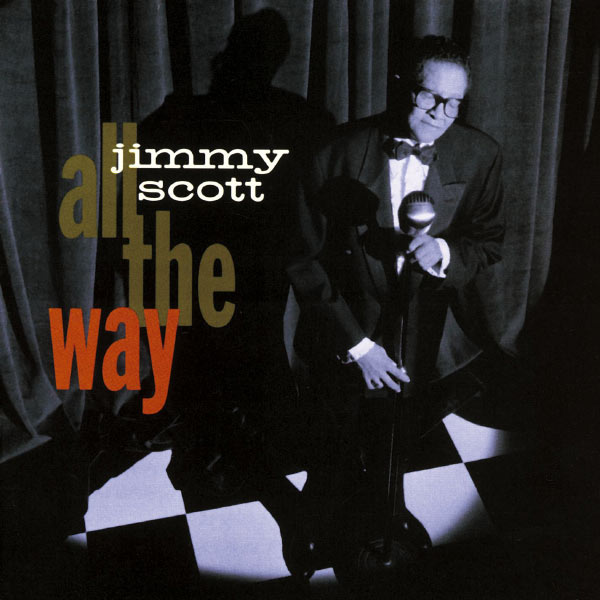
In 1992, a good friend in the record business, Bill Bentley of Warner Bros. Records, called to tell me that he was part of ongoing machinations to make a new record with Jimmy Scott. The singer who everyone assumed was dead—he was in Cleveland working on a loading dock—had just stunned the music world by turning up at Doc Pomus' funeral and launching into an impromptu vocal performance. A mini bidding war ensued and soon Jimmy was signed to Seymour Stein’s Sire Records. Bentley was enthused because for the first time in his career, Jimmy, who pronounced the word “album” as “ablum,” was gonna make an ablum with A list sidemen and top shelf material. The resulting session, All The Way remains one of the spookiest, sexiest jazz vocal records ever made. I bought a box of 24 and gave them out for Christmas that year. Within days, eight friends, most of the non musical variety, were breathless to know who or what the hell this was?
Scott had Kallmann’s disease, which means that although he went through puberty and everything else associated with that happened naturally, his voice never changed and so he had an unnaturally high voice for a man. When he sang, his big hands and the way he moved them, wringing every drop of emotion from a tune, were an integral part of the show. Add to all that the fact that he was a natural at slowly pulling songs in unexpected directions like they were so much taffy and you have a vocalist like no other. No one could re–make standards like “Embraceable You,” or “Over the Rainbow” like Jimmy. Sadly, Scott who outlived all his contemporaries like Charlie Parker by decades and was still giving credible performances well into his 70’s, passed on Friday at the age of 88.
After that long ago call from Bentley I leapt into action and ended up doing several magazine pieces on Scott and his comeback, the most memorable being one for the now–defunct Pulse Magazine (the house mag of Tower Records),who sent me to San Francisco where I sat in the front of the New Orleans Room of the Fairmont Hotel and wept through the entire performance. As David “Fathead” Newman, who was part of All The Way once said to me, “No one does sad like Jimmy Scott.” His way with pathos came from deep inside. Harassed and tormented because of his voice, his diminutive stature and his, and I don’t mean this in a cruel way, odd look, Jimmy had a hard life. An epic tangle with Savoy Records and its infamous owner, Herman Lubinsky, rightly embittered him towards the music business. His shall we say “colorful” history with women scarred him in other ways. And seeing his mother killed, her arm ripped off by a drunk driver in his hometown of Cleveland, was a wound that I suspect never healed. Like most great artists, he had his dark sides: hiring and firing folks who had his best interests at heart, and needlessly and to the detriment of his career, burning out quality sidemen.
And yet, Jimmy was a sweetheart and a genuine card. Over the years, I had the chance to write about the singer and hang out with him a number of times. His big grin and wheezy laugh were unforgettable. A sip of dark firewater and he was off on a tale about some night long ago on 52nd Street. On one occasion, after the big hug and obligatory “Hey Baby,” he tried to borrow $20. Failing that he asked me to go get him cigarettes. Before I could answer, he was laughing, trying to give me another hug. Once when I introduced him to my mother backstage at Birdland in NYC, he unexpectedly grabbed her and planted a big, sloppy kiss on her mouth.
Until the very end, his singing moved me—and a lot of other folks—in ways no other singer has or ever will. Thanks to a spate of recent recordings, that voice will live forever. And despite the persistent nickname, there was nothing little about this man, this truly great artist. Jazz has lost a true giant. Vaya con Dios Jimmy Scott!