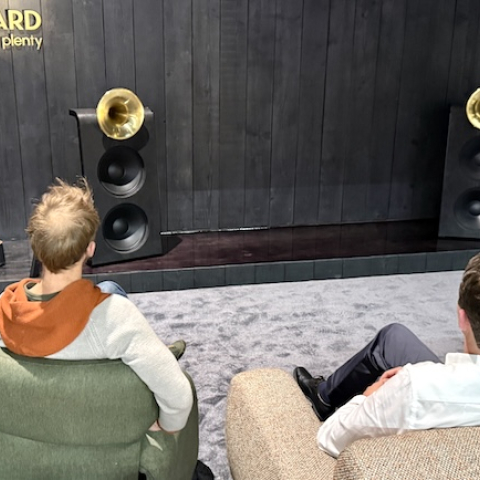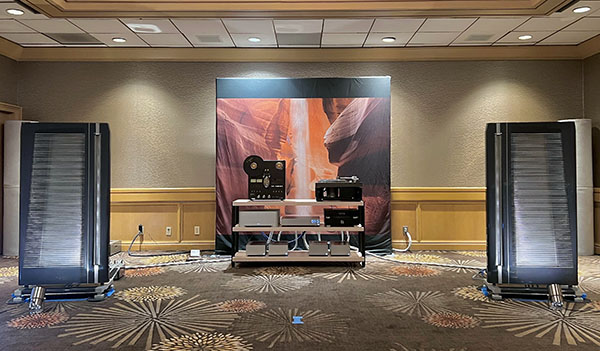
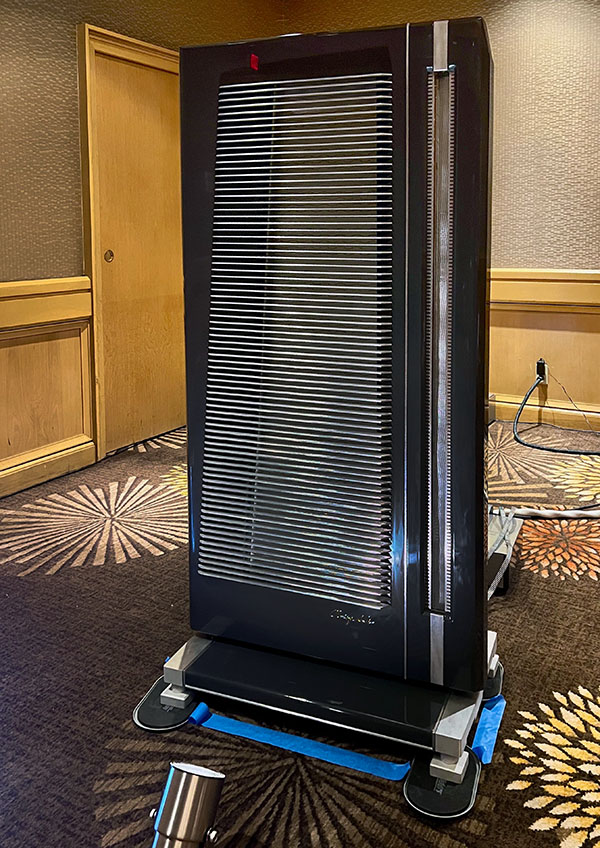
The large Balboa II room at T.H.E. Show in SoCal demo'd a system designed around a pair of Clarisys Audio Studio Plus speakers ($69,000/pair) driven by two pairs of WestminsterLab Rei monoblock class-A amplifiers ($37,900/pair) run in bridged mode, ahead of which was a WestminsterLab Quest balanced preamplifier ($27,900).
A pair of Von Schweikert Foundation 15 subwoofers ($23,000/each) were deployed to correct bass nodes within the room, according to information supplied by the Audio Café.
Digital sources included a Lampizator Horizon DAC (NFS) and a Taiko Audio Olympus music server/streamer ($95,000) paired with a Taiko Audio Extreme Router ($7500).
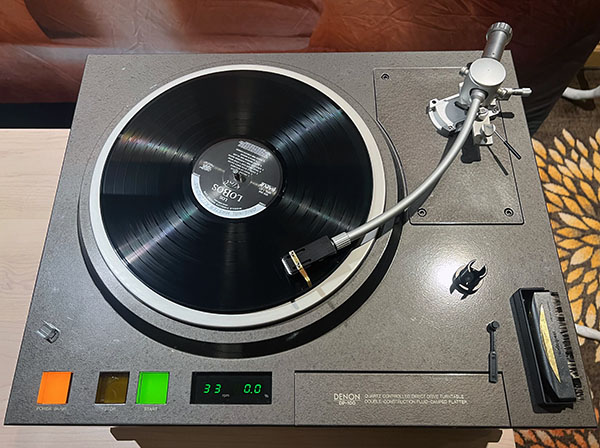
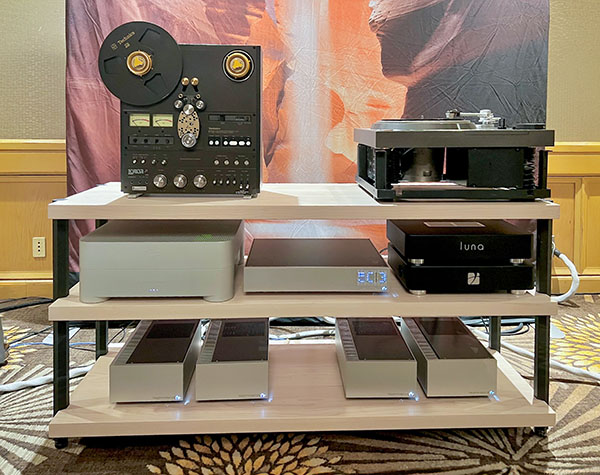 On the analog side, a classic Technics RS-1500 reel-to-reel tape deck was on hand (and not for sale), as was a vintage Denon DP-100M turntable, a pro-audio-focused quartz-controlled direct-drive 'table with a high-torque motor designed for Denon's disc-cutting lathes, a "double-construction fluid-damped platter," and a sprung suspension apparently designed by VPI.1 Resnick said that only 120 DP-100Ms were made, in the late 1970s and very early 1980s. A GrooveMaster tonearm was in place on its plinth, and an an Oasis MCX-3 MC cartridge was attached to the end of the GrooveMaster. The signal from the Oasis was fed into a Trafomatic Luna tubed phono stage ($19,900).
 The Clarisys planar speakers' bipole arrays use a pair of aluminum treble and midrange ribbons in a back-to-back configuration handling from 275Hz and up. The bass ribbon array provides deeper bass than seemed possible. The speakers use an external passive crossover (which can be fine-tuned), with Mundorf capacitors, air-core inductors, and copper foil wiring.
 On A Delicate Motor's "Do for Self," deep, I was struck by the substantial bass as well as realistic timbre on piano and vocal harmonies. The soundstaging stood out on such tracks laske "Linea," from Berio Conducts Berio with the London Sinfonietta, played by the Labèque sisters (Katia and Marielle) early in their careers. The images of the two pianos seemed realistic, as did transients—specifically the sense of hammers real hammers striking real strings with varying force and impact. The sense of openness provided in planar speakers is something special. Here it was holographic without skimping on low end the way many planars do.
Footnote 1: According to Art Dudley's Listening #108, "a spring-loaded isolation base for Denon's top-end models was among the very first products made by the contemporary American turntable company VPI."
On the analog side, a classic Technics RS-1500 reel-to-reel tape deck was on hand (and not for sale), as was a vintage Denon DP-100M turntable, a pro-audio-focused quartz-controlled direct-drive 'table with a high-torque motor designed for Denon's disc-cutting lathes, a "double-construction fluid-damped platter," and a sprung suspension apparently designed by VPI.1 Resnick said that only 120 DP-100Ms were made, in the late 1970s and very early 1980s. A GrooveMaster tonearm was in place on its plinth, and an an Oasis MCX-3 MC cartridge was attached to the end of the GrooveMaster. The signal from the Oasis was fed into a Trafomatic Luna tubed phono stage ($19,900).
The Clarisys planar speakers' bipole arrays use a pair of aluminum treble and midrange ribbons in a back-to-back configuration handling from 275Hz and up. The bass ribbon array provides deeper bass than seemed possible. The speakers use an external passive crossover (which can be fine-tuned), with Mundorf capacitors, air-core inductors, and copper foil wiring.
On A Delicate Motor's "Do for Self," deep, I was struck by the substantial bass as well as realistic timbre on piano and vocal harmonies. The soundstaging stood out on such tracks laske "Linea," from Berio Conducts Berio with the London Sinfonietta, played by the Labèque sisters (Katia and Marielle) early in their careers. The images of the two pianos seemed realistic, as did transients—specifically the sense of hammers real hammers striking real strings with varying force and impact. The sense of openness provided in planar speakers is something special. Here it was holographic without skimping on low end the way many planars do. Footnote 1: According to Art Dudley's Listening #108, "a spring-loaded isolation base for Denon's top-end models was among the very first products made by the contemporary American turntable company VPI."