Sidebar 3: Measurements
I measured the AudioQuest DragonFly Cobalt with my Audio Precision SYS2722 system (see the January 2008 "As We See It"). I performed a full set of tests with WAV and AIFF test-tone files played with Pure Music 3.0 on my MacBook Pro running on battery power, and on my iPhone 6S using a Lightning to USB adapter.
A Drok USB tester (footnote 1) indicated that with no signal being passed, the Cobalt drew 50mA of current from the host's USB port, compared with the Red's 30mA. (Both measurements are ±5mA.) So while the Cobalt's microcontroller chip draws less current than that of the Red, overall the new DAC is a little more hungry for power.
Apple's USB Prober utility identified the DragonFly as "AudioQuest DragonFly Cobalt v1.0" from "AudioQuest" with the serial number string "AQDFCB0101003766." The USB port operated in the optimal isochronous asynchronous mode, and Apple's AudioMIDI utility revealed that the Cobalt accepted 24-bit integer data sampled at all rates from 44.1 to 96kHz. The Cobalt's maximum output levels at 1kHz into a high 100k ohm load was 2.16V, compared with 2.04V for the DragonFly Red and 1.19V for the Black. The Cobalt preserved absolute polarity (ie, was noninverting), and like the Red and Black offered a very low output impedance of 1 ohm. (I measured 0.45 ohm from 20Hz to 20kHz, but the margin of error with this method of estimating output impedance is large with low impedances, so safer to say 1 ohm.)
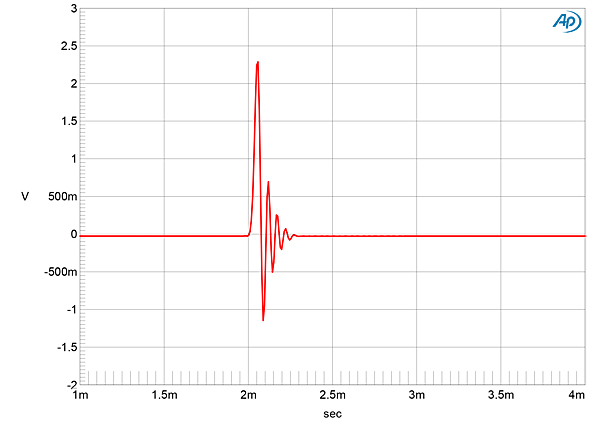
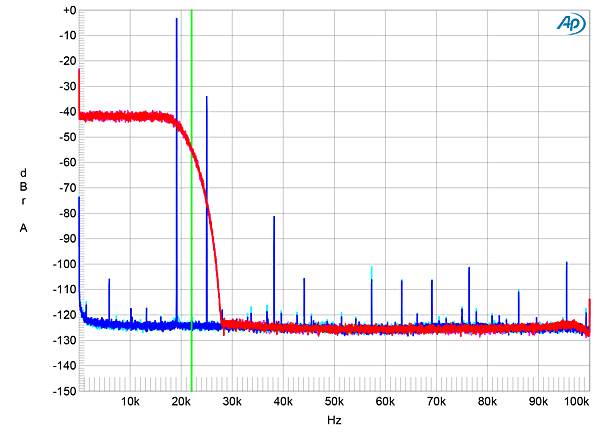
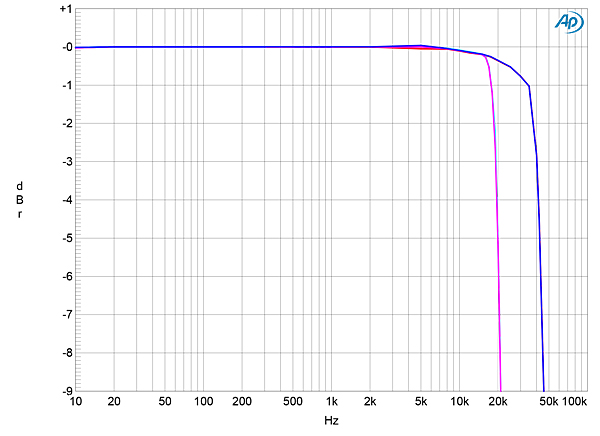
Fig.1 shows the DragonFly Cobalt's impulse response with 44.1kHz data. Whereas the Red's and Black's impulse response was typical of a minimum-phase reconstruction filter, with a fairly large amount of ringing following the single full-scale sample (footnote 2), the Cobalt's impulse response is a short minimum-phase type, similar to but not quite as short as the "Listen" filter used in Ayre's Digital processors (footnote 3). Like all short filters, the ultrasonic rolloff starts in the top octave of the audioband (fig.2, magenta and red traces) and reaches full stop-band attenuation at 28kHz. The aliased image at 25kHz of a full-scale tone at 19.1kHz (cyan, blue) was suppressed by 34dB compared with the Red's >110dB. Like the DragonFly Red, the harmonics associated with the 19.1kHz tone all lie below –80dB. Fig.3 shows the Cobalt's frequency response with data sampled at 44.1 and 96kHz. With 44.1kHz data, the rolloff reaches –0.2dB at 15kHz and –3dB just below 20kHz. Not only is this not a very large "area under the curve," but that area is also in a region where human hearing sensitivity is significantly reduced compared with frequencies below 15kHz. I doubt that this rolloff will be audible.
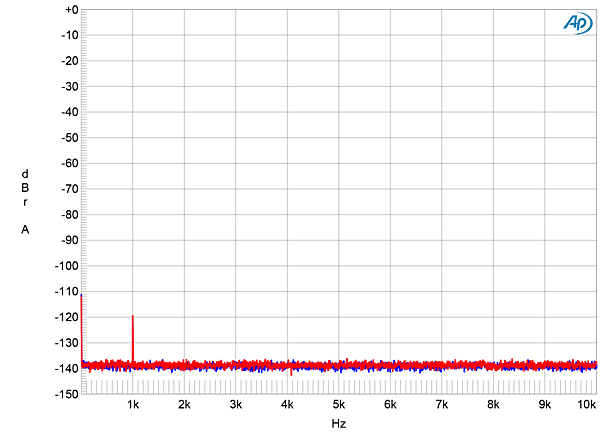
 Channel separation at 1kHz was very good, at 87.4dB R–L and 90.2dB L–R, decreasing to 81.9 and 85.6dB, respectively, at 20kHz. An increase in bit depth from 16 to 24, with dithered data representing a 1kHz tone at –90dBFS, dropped the Cobalt's noise floor by 10dB (fig.4), suggesting a resolution of almost 18 bits, which is good for a USB-powered DAC. The Cobalt readily resolved a tone at –120dBFS (fig.5). When I played undithered data representing a tone at exactly –90.31dBFS, the waveform was symmetrical, with a negligible 25µV DC offset, but the three DC voltage levels described by the data were obscured by high-frequency noise (fig.6).



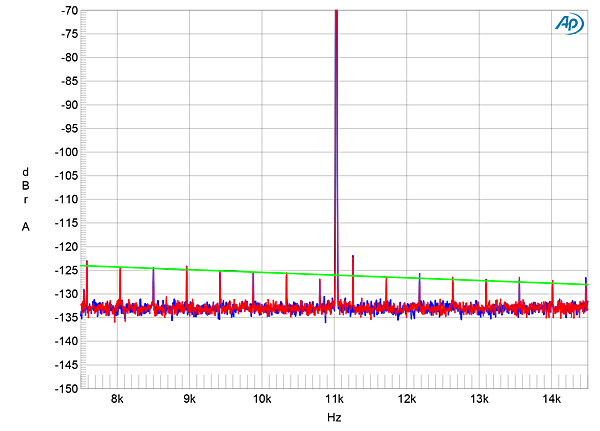
 The DragonFly Cobalt offered low levels of intermodulation distortion when reproducing an equal mix of 19 and 20kHz tones at –3dBFS into 300 ohms (fig.11), the difference tone at 1kHz lying close to –90dB (0.003%). However, the slow rolloff of the reconstruction filter means that the aliased images of the 19kHz and 20kHz tone were only suppressed by 24dB or so. The DragonFly Cobalt offered excellent rejection of word-clock jitter. Fig.12 shows the spectrum of the Cobalt's output when it was fed high- level 16-bit J-Test data. Other than the sidebands at ±229.7Hz, all the odd-order harmonics of the undithered low-frequency, LSB-level squarewave lie at the correct levels and there are no other sideband pairs visible. The spectrum with a 24-bit J-test signal was clean.

 Overall, AudioQuest's DragonFly Cobalt performed well on the test bench.—John Atkinson
Footnote 1: Props to reader Archimago for making me aware of this useful device's existence. Footnote 2: See fig.1 here. Footnote 3: See fig.1 here.
Fig.1 AudioQuest DragonFly Cobalt, impulse response (one sample at 0dBFS, 44.1kHz sampling, 3ms time window).
Fig.2 AudioQuest DragonFly Cobalt, wideband spectrum of white noise at –4dBFS (left channel red, right magenta) and 19.1kHz tone at 0dBFS (left blue, right cyan) into 100k ohms with data sampled at 44.1kHz (20dB/vertical div.).
Fig.3 AudioQuest DragonFly Cobalt, frequency response at –12dBFS into 100k ohms with data sampled at: 44.1kHz (left channel cyan, right magenta), 96kHz (left blue, right red) (1dB/vertical div.).
Fig.4 AudioQuest DragonFly Cobalt, spectrum with noise and spuriae of dithered 1kHz tone at –90dBFS with: 16-bit data (left channel cyan, right magenta), 24-bit data (left blue, right red) (20dB/vertical div.).
Fig.5 AudioQuest DragonFly Cobalt, spectrum with noise and spuriae of dithered 1kHz tone at –120dBFS with 24-bit data (left channel blue, right red) (20dB/vertical div.).
Fig.6 AudioQuest DragonFly Cobalt, waveform of undithered 1kHz sinewave at –90.31dBFS, 16-bit data (left channel blue, right red).
The Cobalt produced low levels of harmonic distortion with the high 100k ohm load (fig.7), with the subjectively benign second harmonic the highest in level. However, the DragonFly will primarily be used with headphones that have impedances as low as 20 ohms. As I had found with the Red, I had to reduce the signal level to –3dB, 1.53V, with a 300 ohm load to avoid clipping the output (fig.8; the bottom halves of the waveform were clipped). The DragonFly overloaded at the same level into a 50 ohm load (equivalent to an output current of approximately 30mA), and into 30 ohms, I had to lower the signal level to –6dB to reduce the harmonic distortion to an appropriately low level (fig.9). AudioQuest says that 16 ohms is the lowest load with which the DragonFly Cobalt should be used—with 10 ohms, which is close to the minimum impedance of my Ultimate Ear 18 Pro in-ear monitors, the Cobalt's output clipped at levels above –12dBFS (fig.10). It is fair to note, however, that at the highest levels I used with the Ultimate Ears, I didn't hear any distortion.
Fig.7 AudioQuest DragonFly Cobalt, 24-bit data, spectrum of 50Hz sinewave, DC–1kHz, at 0dBFS into 100k ohms (left channel blue, right red; linear frequency scale).
Fig.8 AudioQuest DragonFly Cobalt, 24-bit data, spectrum of 50Hz sinewave, DC–1kHz, at –3dBFS into 300 ohms (left channel red; linear frequency scale).
Fig.9 AudioQuest DragonFly Cobalt, 24-bit data, spectrum of 50Hz sinewave, DC–1kHz, at –6dBFS into 30 ohms (left channel red; linear frequency scale).
Fig.10 AudioQuest DragonFly Cobalt, 24-bit data, spectrum of 50Hz sinewave, DC–1kHz, at –12dBFS into 10 ohms (left channel red; linear frequency scale).
Fig.11 AudioQuest DragonFly Cobalt, 24-bit data, HF intermodulation spectrum, DC–30kHz, 19+20kHz at –3dBFS into 300 ohms, 44.1kHz data (left channel blue, right red; linear frequency scale).
Fig.12 AudioQuest DragonFly Cobalt, high-resolution jitter spectrum of analog output signal, 11.025kHz at –6dBFS, sampled at 44.1kHz with LSB toggled at 229Hz: 16-bit USB data sourced from MacBook Pro (left channel blue, right red). Center frequency of trace, 11.025kHz; frequency range, ±3.5kHz.
Footnote 1: Props to reader Archimago for making me aware of this useful device's existence. Footnote 2: See fig.1 here. Footnote 3: See fig.1 here.