Given how many great systems—that's great, not good—I had already encountered in the perpetually pale yellow, beige, and brown rooms on the Westin's 12th, 5th, and 3rd floors, the big question was, would the rest of the 3rd floor, and the other floors I would head to in the day and a half remaining, deliver as many delights? After all, given the variables of hotel room acoustics, noisy and sometimes unreliable power sources, and electronics and cabling whose sound changes as they settle in, it was a near miracle to happen upon as many superb sounding rooms as I had in such a short time period. Would my streak of good fortune continue?
Okay, that does sound a bit melodramatic, or like a come on for the next installment of "A Brighter Day." But let's face it. Unless one has multiple opportunities to revel in great sound at an audio show, going room-to-room becomes a bit like channel surfing. At a certain point, you begin to ask, "What's the point?"
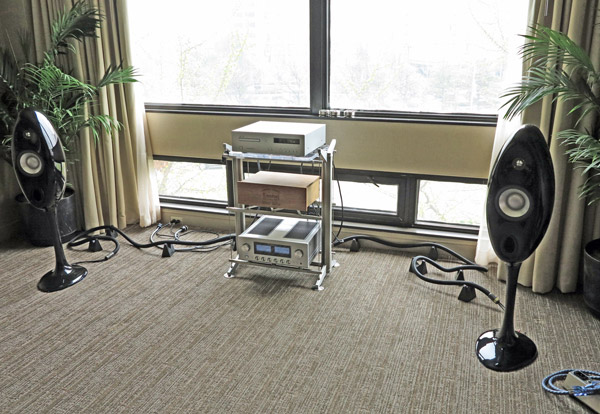
Using Vivid loudspeakers, Richard Rogers of Shunyata and Bruce Jacobs of Stillpoints conducted a very convincing demo in which they began with stock power cables and no room treatment. First, they switched from stock power cables to Shunyata's Venom digital power cable ($395) and Venom High Current power cable ($295). Next, they added Stillpoints Ultra 6 equipment supports under equipment where there had been no supports before.
Finally, they added at least six Stillpoints Aperture acoustic panels to the sidewalls and horribly reflective glass windows behind the speakers. Each change elicited more depth, air, believable timbres, midrange, bass, vibrancy and substantiality to the sound. The changes were cumulative. As the ameliorations were removed, the system returned to its original mono-dimensional, cardboard cut-out, distinctly hifi-ish state.
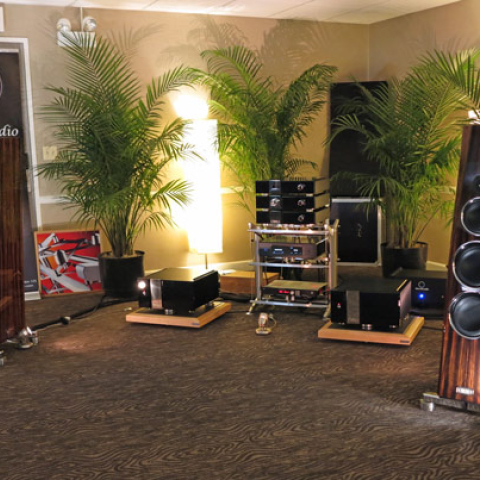
 I entered the extremely large room from HiFi Imports, which was dominated by Polymer Audio's MKS-X loudspeakers ($68,000/pair). The handsome MKS-X has a new crossover, new 5" mid-bass driver with a composite cone made from an alloy designed to emulate the stiffness of diamond, and new side wings. It also has a 0.75" pure-diamond tweeter and 2.1" pure-diamond midrange. Most important, it claims a faster response, sensitivity of 92dB, and impressive in room frequency response of 30Hz—70kHz ±3dB.
Allied with a Weiss Man301 Music Archive network player (without DAC $9083, with DAC $12,262), Thrax Dionysos line level preamplifier ($21,500), Thrax Maximinus 32/384 DAC ($33,000), new Thrax Teres transformer-coupled 250W/8ohm battery biased hybrid power amplifier, and Enklein cables and powercords, the Polymer Audio MKS-X loudspeakers projected a huge, ear-opening soundstage with great depth. On top of that, the notable air around Rachel Podger's baroque violin on Channel Classics' new SACD of Vivaldi's L'Estro Armonico immediately seized attention.
Alas, the speakers suffered from the same pronounced midrange over-emphasis that I have encountered on other occasions. Everything from violin to harpsichord was surrounded by a distinctly artificial midrange halo that robbed music of sparkle and life. Nor did my beloved recording of Sarah Vaughan and the Duke Ellington Orchestra performing Sondheim's "Send in the Clowns" escape a similar fate as Podger and Vivaldi. Which is not to say that the midrange wasn't beautiful in and of itself. It's just that there was far much of it, and in places where it should have naturally and gracefully ceded to other tonalities.
I entered the extremely large room from HiFi Imports, which was dominated by Polymer Audio's MKS-X loudspeakers ($68,000/pair). The handsome MKS-X has a new crossover, new 5" mid-bass driver with a composite cone made from an alloy designed to emulate the stiffness of diamond, and new side wings. It also has a 0.75" pure-diamond tweeter and 2.1" pure-diamond midrange. Most important, it claims a faster response, sensitivity of 92dB, and impressive in room frequency response of 30Hz—70kHz ±3dB.
Allied with a Weiss Man301 Music Archive network player (without DAC $9083, with DAC $12,262), Thrax Dionysos line level preamplifier ($21,500), Thrax Maximinus 32/384 DAC ($33,000), new Thrax Teres transformer-coupled 250W/8ohm battery biased hybrid power amplifier, and Enklein cables and powercords, the Polymer Audio MKS-X loudspeakers projected a huge, ear-opening soundstage with great depth. On top of that, the notable air around Rachel Podger's baroque violin on Channel Classics' new SACD of Vivaldi's L'Estro Armonico immediately seized attention.
Alas, the speakers suffered from the same pronounced midrange over-emphasis that I have encountered on other occasions. Everything from violin to harpsichord was surrounded by a distinctly artificial midrange halo that robbed music of sparkle and life. Nor did my beloved recording of Sarah Vaughan and the Duke Ellington Orchestra performing Sondheim's "Send in the Clowns" escape a similar fate as Podger and Vivaldi. Which is not to say that the midrange wasn't beautiful in and of itself. It's just that there was far much of it, and in places where it should have naturally and gracefully ceded to other tonalities.
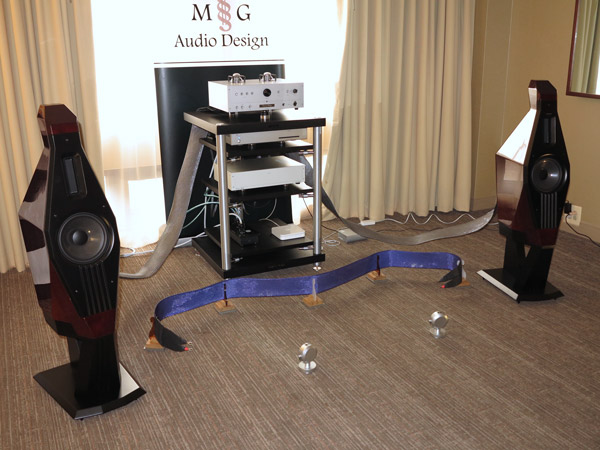 MG P4 Ag speaker cables and interconnects anchored a system that also included Lawrence Violin SE speakers, a new Concert Fidelity integrated amplifier, Weiss Music Server, Concert Fidelity DAC, Krolo stands, and Krolo Music Enhancers. There was too much talking to allow serious evaluation, but what I could catch between words sounded rather sharp and monotone.
 Why do exhibitors insist on leaving out bowls of candy for visitors who inevitably make a racket unwrapping the stuff and then playing with the wrappers whenever the music gets softer? Strike a blow against diabetes and sonic pollution, folks, and leave the crap at home.
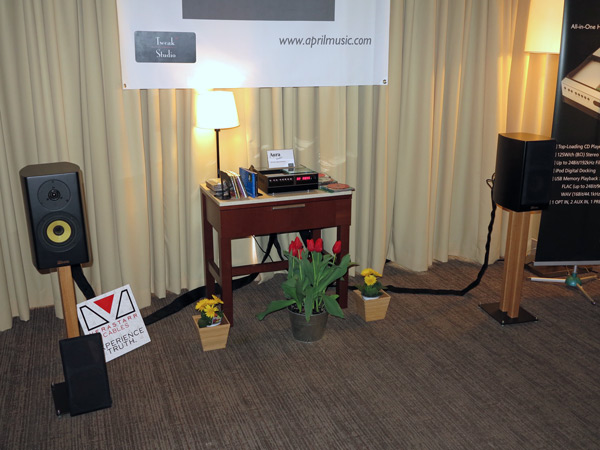
Be that as it may, the combination of the South Korean-made Auranote Version 2 all-in-one high end receiver ($2750), which even includes a tuner, and French Davis Acoustics Olympia One loudspeakers ($2500/pair) in the April Music room produced some really nice sound for a little system. The depiction of an unidentified female vocalist was very clean and enjoyable. Despite a bit of wiriness and ringing on Murray Perahia's piano, there was something compelling about this system that suggests, at low volume at least, it could please many an audiophile.
Why do exhibitors insist on leaving out bowls of candy for visitors who inevitably make a racket unwrapping the stuff and then playing with the wrappers whenever the music gets softer? Strike a blow against diabetes and sonic pollution, folks, and leave the crap at home.
Be that as it may, the combination of the South Korean-made Auranote Version 2 all-in-one high end receiver ($2750), which even includes a tuner, and French Davis Acoustics Olympia One loudspeakers ($2500/pair) in the April Music room produced some really nice sound for a little system. The depiction of an unidentified female vocalist was very clean and enjoyable. Despite a bit of wiriness and ringing on Murray Perahia's piano, there was something compelling about this system that suggests, at low volume at least, it could please many an audiophile.
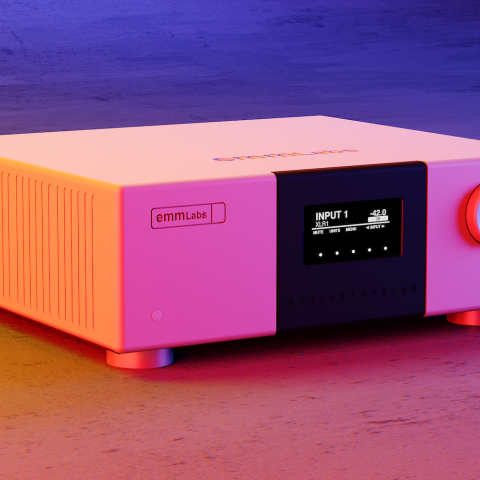
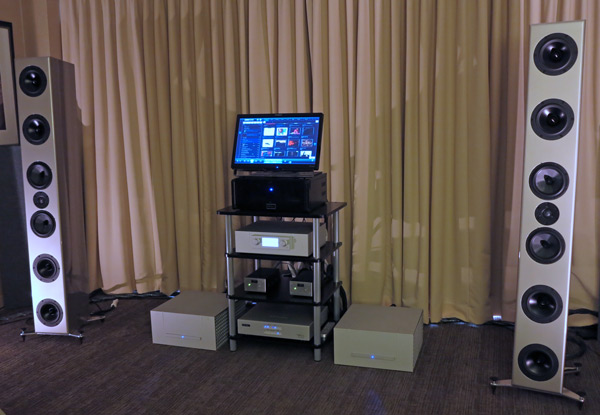 I was excited to begin my tour of the 4th floor with a visit to the room dominated by Endeavor Audio's enthusiastically received and newly tweaked E-5 reference loudspeakers ($35,000/pair) and Constellation Audio's equally lauded Inspiration Series Mono 1.0 amplifiers ($10,000/each) and Inspiration Series preamp 1.0 ($9000). Add in the YFS-Your Final System Ref-3 digital file transport ($15,500), EMM Labs' DAC2X DSD DAC ($15,500), and Master Built audio cables, and it was a potential knockout system.
Without question, the combo exhibited absolute control—no mean feat—and a fine midrange. But its dismaying metallic top was a puzzlement. Certainly it wasn't due to the Constellation electronics, which I've heard at many shows. Nor, having heard the components from the other companies before, did I suspect that any of them were the cause.
Because I knew Constellation's Peter Madnick (of Audio Alchemy fame) and Irv Gross, as well as Endeavor's Leif Swanson, I felt free to ask them what was up. Eventually they explained that they had made a hard choice between using Master Built's Ultra interconnect, which was in the system when I entered, and Master Built's flatter but mellower-sounding Signature interconnect between the preamp and DAC. Once we switched to the Signature, the system's midrange came into balance with everything above and below it, timbres sounded extremely natural, bass was tight and deep, and colors were plentiful and true. If excerpts from Stravinsky's L'Histoire du Soldat and a cut by Jacintha sounded wonderful, Ray Brown and Laurindo Almeida's "Round About Midnight" was graced by a superb midrange and great bottom end. We had moved from disappointment to delight with a single cable change.
Swanson says that the E-5's cabinet is composed of a costly, near zero-resonance cellulose composite, sourced from Teragram, that costs him $1000 for a 4x8 sheet. The company claims its material has greater comprehensive strength than concrete, and a tensile strength-to-weight ratio several times greater than solid aluminum.
I was excited to begin my tour of the 4th floor with a visit to the room dominated by Endeavor Audio's enthusiastically received and newly tweaked E-5 reference loudspeakers ($35,000/pair) and Constellation Audio's equally lauded Inspiration Series Mono 1.0 amplifiers ($10,000/each) and Inspiration Series preamp 1.0 ($9000). Add in the YFS-Your Final System Ref-3 digital file transport ($15,500), EMM Labs' DAC2X DSD DAC ($15,500), and Master Built audio cables, and it was a potential knockout system.
Without question, the combo exhibited absolute control—no mean feat—and a fine midrange. But its dismaying metallic top was a puzzlement. Certainly it wasn't due to the Constellation electronics, which I've heard at many shows. Nor, having heard the components from the other companies before, did I suspect that any of them were the cause.
Because I knew Constellation's Peter Madnick (of Audio Alchemy fame) and Irv Gross, as well as Endeavor's Leif Swanson, I felt free to ask them what was up. Eventually they explained that they had made a hard choice between using Master Built's Ultra interconnect, which was in the system when I entered, and Master Built's flatter but mellower-sounding Signature interconnect between the preamp and DAC. Once we switched to the Signature, the system's midrange came into balance with everything above and below it, timbres sounded extremely natural, bass was tight and deep, and colors were plentiful and true. If excerpts from Stravinsky's L'Histoire du Soldat and a cut by Jacintha sounded wonderful, Ray Brown and Laurindo Almeida's "Round About Midnight" was graced by a superb midrange and great bottom end. We had moved from disappointment to delight with a single cable change.
Swanson says that the E-5's cabinet is composed of a costly, near zero-resonance cellulose composite, sourced from Teragram, that costs him $1000 for a 4x8 sheet. The company claims its material has greater comprehensive strength than concrete, and a tensile strength-to-weight ratio several times greater than solid aluminum.
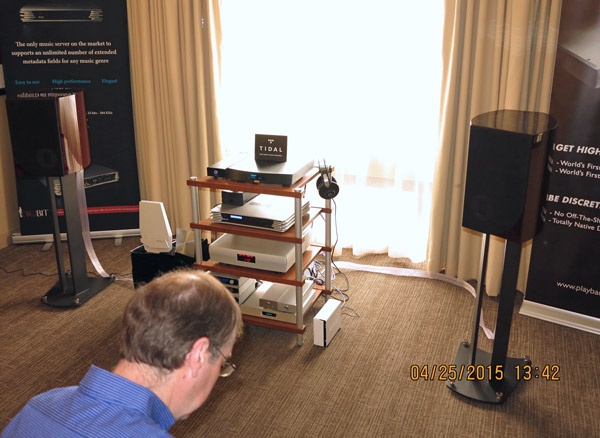 Lots of lovely timbres and an extremely pleasant if ultimately toned down presentation distinguished a system that included the premiere of Playback Designs' IPS-3 firmware-upgradable, all-in-one integrated amp+DSD DAC ($13,000), Aria Audio Server ($7999) and new Aria-Mini Audio Server ($3800); Lumin S-1 Audio streamer (12,500), Lumin T-1 audio streamer ($5000), and Lumin L-1 media server library; M2 Tech Marley preamp ($1699), M2 Tech Young DSD/DXD/PCM DAC/preamp ($1699), and M2 Tech Van der Graff power supply ($1199); and first US showing of the Apertura-Kayla loudspeakers ($13,000).
The attentive reader will realize that all of that stuff could not possibly have been active at the same time. The apologetic writer will acknowledge that he did not look at the equipment sheet after it was handed to him, and thus failed to ask which components were playing. Regardless, what he did notice with pleasure was how well the system depicted the soprano performing on a Channel Classics recording of music by Pergolesi.
Lots of lovely timbres and an extremely pleasant if ultimately toned down presentation distinguished a system that included the premiere of Playback Designs' IPS-3 firmware-upgradable, all-in-one integrated amp+DSD DAC ($13,000), Aria Audio Server ($7999) and new Aria-Mini Audio Server ($3800); Lumin S-1 Audio streamer (12,500), Lumin T-1 audio streamer ($5000), and Lumin L-1 media server library; M2 Tech Marley preamp ($1699), M2 Tech Young DSD/DXD/PCM DAC/preamp ($1699), and M2 Tech Van der Graff power supply ($1199); and first US showing of the Apertura-Kayla loudspeakers ($13,000).
The attentive reader will realize that all of that stuff could not possibly have been active at the same time. The apologetic writer will acknowledge that he did not look at the equipment sheet after it was handed to him, and thus failed to ask which components were playing. Regardless, what he did notice with pleasure was how well the system depicted the soprano performing on a Channel Classics recording of music by Pergolesi.
 I expected no less than excellent sound from the system assembled by GTT Audio, since excellence has always been the company's bottom line. Once the volume was turned up a bit, and grayness disappeared, colors and clarity on a recording of a boy soprano, another of the Meditation from Massenet's Thaïs, and a third from 88 Basin Street all impressed with their beautiful timbres, solid bass, and true-to-life impact.
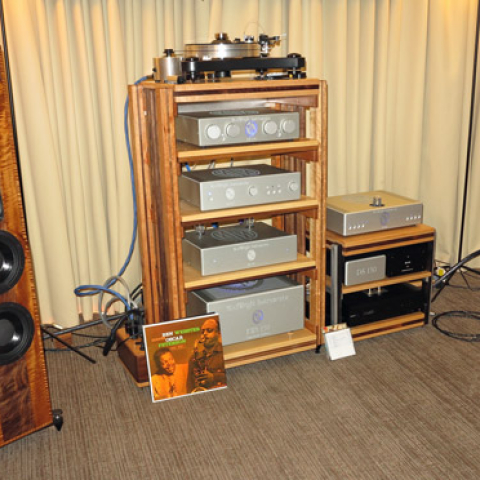
"Great color on piano, trumpet sounds very right with sufficient bite yet no artificial harshness, and the horns blare wonderfully," I wrote in my notes of a system that began with a Kronos limited edition Pro turntable ($38,000) with new motor stack and 12" Black Beauty tonearm ($8500) [cartridge not indicated]; Audionet's PAM G2 phonostage ($20,200), PRE G2 preamp ($23,350) and MAX monoblock amplifiers ($30,500/pair); and KubalaSosna Xpander ($4800), and ended with YG Acoustics' Carmel 2 loudspeakers ($24,500/pair).
I expected no less than excellent sound from the system assembled by GTT Audio, since excellence has always been the company's bottom line. Once the volume was turned up a bit, and grayness disappeared, colors and clarity on a recording of a boy soprano, another of the Meditation from Massenet's Thaïs, and a third from 88 Basin Street all impressed with their beautiful timbres, solid bass, and true-to-life impact.
"Great color on piano, trumpet sounds very right with sufficient bite yet no artificial harshness, and the horns blare wonderfully," I wrote in my notes of a system that began with a Kronos limited edition Pro turntable ($38,000) with new motor stack and 12" Black Beauty tonearm ($8500) [cartridge not indicated]; Audionet's PAM G2 phonostage ($20,200), PRE G2 preamp ($23,350) and MAX monoblock amplifiers ($30,500/pair); and KubalaSosna Xpander ($4800), and ended with YG Acoustics' Carmel 2 loudspeakers ($24,500/pair).
 When I entered the exaSound room, the exaSound e22 Mk.II DAC ($3499), a 32-bit device that can play DSD 256 as well as DXD (384/24 PCM), was making extremely fine music from a recording of a boy soprano singing a tune that I've sung to countless editors present and past, Mozart's "Vorrei spiegarvi, O Dio!" (Let me explain, oh God). In addition, the system, which also included Magnepan 3.7I loudspeakers ($5495/pair) and Pass Labs X250.8 200W monoblock amplifiers ($9600), depicted percussion wonderfully on a violin and tabla track from one of the company's collaborations with Yarlung Records, Suryodaya.
Midway in his demonstration, George Klissarov (Mr. exaSound) held up the e12 DAC ($1999). After explaining that the e12 was designed to extract the e22 Mk.II DAC's sound from a smaller and less costly unit, he began to play a piece of music. After switching between DACs after about 10 seconds of music, he asked me if I could discern any difference between the two units. When I replied that the more costly e22 Mk.II sounded fuller, he declared that impossible. It seems the differences between the two units have to do solely with presence or absence of headphone amp and balanced outputs; boards, parts, and everything except cabinet dimensions are the same.
I could protest that the piece of music was classical, and that it grew more complex and dense after the first 10 seconds, which made the test invalid. I could also protest that even if the music had been consistent in instrumentation and volume, the experiment was flawed because the snippet of music was too short, and there was no final switch back to the original unit. Or I could just throw up my hands and write, "Busted." Of course, if I really did throw up my hands, I could hardly write "Busted" or anything else. But you get the point or, at least, Klissarov's.
When I entered the exaSound room, the exaSound e22 Mk.II DAC ($3499), a 32-bit device that can play DSD 256 as well as DXD (384/24 PCM), was making extremely fine music from a recording of a boy soprano singing a tune that I've sung to countless editors present and past, Mozart's "Vorrei spiegarvi, O Dio!" (Let me explain, oh God). In addition, the system, which also included Magnepan 3.7I loudspeakers ($5495/pair) and Pass Labs X250.8 200W monoblock amplifiers ($9600), depicted percussion wonderfully on a violin and tabla track from one of the company's collaborations with Yarlung Records, Suryodaya.
Midway in his demonstration, George Klissarov (Mr. exaSound) held up the e12 DAC ($1999). After explaining that the e12 was designed to extract the e22 Mk.II DAC's sound from a smaller and less costly unit, he began to play a piece of music. After switching between DACs after about 10 seconds of music, he asked me if I could discern any difference between the two units. When I replied that the more costly e22 Mk.II sounded fuller, he declared that impossible. It seems the differences between the two units have to do solely with presence or absence of headphone amp and balanced outputs; boards, parts, and everything except cabinet dimensions are the same.
I could protest that the piece of music was classical, and that it grew more complex and dense after the first 10 seconds, which made the test invalid. I could also protest that even if the music had been consistent in instrumentation and volume, the experiment was flawed because the snippet of music was too short, and there was no final switch back to the original unit. Or I could just throw up my hands and write, "Busted." Of course, if I really did throw up my hands, I could hardly write "Busted" or anything else. But you get the point or, at least, Klissarov's.
 One of the most revealing demos of AXPONA/AudioCon 2015 was sponsored in two adjacent rooms by Bart Andeer's Resolution Acoustics. In one room that had no room treatment, an excellent system that included Sonus Faber Stradivari loudspeakers, Pass Labs electronics, Meitner MA-1 DAC, and a Mac mini played a piece of music. In the next room, complete with room treatment custom designed and placed by Andeer, the exact same equipment in the exact same location played the same piece of music via a signal split at a Pass Labs XP-30 preamplifier.
I had expected greater bass control in the treated room. What I did not expect was how much richer, fuller, focused, and more refined the music sounded, top to bottom. Even the highs were rounder and more colorful. I've never experienced a more convincing demonstration of what optimally chosen and judiciously positioned room treatment can do.
Andeer, who launched his company at AXPONA, is going public after spending five years mastering his craft. A former ship captain and Marine Engineer, he will work remotely, choosing appropriate room treatment for clients who send him photos and room dimensions. He is also available to fly to the client's home afterwards for fine-tuning.
One of the most revealing demos of AXPONA/AudioCon 2015 was sponsored in two adjacent rooms by Bart Andeer's Resolution Acoustics. In one room that had no room treatment, an excellent system that included Sonus Faber Stradivari loudspeakers, Pass Labs electronics, Meitner MA-1 DAC, and a Mac mini played a piece of music. In the next room, complete with room treatment custom designed and placed by Andeer, the exact same equipment in the exact same location played the same piece of music via a signal split at a Pass Labs XP-30 preamplifier.
I had expected greater bass control in the treated room. What I did not expect was how much richer, fuller, focused, and more refined the music sounded, top to bottom. Even the highs were rounder and more colorful. I've never experienced a more convincing demonstration of what optimally chosen and judiciously positioned room treatment can do.
Andeer, who launched his company at AXPONA, is going public after spending five years mastering his craft. A former ship captain and Marine Engineer, he will work remotely, choosing appropriate room treatment for clients who send him photos and room dimensions. He is also available to fly to the client's home afterwards for fine-tuning.
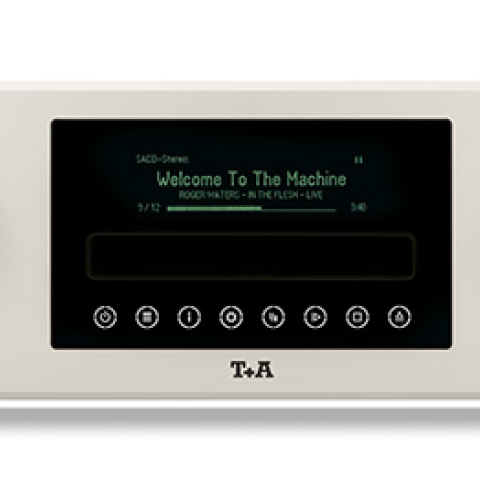
 In a system assembled by Joseph Audio Video of Chicago that included the new Mark Levinson No.52 preamp ($30,000) and No.53 mono blocks ($50,000/pair), as well as Dynaudio Evidence Platinum loudspeakers ($85,000/pair), we used intriguing-looking Argento Flow Master Reference cabling (well over $70,000 including power cables and the $11,400 Argento Flow Power Distribution Center) as we switched between a discontinued Levinson No.512 CD player ($15,000) and T+A's far more up-to-date PDP 3000 HV CD-SACD player with PCM-DSD DAC ($19,000).
Listening to selections that included pianist Earl Wild with orchestra, baroque violinist Rachel Podger and period instrument ensemble playing Vivaldi, and pianist Murray Perahia playing Handel, I found the Levinson softer and darker on top, with a fine midrange and bottom end. The T+A was airier on top—there was more shimmer, but also more of a leading edge to high notes, which in this room was somewhat of a mixed bag—but lacked the Levinson's solidly fleshed out bottom end. Each emphasized different elements of the picture. What I wanted was the best of both. But that would have to wait for the final day of the show, where it was delivered in spades, and in far more than one room.
In a system assembled by Joseph Audio Video of Chicago that included the new Mark Levinson No.52 preamp ($30,000) and No.53 mono blocks ($50,000/pair), as well as Dynaudio Evidence Platinum loudspeakers ($85,000/pair), we used intriguing-looking Argento Flow Master Reference cabling (well over $70,000 including power cables and the $11,400 Argento Flow Power Distribution Center) as we switched between a discontinued Levinson No.512 CD player ($15,000) and T+A's far more up-to-date PDP 3000 HV CD-SACD player with PCM-DSD DAC ($19,000).
Listening to selections that included pianist Earl Wild with orchestra, baroque violinist Rachel Podger and period instrument ensemble playing Vivaldi, and pianist Murray Perahia playing Handel, I found the Levinson softer and darker on top, with a fine midrange and bottom end. The T+A was airier on top—there was more shimmer, but also more of a leading edge to high notes, which in this room was somewhat of a mixed bag—but lacked the Levinson's solidly fleshed out bottom end. Each emphasized different elements of the picture. What I wanted was the best of both. But that would have to wait for the final day of the show, where it was delivered in spades, and in far more than one room.
I entered the extremely large room from HiFi Imports, which was dominated by Polymer Audio's MKS-X loudspeakers ($68,000/pair). The handsome MKS-X has a new crossover, new 5" mid-bass driver with a composite cone made from an alloy designed to emulate the stiffness of diamond, and new side wings. It also has a 0.75" pure-diamond tweeter and 2.1" pure-diamond midrange. Most important, it claims a faster response, sensitivity of 92dB, and impressive in room frequency response of 30Hz—70kHz ±3dB.
Allied with a Weiss Man301 Music Archive network player (without DAC $9083, with DAC $12,262), Thrax Dionysos line level preamplifier ($21,500), Thrax Maximinus 32/384 DAC ($33,000), new Thrax Teres transformer-coupled 250W/8ohm battery biased hybrid power amplifier, and Enklein cables and powercords, the Polymer Audio MKS-X loudspeakers projected a huge, ear-opening soundstage with great depth. On top of that, the notable air around Rachel Podger's baroque violin on Channel Classics' new SACD of Vivaldi's L'Estro Armonico immediately seized attention.
MG P4 Ag speaker cables and interconnects anchored a system that also included Lawrence Violin SE speakers, a new Concert Fidelity integrated amplifier, Weiss Music Server, Concert Fidelity DAC, Krolo stands, and Krolo Music Enhancers. There was too much talking to allow serious evaluation, but what I could catch between words sounded rather sharp and monotone.
Why do exhibitors insist on leaving out bowls of candy for visitors who inevitably make a racket unwrapping the stuff and then playing with the wrappers whenever the music gets softer? Strike a blow against diabetes and sonic pollution, folks, and leave the crap at home.
I was excited to begin my tour of the 4th floor with a visit to the room dominated by Endeavor Audio's enthusiastically received and newly tweaked E-5 reference loudspeakers ($35,000/pair) and Constellation Audio's equally lauded Inspiration Series Mono 1.0 amplifiers ($10,000/each) and Inspiration Series preamp 1.0 ($9000). Add in the YFS-Your Final System Ref-3 digital file transport ($15,500), EMM Labs' DAC2X DSD DAC ($15,500), and Master Built audio cables, and it was a potential knockout system.
Without question, the combo exhibited absolute control—no mean feat—and a fine midrange. But its dismaying metallic top was a puzzlement. Certainly it wasn't due to the Constellation electronics, which I've heard at many shows. Nor, having heard the components from the other companies before, did I suspect that any of them were the cause.
Lots of lovely timbres and an extremely pleasant if ultimately toned down presentation distinguished a system that included the premiere of Playback Designs' IPS-3 firmware-upgradable, all-in-one integrated amp+DSD DAC ($13,000), Aria Audio Server ($7999) and new Aria-Mini Audio Server ($3800); Lumin S-1 Audio streamer (12,500), Lumin T-1 audio streamer ($5000), and Lumin L-1 media server library; M2 Tech Marley preamp ($1699), M2 Tech Young DSD/DXD/PCM DAC/preamp ($1699), and M2 Tech Van der Graff power supply ($1199); and first US showing of the Apertura-Kayla loudspeakers ($13,000).
I expected no less than excellent sound from the system assembled by GTT Audio, since excellence has always been the company's bottom line. Once the volume was turned up a bit, and grayness disappeared, colors and clarity on a recording of a boy soprano, another of the Meditation from Massenet's Thaïs, and a third from 88 Basin Street all impressed with their beautiful timbres, solid bass, and true-to-life impact.
"Great color on piano, trumpet sounds very right with sufficient bite yet no artificial harshness, and the horns blare wonderfully," I wrote in my notes of a system that began with a Kronos limited edition Pro turntable ($38,000) with new motor stack and 12" Black Beauty tonearm ($8500) [cartridge not indicated]; Audionet's PAM G2 phonostage ($20,200), PRE G2 preamp ($23,350) and MAX monoblock amplifiers ($30,500/pair); and KubalaSosna Xpander ($4800), and ended with YG Acoustics' Carmel 2 loudspeakers ($24,500/pair).
When I entered the exaSound room, the exaSound e22 Mk.II DAC ($3499), a 32-bit device that can play DSD 256 as well as DXD (384/24 PCM), was making extremely fine music from a recording of a boy soprano singing a tune that I've sung to countless editors present and past, Mozart's "Vorrei spiegarvi, O Dio!" (Let me explain, oh God). In addition, the system, which also included Magnepan 3.7I loudspeakers ($5495/pair) and Pass Labs X250.8 200W monoblock amplifiers ($9600), depicted percussion wonderfully on a violin and tabla track from one of the company's collaborations with Yarlung Records, Suryodaya.
Midway in his demonstration, George Klissarov (Mr. exaSound) held up the e12 DAC ($1999). After explaining that the e12 was designed to extract the e22 Mk.II DAC's sound from a smaller and less costly unit, he began to play a piece of music. After switching between DACs after about 10 seconds of music, he asked me if I could discern any difference between the two units. When I replied that the more costly e22 Mk.II sounded fuller, he declared that impossible. It seems the differences between the two units have to do solely with presence or absence of headphone amp and balanced outputs; boards, parts, and everything except cabinet dimensions are the same.
I could protest that the piece of music was classical, and that it grew more complex and dense after the first 10 seconds, which made the test invalid. I could also protest that even if the music had been consistent in instrumentation and volume, the experiment was flawed because the snippet of music was too short, and there was no final switch back to the original unit. Or I could just throw up my hands and write, "Busted." Of course, if I really did throw up my hands, I could hardly write "Busted" or anything else. But you get the point or, at least, Klissarov's.
One of the most revealing demos of AXPONA/AudioCon 2015 was sponsored in two adjacent rooms by Bart Andeer's Resolution Acoustics. In one room that had no room treatment, an excellent system that included Sonus Faber Stradivari loudspeakers, Pass Labs electronics, Meitner MA-1 DAC, and a Mac mini played a piece of music. In the next room, complete with room treatment custom designed and placed by Andeer, the exact same equipment in the exact same location played the same piece of music via a signal split at a Pass Labs XP-30 preamplifier.
I had expected greater bass control in the treated room. What I did not expect was how much richer, fuller, focused, and more refined the music sounded, top to bottom. Even the highs were rounder and more colorful. I've never experienced a more convincing demonstration of what optimally chosen and judiciously positioned room treatment can do.
Andeer, who launched his company at AXPONA, is going public after spending five years mastering his craft. A former ship captain and Marine Engineer, he will work remotely, choosing appropriate room treatment for clients who send him photos and room dimensions. He is also available to fly to the client's home afterwards for fine-tuning.
In a system assembled by Joseph Audio Video of Chicago that included the new Mark Levinson No.52 preamp ($30,000) and No.53 mono blocks ($50,000/pair), as well as Dynaudio Evidence Platinum loudspeakers ($85,000/pair), we used intriguing-looking Argento Flow Master Reference cabling (well over $70,000 including power cables and the $11,400 Argento Flow Power Distribution Center) as we switched between a discontinued Levinson No.512 CD player ($15,000) and T+A's far more up-to-date PDP 3000 HV CD-SACD player with PCM-DSD DAC ($19,000).
Listening to selections that included pianist Earl Wild with orchestra, baroque violinist Rachel Podger and period instrument ensemble playing Vivaldi, and pianist Murray Perahia playing Handel, I found the Levinson softer and darker on top, with a fine midrange and bottom end. The T+A was airier on top—there was more shimmer, but also more of a leading edge to high notes, which in this room was somewhat of a mixed bag—but lacked the Levinson's solidly fleshed out bottom end. Each emphasized different elements of the picture. What I wanted was the best of both. But that would have to wait for the final day of the show, where it was delivered in spades, and in far more than one room.