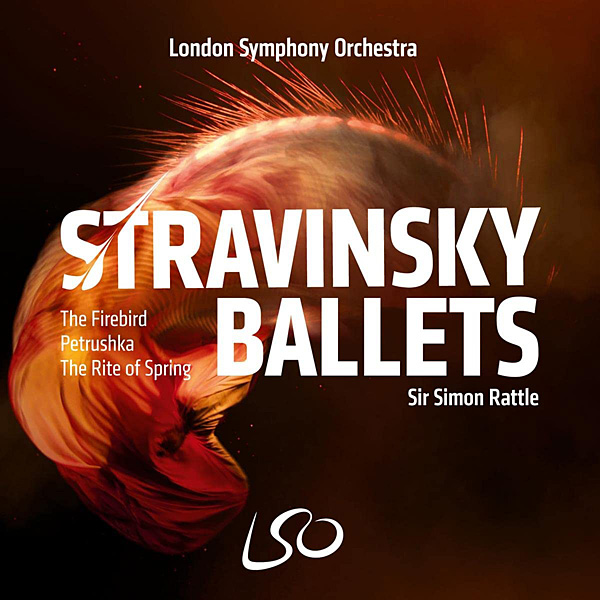
 While I had the B&Ws in my system, I acquired two new recordings of the full score of Stravinsky's ballet The Firebird. One is by the London Symphony Orchestra, conducted by Simon Rattle (24/96 download, LSO Live LSO5096), the other by the Orchestre de Paris under Klaus Mäkelä, their young, new music director (16/44.1 download, Decca 4853946). This brilliant score is most popular as an orchestral-suite arrangement (footnote 3), but to fully appreciate Stravinsky's achievement in combining Rimsky-Korsakov's color palette with his own melodic mastery, one must listen to the full ballet score.
The full version clearly demonstrates the 705's ability to fully reveal the colors and complexity of this music. Koschei's thrilling "Infernal Dance" can pound your chest with big speakers, something the 705s can't replicate—but they can and did convey this music's exhilarating dynamism. They also uncovered delicious details of the more reflective parts of the score that demand more than brawn. I found Mäkelä's interpretation richer than Rattle's, though treble—whether in the performance or the recording—was excessive, particularly with the violins, flutes, and piccolos. Rattle was an easier listen but less fun. Either way: great detail, great soundstage.
While I had the B&Ws in my system, I acquired two new recordings of the full score of Stravinsky's ballet The Firebird. One is by the London Symphony Orchestra, conducted by Simon Rattle (24/96 download, LSO Live LSO5096), the other by the Orchestre de Paris under Klaus Mäkelä, their young, new music director (16/44.1 download, Decca 4853946). This brilliant score is most popular as an orchestral-suite arrangement (footnote 3), but to fully appreciate Stravinsky's achievement in combining Rimsky-Korsakov's color palette with his own melodic mastery, one must listen to the full ballet score.
The full version clearly demonstrates the 705's ability to fully reveal the colors and complexity of this music. Koschei's thrilling "Infernal Dance" can pound your chest with big speakers, something the 705s can't replicate—but they can and did convey this music's exhilarating dynamism. They also uncovered delicious details of the more reflective parts of the score that demand more than brawn. I found Mäkelä's interpretation richer than Rattle's, though treble—whether in the performance or the recording—was excessive, particularly with the violins, flutes, and piccolos. Rattle was an easier listen but less fun. Either way: great detail, great soundstage.
 Finally comes Fauré's Requiem, one of my many music obsessions. I have accumulated many recordings of this work over the years, none of which I can live without, but two relatively recent ones get a lot of play: Lawrence Equilbey and the Accentus choir's recording with L'Orchestre National De France (CD, Naive V5137) and Mathieu Romano and the Ensembles Aedes's recording with Les Siècles' period-instrument orchestra (Aparté AP201, auditioned from a 24/96 download). This work begins with a powerful, defining chord with, on Lawrence Equilbey's recording, impressive weight and depth. Overall, the performance is more solemn than Mathieu Romano's, whose opening chord is broad and rich. That distinction was lost with the 705s because the lowest frequency components on the Equilbey recording were simply not heard. Other fascinating distinctions were revealed, such as the more immediate recording of the chorus presentation on the Equilbey and the enrichment of Romano's more distant choir by the church acoustics where it was recorded. Despite these differences, choral detail was strikingly clear on both.
 The 705 is capable of satisfying critical ears. It offers striking clarity and detail and can generate a wide, stable, realistic soundstage. The elevated upper midrange and treble of the 705 S3 contributes to its perceived clarity and soundstage. Only at very high listening levels did it seem bright. Even then it was not a disqualifier, because it seemed to remain distortion-free. At the other end, extreme low bass was left for the imagination, but in most cases (eg, in the Malena and Lofgren tracks), the 705's midbass richness compensated well for this deficiency. Large, complex orchestral or choral music can reveal the 705's shortcoming in bottom end acoustic output, but that might be ameliorated if used in a smaller room and positioned close to room boundaries.
Egregious comparisons
I compared the B&W 705 S3s to my Revel F206s. They occupy about the same amount of space and, with the cost of the B&W stands included, they are similar in price. The three-way, double-woofer Revel did fill in the bottom end to restore balance to "The First Tears," but the B&W's treble seemed more detailed and spacious. On the orchestral tests, the Revel's more-extended bass and superior bass impact were obvious, but the B&W—perhaps because its attenuated bass excited fewer room modes—could sound tighter.
I also compared the B&W to the KEF Blade 2 Meta—an unfair comparison, but the little B&W held its own respectably. No surprise, the big KEFs had significantly more extended and taut bass; they also presented a deeper, taller soundstage. They were richer and fuller without any audible emphases in the midbass or treble. Still, with the B&W's tweeter at just about the same height as KEF's Uni-Q, there were moments, standing less than a meter away, when they sounded much the same.
The 705 is capable of satisfying critical ears. It offers striking clarity and detail and can generate a wide, stable, realistic soundstage. The elevated upper midrange and treble of the 705 S3 contributes to its perceived clarity and soundstage. Only at very high listening levels did it seem bright. Even then it was not a disqualifier, because it seemed to remain distortion-free. At the other end, extreme low bass was left for the imagination, but in most cases (eg, in the Malena and Lofgren tracks), the 705's midbass richness compensated well for this deficiency. Large, complex orchestral or choral music can reveal the 705's shortcoming in bottom end acoustic output, but that might be ameliorated if used in a smaller room and positioned close to room boundaries.
Egregious comparisons
I compared the B&W 705 S3s to my Revel F206s. They occupy about the same amount of space and, with the cost of the B&W stands included, they are similar in price. The three-way, double-woofer Revel did fill in the bottom end to restore balance to "The First Tears," but the B&W's treble seemed more detailed and spacious. On the orchestral tests, the Revel's more-extended bass and superior bass impact were obvious, but the B&W—perhaps because its attenuated bass excited fewer room modes—could sound tighter.
I also compared the B&W to the KEF Blade 2 Meta—an unfair comparison, but the little B&W held its own respectably. No surprise, the big KEFs had significantly more extended and taut bass; they also presented a deeper, taller soundstage. They were richer and fuller without any audible emphases in the midbass or treble. Still, with the B&W's tweeter at just about the same height as KEF's Uni-Q, there were moments, standing less than a meter away, when they sounded much the same.
Footnote 3: Stravinsky created three orchestral-suite arrangements of The Firebird, as well as a piano arrangement of the full score.