Late on Saturday, the last night of SXSW, I somehow ended up having a pint with a mixed party of American and British band members, only one of whom I knew previously, when suddenly the subject of the British government’s support of the arts came up. Seems these four young lads, and their frontwoman—one stunning fulfillment of my perky blonde English chick singer fantasy (oh my)—hadn’t used their money to come all the way to Texas. No, the government had picked up the tab. The fact that they were vaguely ashamed—because being on the dole is unhip and kind of the opposite of DIY—told me it was true.
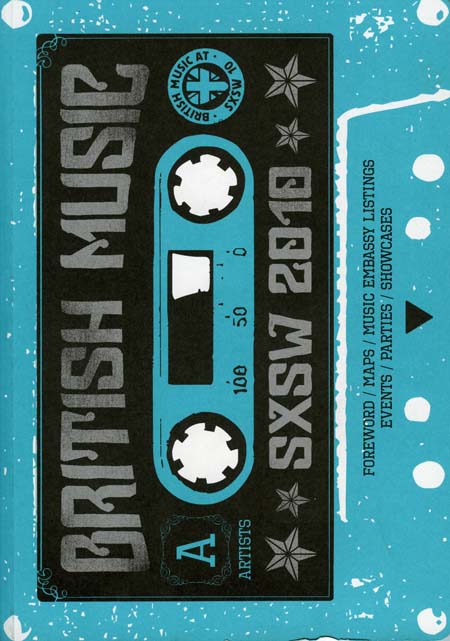
At SXSW this year there was a very pronounced increase in the amount of German and UK bands. The publications pictured above and below, both of which were in the goody bags you get each year when you register, are both products of their countries respective governments, i.e. they were paid for with tax dollars.
Both books open with statements from a government official. The German book featured a preface by Hans–Joachim Otto whose job title is crazy silly and reveals a whole bunch about how the German mind works: The Parlimentary State Secretary of the Federal Ministry of Economics and Technology. I mean C’mon! They can’t shorten that? Make it less Stars Wars–sounding? Next thing you know they’ll be working on a Death Star. Oh God, probably shouldn’t tempt fate, this
is Deutschland we’re talking about.
Anyway, Hans, in his introduction to this 51–page booklet that included a compilation CD featuring a track by 14 different German acts, he says in 2008 the music business in Germany generated revenues of approximately, “5.4 billion Euros,” and that “11,300 companies with “36,000 employees” work in the German music business.
His British counterpart, Feargal Sharkey, CEO of UK Music, which I’m thinking is an arm of the British government organization, UK Trade & Investment, had a booth, threw several parties and had a very visible presence in Austin. Feargal ( I was going to make fun of the name, but it’s just too easy) noted in his opening essay that, “1 in 10 albums sold in the U.S. in 2008 was made by a UK artist.” Actually I would have thought that number would have been higher. But even with the lower number, he reckons that: “We are world beaters” and that the mass of music coming out of the UK “illustrates a nation’s true creative health.” The idea probably in both the German and British case is that any money invested in the music business will come back to the country in the form of increased exports and sales taxes.
As far as promotional materials, scale is obviously the deciding factor. Because Britain and Germany are small, they can print up a book the shills for much if not all the music business in the entire country. A US guide, would have to be multiple volumes and would never be done because of the squabblins that would immediately ensure (“Whattya mean Warners has more space than we do?” sayeth the Sony rep). And given the strains on the public pot these days in the land of the free, there is not money for music in the federal budget. If there’s no money for music education in schools, there’s no cash for adults musicians whether they be symphony players or punk rockers. But maybe there should be. Even a tiny investment of tax dollars, say 50 or 100 million dollars which is about what it costs to put a tire on an F–16 (clearly I exaggerate but you get the idea) could become grants to songwriters or public performance venues, fund a concert series or hell, even pay to send jazz musicians to one of the many prestigious European summer jazz festivals. Yes, I know, in the USA capitalism reigns supreme and we don’t give a bunch of no good, lazy–assed, starving artists any of our hard earned money. We’d rather do constructive things like bribe a senator or start a war or fund the pensions of overpaid government workers who think they are living in 1959.
And to be honest, if I’m British, I’m not sure that I quite agree with paying to fly a couple hundred indie rock acts to Texas. Yet it does say something about how the Allemagne and UK value civilization. Music, even rock music, is a thing to be valued and supported. And as far as I could tell, there were no morals requirements attached. And as businesses go, it is a viable export. It does bring in hard currency. Best of all, as far as I could tell, there were no morals requirements attached. If you’re lyrics contained naughty bits, then, oh well. No Mapplethorpe religious right wrangling required. And yes, the NEA, NEH and IMLS (Institute of Museum and Library Services) do give out grants of public money for art—and the Obama administration is trying to revive some of the government’s involvement in culture—but as we’ve all learned several times over now, the cash often comes with many strings, if not ropes, steel cables, nothing you want to be associated with, attached.
Again while there are many sides to this argument, most of them valid in spots, all I know is I came back from SXSW with a gorgeously printed book, that is thicker than the average
Stereophile, and talks about what I assume is a reasonably large slice of British music businesses as well as all the bands playing SXSW whether they were getting money from the British government or not. Hard to see exactly how this kind of support for music can be bad.