

Ella Fitzgerald has always swung me into next week, but through the Kuzma, Cary, Tavish, and DeVores, her 1962 LP Ella Swings Brightly With Nelson (LP, Verve V6-4054) moved me. I heard greater soundstage depth and air compared to that of the Ragnarok, and stronger center fill, which gave Ella's voice a heightened sense of corporeality. The Cary resolved Ella's sure sense of pitch, her distinctive delivery, her natural swing.
Through the SLI-80HS, the 1989 Japanese reissue of the Beatles' Magical Mystery Tour (LP, EMI/Apple Records TOCP-8514) sounded small. The superior 1971 German reissue (LP, Apple Records HôRZU SHZE 327) was better fleshed out but still thin overall by contemporary standards. The Cary also refused to gussy up the rather shallow production of various mid-'60s Atlantic Records by Carmen McRae. And an electronic record I've loved for its lush electric bass and dreamy synthesizer, Air's Premiers Symptômes (Parlophone RP1 47245), was exposed for its obvious digital lineage. The Cary told the truth, and sometimes the truth hurts. Yet when I spun Kruder and Dorfmeister's remix of Rockers Hi-Fi's "Going Under (Evil Love And Insanity Dub)" from 1998's The K&D Sessions (5 LPs, G-Stone Recordings !K7073LP), the Cary dispensed sub-bass frequencies so tangible, I swear I heard thrusting air swoosh by and the precise moment of impact between beater and bass drum head: thump! Drum size was evident.
The Cary also delivered new revelations from Kirsten Flagstad's 1956 Wagner Recital with the Vienna Philharmonic Orchestra conducted by Hans Knappertsbusch (LP, London 5259). In tandem with the DeVore O/93s, it exposed the beauty of Flagstad's heavenly instrument, reproduced with intense spatial presence and depth plus fine color and musical nuance. Later, I also played the Flagstad LP via the Cary's headphone amp and a pair of Master & Dynamic MH40 headphones ($249); the sound's dimensionality was similar to that of its loudspeaker output.
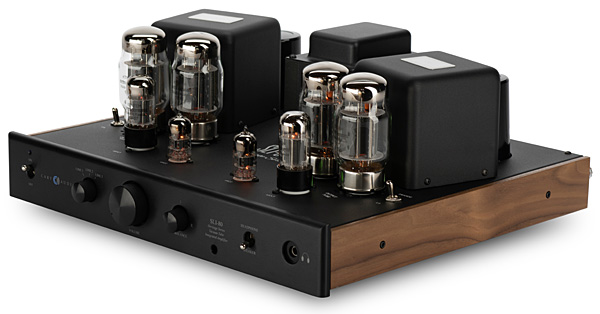 I detoured for a moment, switching the SLI-80HS from triode mode to Ultralinear. Immediately apparent: even more low-end depth from the Hammond B3 pedal notes but also a loss of bloom, sweetness, and spaciousness. Too much to bear—back to triode.
It's true that many of the best-sounding Blue Note LPs are mono; with that in mind, I played Horace Silver's classic No.1518 (cognoscenti always refer to Blue Note records by their catalog number), also known as Horace Silver and the Jazz Messengers (LP, Blue Note BLP 1518). A compilation of material from two 10" discs, the lineup of Silver on piano, Kenny Dorham on trumpet, Hank Mobley on tenor saxophone, Doug Watkins on bass, and Art Blakey on drums is at times surging ("Room 608"), serene ("Creepin' In"), and droll ("Doodlin'"). Through the Cary, the LP's mono image was larger and more luxurious than my Greenwich Village apartment. The amp unleashed the charging dynamics in this deep-groove, "47 West 63rd" Blue Note pressing: Mono pressings from the late '50s/early '60s often have more drive and slam than their stereo counterparts, and I heard that in the sound of Watkins's bass, which felt like an 80,000lb tractor-trailer blowing past. Blakey's cymbals had tons of air, and, although reverb had been added to the mix, the sound remained sweet, not shrill. The Cary facilitated this sonic glory as well as I've heard it in my apartment, damn anyone who says different!
With the Klipsch Forte IIIs
I detoured for a moment, switching the SLI-80HS from triode mode to Ultralinear. Immediately apparent: even more low-end depth from the Hammond B3 pedal notes but also a loss of bloom, sweetness, and spaciousness. Too much to bear—back to triode.
It's true that many of the best-sounding Blue Note LPs are mono; with that in mind, I played Horace Silver's classic No.1518 (cognoscenti always refer to Blue Note records by their catalog number), also known as Horace Silver and the Jazz Messengers (LP, Blue Note BLP 1518). A compilation of material from two 10" discs, the lineup of Silver on piano, Kenny Dorham on trumpet, Hank Mobley on tenor saxophone, Doug Watkins on bass, and Art Blakey on drums is at times surging ("Room 608"), serene ("Creepin' In"), and droll ("Doodlin'"). Through the Cary, the LP's mono image was larger and more luxurious than my Greenwich Village apartment. The amp unleashed the charging dynamics in this deep-groove, "47 West 63rd" Blue Note pressing: Mono pressings from the late '50s/early '60s often have more drive and slam than their stereo counterparts, and I heard that in the sound of Watkins's bass, which felt like an 80,000lb tractor-trailer blowing past. Blakey's cymbals had tons of air, and, although reverb had been added to the mix, the sound remained sweet, not shrill. The Cary facilitated this sonic glory as well as I've heard it in my apartment, damn anyone who says different!
With the Klipsch Forte IIIs
This was a nigh-on saintly pairing, the rich timbre and mountain-sized bloom of the Cary creating juicy, lifelike images via the Forte III ($3998/pair) and its horn-loaded tweeter and midrange, 12" woofer, and 15" passive radiator.
 The soundstage was larger than that of the DeVore Fidelity O/93s, with deep bass that sounded clear, detailed, and reasonably extended. The Klipsch/Cary combination generated the greatest number of Hallelujah! moments. Flagstad's voice was integrated better with the Vienna Philharmonic Orchestra while losing none of her—or the recording's—silken sharpness: I heard Flagstad, the orchestra, and the hall. Similarly, Horace Silver's Blue Note disc yielded more visceral low notes and midrange meat within a shimmering expanse of air, as the music's natural echo reflected off the wooden cathedral ceiling of Rudy Van Gelder's Englewood Cliffs studio.
Conclusions
The soundstage was larger than that of the DeVore Fidelity O/93s, with deep bass that sounded clear, detailed, and reasonably extended. The Klipsch/Cary combination generated the greatest number of Hallelujah! moments. Flagstad's voice was integrated better with the Vienna Philharmonic Orchestra while losing none of her—or the recording's—silken sharpness: I heard Flagstad, the orchestra, and the hall. Similarly, Horace Silver's Blue Note disc yielded more visceral low notes and midrange meat within a shimmering expanse of air, as the music's natural echo reflected off the wooden cathedral ceiling of Rudy Van Gelder's Englewood Cliffs studio.
Conclusions
I can safely report that in most subjective respects, the SLI-80HS outperformed its solid-state sibling, the Cary SI-300.2d integrated amplifier ($5995), which I reviewed in the December 2016 Stereophile—although the more expensive Cary offers more power (300Wpc), a DAC, and Bluetooth capabilities. In my system, the tubed SLI-80HS sounded great with conventional loudspeakers and horns alike, and with all styles of music. It provided an uncluttered pathway to musical satisfaction, LP after LP. The Cary possesses all the qualities tube aficionados seek—and, perhaps due to its solid-state rectification, good if not spectacular grip on low-end fundamentals. Most important—and here's where it shares more than just wood-finish choices with Klipsch—it's tremendous fun.
In triode mode, which I favored, the Cary's 40Wpc won't drive every speaker—but with that consideration noted, the SLI-80HS ranks near the top of all the many tube integrated amps that have passed through my door.
I detoured for a moment, switching the SLI-80HS from triode mode to Ultralinear. Immediately apparent: even more low-end depth from the Hammond B3 pedal notes but also a loss of bloom, sweetness, and spaciousness. Too much to bear—back to triode.
It's true that many of the best-sounding Blue Note LPs are mono; with that in mind, I played Horace Silver's classic No.1518 (cognoscenti always refer to Blue Note records by their catalog number), also known as Horace Silver and the Jazz Messengers (LP, Blue Note BLP 1518). A compilation of material from two 10" discs, the lineup of Silver on piano, Kenny Dorham on trumpet, Hank Mobley on tenor saxophone, Doug Watkins on bass, and Art Blakey on drums is at times surging ("Room 608"), serene ("Creepin' In"), and droll ("Doodlin'"). Through the Cary, the LP's mono image was larger and more luxurious than my Greenwich Village apartment. The amp unleashed the charging dynamics in this deep-groove, "47 West 63rd" Blue Note pressing: Mono pressings from the late '50s/early '60s often have more drive and slam than their stereo counterparts, and I heard that in the sound of Watkins's bass, which felt like an 80,000lb tractor-trailer blowing past. Blakey's cymbals had tons of air, and, although reverb had been added to the mix, the sound remained sweet, not shrill. The Cary facilitated this sonic glory as well as I've heard it in my apartment, damn anyone who says different!
With the Klipsch Forte IIIsThis was a nigh-on saintly pairing, the rich timbre and mountain-sized bloom of the Cary creating juicy, lifelike images via the Forte III ($3998/pair) and its horn-loaded tweeter and midrange, 12" woofer, and 15" passive radiator.
The soundstage was larger than that of the DeVore Fidelity O/93s, with deep bass that sounded clear, detailed, and reasonably extended. The Klipsch/Cary combination generated the greatest number of Hallelujah! moments. Flagstad's voice was integrated better with the Vienna Philharmonic Orchestra while losing none of her—or the recording's—silken sharpness: I heard Flagstad, the orchestra, and the hall. Similarly, Horace Silver's Blue Note disc yielded more visceral low notes and midrange meat within a shimmering expanse of air, as the music's natural echo reflected off the wooden cathedral ceiling of Rudy Van Gelder's Englewood Cliffs studio.
ConclusionsI can safely report that in most subjective respects, the SLI-80HS outperformed its solid-state sibling, the Cary SI-300.2d integrated amplifier ($5995), which I reviewed in the December 2016 Stereophile—although the more expensive Cary offers more power (300Wpc), a DAC, and Bluetooth capabilities. In my system, the tubed SLI-80HS sounded great with conventional loudspeakers and horns alike, and with all styles of music. It provided an uncluttered pathway to musical satisfaction, LP after LP. The Cary possesses all the qualities tube aficionados seek—and, perhaps due to its solid-state rectification, good if not spectacular grip on low-end fundamentals. Most important—and here's where it shares more than just wood-finish choices with Klipsch—it's tremendous fun.















