


Fifteen years? Has it really been 15 years since I reviewed what was then the flagship D/A processor from English company Chord Electronics? In the July 2002 issue, here's how I summed up my review of the Chord DAC64: "While the Chord Electronics DAC64 is undoubtedly expensive, it is eye-poppingly gorgeous. . . . many listeners should find its silky-smooth highs seductive, as well as its slightly larger-than-life lows." How times and prices change—the "undoubtedly expensive" DAC64 cost only $3040! I did make a couple of criticisms of the DAC64 in my review, but according to Wes Phillips, in his August 2007 review of Chord's revised DAC64, "the Choral Blu [CD transport] and Choral DAC64 are, together, the CD player we music lovers have long prayed for"—even if, five years after my own review, the DAC64's price had risen to $5000.
Then, in late 2015, at an event at Manhattan retailer Stereo Exchange to introduce the impressive little Chord Mojo portable D/A headphone amplifier (which I reviewed in our February 2016 issue), I saw an early production sample of the DAVE. The DAVE—for Digital [to] Analog Veritas [in] Extremis (Truth in Extreme)—is said by its designer, Rob Watts, to be the highest-performance DAC to come from Chord, but at a price: it costs $10,588.
I made a mental note to put the Chord DAVE on my "must-review" list.
Description
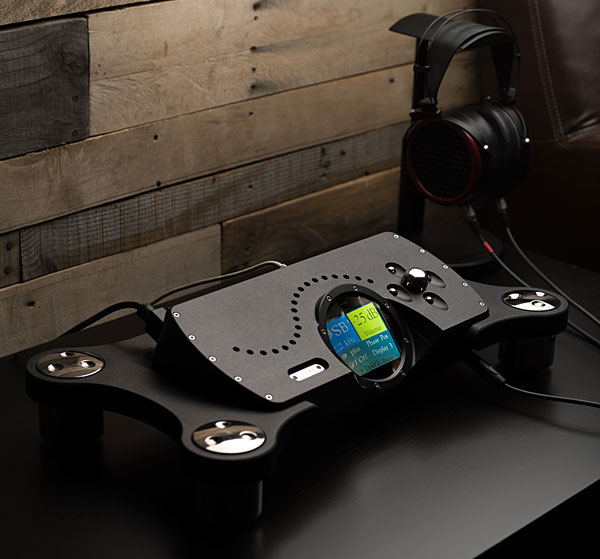
Without its matching stand, the DAVE is housed in a relatively small but undoubtedly elegant rectangular enclosure with rounded sides that is superficially identical to that of the DAC64. Whereas the older DAC had a small, convex glass window in its top, the DAVE's top panel features a large, circular, four-color display set into it at an angle, and accompanied by an array of four inset spherical silver buttons surrounding a larger central button. Other than a recessed ¼" headphone jack at the bottom right of the front panel and a deeply recessed Chord logo on the front left of the top panel, that's all there is to see.
 The rear panel features an array of digital input and analog output jacks, all unmarked save the right-channel unbalanced RCA jack, which has a red ring. Both balanced and single-ended outputs are provided, and the digital inputs include AES/EBU, USB2.0, two TosLink, and two coaxial S/PDIF on BNC jacks. There are also four digital-output BNCs. But what's inside the DAVE's elegant exterior?
Filter Technology
The rear panel features an array of digital input and analog output jacks, all unmarked save the right-channel unbalanced RCA jack, which has a red ring. Both balanced and single-ended outputs are provided, and the digital inputs include AES/EBU, USB2.0, two TosLink, and two coaxial S/PDIF on BNC jacks. There are also four digital-output BNCs. But what's inside the DAVE's elegant exterior?
Filter Technology
When Chord's Rob Watts visited my office in spring 2016, I asked him what his priorities had been in designing the DAVE. Chord's previous DACs had featured what was called the Watts Transient Aligned (WTA) reconstruction filter, which is said to minimize timing errors. I asked Watts what he meant by "Transient Aligned." "Digital audio's Achilles' heel is the timing of transients. . . . Transients are very important for the brain's processing and how we perceive sound. Transients affect how we perceive pitch, timbre, and the positions of objects within the soundstage . . . very small timing errors have a very big subjective impact. The timing is reconstructed by the interpolation filter in the DAC and conventional DACs have timing uncertainty due to their limited processing. I used extensive listening tests to create the WTA filter, to simulate as closely as possible the results of an infinite-tap filter."
Watts explained that when digital audio data are created by sampling an analog signal, as long as those data are bandwidth-limited with zero output at half the sample rate, a sinc-function reconstruction filter with an infinite number of coefficients, or taps, will result in perfect reconstruction of the original waveform with perfectly defined transients. "But we can't have an infinite tap length, because we would be waiting an infinite length of time for the signal to fall out," he continued. "However, I did find that the filter algorithm makes a big difference to sound quality, so using an optimal filter allows the number of taps to be reduced to a practical number."
I asked him how many filter taps are "practical."
"If you have a conventional filter with 100 taps, you will recover some of the transient information," Watts replied. "A 100-tap filter gives you sufficiently good frequency-domain performance, but not in the time domain. . . . Every time you increase the number of taps, you improve the perception of pitch, timbre gets better—bright instruments sound brighter, dark instruments sound darker—the starting and stopping of notes becomes easier to hear, the localization of sounds get better. There is less listening fatigue—the brain has to do less processing of the information presented to it to understand what's going on."
The digital filter in the discontinued DAC64 had 1024 taps; the WTA filter in Chord's still-available Hugo TT [$4795] has a tap length of 26,368. What is the tap length in the DAVE, I asked.
"The Xilinx FPGA [field programmable gate array chip] in DAVE is 10 times larger than the one used in the Hugo. . . . We've got 164,000 taps in DAVE's WTA filter, implemented in 166 DSP cores running in parallel; some of them are cores in the FPGA, some of them are custom cores using the FPGA fabric."
Did Watts use the same filter for PCM and DSD data, decimating the latter into high-resolution PCM?
"I managed to run two separate programs in the FPGA, one for PCM and one for the non-decimating DSD filter," he clarified. "My goal for DAVE was to keep the subjective timing improvement in Hugo, improve the noise-shaper performance, and, in the time domain, really get the transients more accurate, keep the noise-floor modulation and distortion very low—and we've got the budget to do much more advanced analog electronics. However, it is not just the tap length that matters. The filter also needs to be optimized. In Hugo, I went from a single-stage WTA filter to three stages. The first stage oversamples the data eight times; the second stage takes that to 16 times, and is followed by a linear interpolation filter to go to 2048Fs [2048 times the original sample rate]; then there are two low-pass filters. What I'd done [before Hugo], there was just a single interpolation filter, but that caused problems with noise-floor modulation and jitter sensitivity. In DAVE, by going from 16Fs to a 256Fs filter, that would recover the timing in a more efficient, more elegant way—a more mathematically correct way of doing it. And when I got the 256Fs filter in, it sharpened up the transients and the whole presentation became much faster, became more neutral [compared with simply increasing tap length].
 "To do a 256Fs FIR filter wasn't easy because you haven't got many cycles available—it used eight DSP cores. I've still got the linear interpolator filter to take it to 2048Fs, and then the two low-pass filters. What this all means is that inside the device, [even before being used to reconstruct the analog signal,] digital data at 2048Fs look much closer to the reconstructed analog signal—very tiny steps. The benefit of this is that, with 8Fs data, the steps are large and are much more susceptible to jitter.
"To turn those hi-rez 32-bit, 2048Fs data to analog, that's the function of the noise shaper. I use a noise shaper to reduce word length to 4 or 5-bit data [to present to a DAC using discrete components]. The design of the noise shaper was crucial, and as I had a lot more gates to play with than with Hugo, I could run the noise shaper at a much faster rate. My noise shaper is running at 104MHz compared with the typical 6MHz. The benefit of this fast rate is that noise shaping is an iterative process—it constructs a low-frequency signal by running backward and forward at a very fast rate. If you run at a faster rate, you get much better accuracy in the audioband . . . soundstage depth gets a lot better."
Watts ended up with a 17th-order noise shaper (!) with 350dB dynamic range (!!) in the audioband, equivalent to 50 bits resolution (!!!). He designed his first pulse-array DAC, using flip-flops with a high but constant switching rate, in 1994; the DAVE, he said, "uses a 20-element pulse-array DAC in an FPGA. It's got a second-order analog noise shaper for the output stage, as DAVE's analog output stage needs to drive low-impedance headphones."
I was at first puzzled by the idea of an analog noise shaper—until I realized that, as a first-order digital noise shaper comprises a feedback loop around a single-sample delay, a first-order analog noise shaper is simply a conventional feedback loop around an amplification stage. But . . . a second-order analog noise shaper?
"To do a 256Fs FIR filter wasn't easy because you haven't got many cycles available—it used eight DSP cores. I've still got the linear interpolator filter to take it to 2048Fs, and then the two low-pass filters. What this all means is that inside the device, [even before being used to reconstruct the analog signal,] digital data at 2048Fs look much closer to the reconstructed analog signal—very tiny steps. The benefit of this is that, with 8Fs data, the steps are large and are much more susceptible to jitter.
"To turn those hi-rez 32-bit, 2048Fs data to analog, that's the function of the noise shaper. I use a noise shaper to reduce word length to 4 or 5-bit data [to present to a DAC using discrete components]. The design of the noise shaper was crucial, and as I had a lot more gates to play with than with Hugo, I could run the noise shaper at a much faster rate. My noise shaper is running at 104MHz compared with the typical 6MHz. The benefit of this fast rate is that noise shaping is an iterative process—it constructs a low-frequency signal by running backward and forward at a very fast rate. If you run at a faster rate, you get much better accuracy in the audioband . . . soundstage depth gets a lot better."
Watts ended up with a 17th-order noise shaper (!) with 350dB dynamic range (!!) in the audioband, equivalent to 50 bits resolution (!!!). He designed his first pulse-array DAC, using flip-flops with a high but constant switching rate, in 1994; the DAVE, he said, "uses a 20-element pulse-array DAC in an FPGA. It's got a second-order analog noise shaper for the output stage, as DAVE's analog output stage needs to drive low-impedance headphones."
I was at first puzzled by the idea of an analog noise shaper—until I realized that, as a first-order digital noise shaper comprises a feedback loop around a single-sample delay, a first-order analog noise shaper is simply a conventional feedback loop around an amplification stage. But . . . a second-order analog noise shaper?
Without its matching stand, the DAVE is housed in a relatively small but undoubtedly elegant rectangular enclosure with rounded sides that is superficially identical to that of the DAC64. Whereas the older DAC had a small, convex glass window in its top, the DAVE's top panel features a large, circular, four-color display set into it at an angle, and accompanied by an array of four inset spherical silver buttons surrounding a larger central button. Other than a recessed ¼" headphone jack at the bottom right of the front panel and a deeply recessed Chord logo on the front left of the top panel, that's all there is to see.
The rear panel features an array of digital input and analog output jacks, all unmarked save the right-channel unbalanced RCA jack, which has a red ring. Both balanced and single-ended outputs are provided, and the digital inputs include AES/EBU, USB2.0, two TosLink, and two coaxial S/PDIF on BNC jacks. There are also four digital-output BNCs. But what's inside the DAVE's elegant exterior?
Filter TechnologyWhen Chord's Rob Watts visited my office in spring 2016, I asked him what his priorities had been in designing the DAVE. Chord's previous DACs had featured what was called the Watts Transient Aligned (WTA) reconstruction filter, which is said to minimize timing errors. I asked Watts what he meant by "Transient Aligned." "Digital audio's Achilles' heel is the timing of transients. . . . Transients are very important for the brain's processing and how we perceive sound. Transients affect how we perceive pitch, timbre, and the positions of objects within the soundstage . . . very small timing errors have a very big subjective impact. The timing is reconstructed by the interpolation filter in the DAC and conventional DACs have timing uncertainty due to their limited processing. I used extensive listening tests to create the WTA filter, to simulate as closely as possible the results of an infinite-tap filter."
"To do a 256Fs FIR filter wasn't easy because you haven't got many cycles available—it used eight DSP cores. I've still got the linear interpolator filter to take it to 2048Fs, and then the two low-pass filters. What this all means is that inside the device, [even before being used to reconstruct the analog signal,] digital data at 2048Fs look much closer to the reconstructed analog signal—very tiny steps. The benefit of this is that, with 8Fs data, the steps are large and are much more susceptible to jitter.
"To turn those hi-rez 32-bit, 2048Fs data to analog, that's the function of the noise shaper. I use a noise shaper to reduce word length to 4 or 5-bit data [to present to a DAC using discrete components]. The design of the noise shaper was crucial, and as I had a lot more gates to play with than with Hugo, I could run the noise shaper at a much faster rate. My noise shaper is running at 104MHz compared with the typical 6MHz. The benefit of this fast rate is that noise shaping is an iterative process—it constructs a low-frequency signal by running backward and forward at a very fast rate. If you run at a faster rate, you get much better accuracy in the audioband . . . soundstage depth gets a lot better."
Watts ended up with a 17th-order noise shaper (!) with 350dB dynamic range (!!) in the audioband, equivalent to 50 bits resolution (!!!). He designed his first pulse-array DAC, using flip-flops with a high but constant switching rate, in 1994; the DAVE, he said, "uses a 20-element pulse-array DAC in an FPGA. It's got a second-order analog noise shaper for the output stage, as DAVE's analog output stage needs to drive low-impedance headphones."















