Perhaps it’s a form of cosmic justice, but it seems that just as a form of audio playback technology is perfected, it dies. But often, in its death throes, it also finds its finest expression and suddenly now that the CD is on the run, oodles of live material, some of which has never been heard before, have been digitized and released on CD. While some of it is bad-sounding nonsense meant to make a quick buck (until a weight of bad user reviews on Amazon blows their cover), some of it is important and worth hearing.
While there have always been lots of tempting rock CD and LP bootlegs (Springsteen’s Piece de Resistance, for example, being beyond essential), live jazz recordings, mostly European radio broadcasts, while available in the U.S. on occasion, have always been more the province of specialty shops in places like Rome and Barcelona.
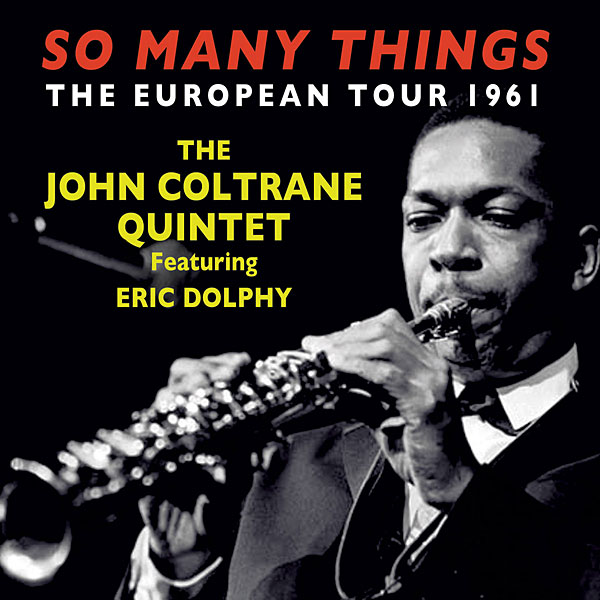
Now along comes a legitimate UK release, So Many Things, The John Coltrane Quintet which collects tapes from a number of European shows from Trane’s much recorded and much debated 1961 tour of the UK and the continent with what is often referred to as his “classic” quartet, of McCoy Tyner on piano, Reggie Workman on bass, and drummer Elvin Jones. This is the same group who recorded, among other things, Coltrane’s breakthrough record, My Favorite Things. This trip also included a special guest, the always incendiary Eric Dolphy, whose solos on flute and alto sax were too out, too uncontrolled for many audience members and critics alike. Whether he was a useful spur to drive Coltrane’s solos to new levels or merely a showoff who took space from Tyner and even Coltrane’s playing, is an argument that continues to smolder. According to the excellent liner notes for this set by Simon Spillett, many in the both the press and the audience at the UK shows, vehemently objected to Dolphy’s squawking histrionics which in turn motivated Coltrane to respond in kind. Many carped because the band no longer “swung.” Needless to say, given the subsequent arc of Coltrane’s career and the glories of his late career masterpieces like Ascension, and Sun Ship this stylistic nitpicking, now looks ridiculous. He was just then beginning to incorporate and embrace the world of the avant garde that would come to define his latter music. His music was growing in exciting and yes, brash ways, as is so boldy demonstrated by the pair of very different versions of “Naima,” each stretched and pulled in different harmonic directions.
For audiophiles, this four disc set represents yet another example of the eternal dilemma of sound quality versus the importance of the content. In other words, how bad does the sound quality have to be before you’ll stop listening? While it’s fascinating to hear how different the six full versions of “My Favorite Things” are here from each other and the familiar studio version, the sound quality throughout is thin and very limited. While this set pays the usual lip service to being “newly remastered,” only so much can be done with source material of this quality and vintage. While nothing here is unlistenable, the sound varies from good to poor. It’s a Coltrane concert coming out of a tin can. But what music!