I've found that some audio amplifiers have sonic signatures so subtle that they emerge only over weeks of listening; yet other amps sound so distinctive—more vivid, more transparent, more dynamic—that their signatures are immediately apparent. Can those latter qualities really be inherent in the recording, or are they colorations produced in the amplifier?
The question arose soon after I moved from New York to San Rafael, California. My New York listening room had been big—25' by 13', with a 12' semi-cathedral ceiling. I now listen to music in a room only 11' by 11.5', with a flat ceiling 8' high. My California room is less reverberant, with less bass extension and a shallower soundstage, but it's more revealing of instrumental timbres.
Which brings me to the first audio component I've reviewed in this new room: Constellation Audio's least expensive power amplifier, the 200Wpc Inspiration Stereo 1.0 ($11,000). I wondered if this amplifier would deliver the same excellent sonic qualities I've heard from costlier Constellations. The minute I heard the Stereo 1.0 play music, I had my answer.
Description
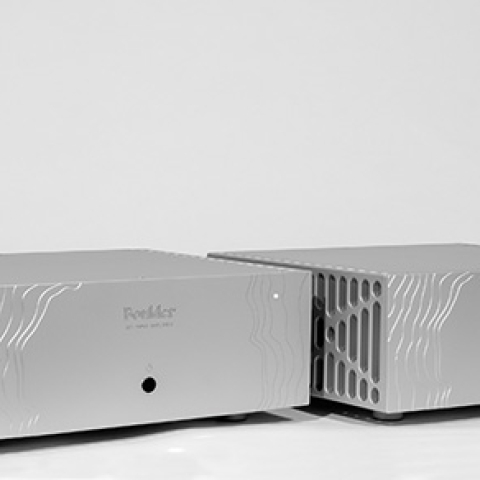
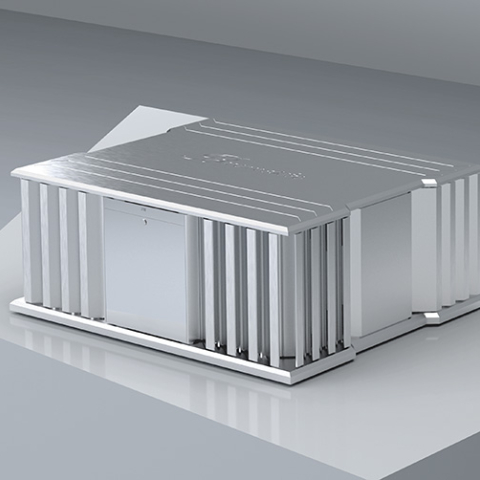
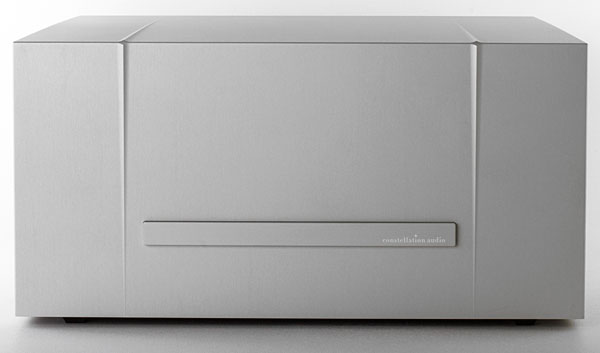
From the front, the Inspiration Stereo 1.0 is a rectangular block of aluminum 8.5" high by 17 wide by 19" deep; it weighs 55 lbs. Its matte brushed-aluminum finish is relaxing to the eye and perfectly smooth to the touch—except for two ridges that gradually emerge from the surface as they ascend the height of the faceplate, then just as gradually disappear into the surface of the top plate as they run from front to back. The only control is a bar that runs most of the width of the front panel. This functions as a Power/Mute switch and has a single central LED. On each side panel are 9 rows and 22 columns of circular vents, offset from similar holes in a second panel under the first. This design creates a unique pattern of interlocking ports that provide ventilation for the internal heatsinks. In the bottom plate below the internal heatsinks on each side is a row of rectangular vents parallel to its side panel, for convection cooling. Like the Mark Levinson No.585 integrated amplifier, the Stereo 1.0's heatsinks extend roughly half the length of each side panel. Each part of the case—top, bottom, and perforated sides—is tightly fitted around the heatsinks inside, making the entire case an effective radiator of heat. This allows the amp's exterior to resemble a smooth, uninterrupted, rectangular billet of aluminum that looks more like a sculpture than an exotic, high-end amplifier. Sitting atop the rear panel at chassis center is a small black subpanel with a 20 amp IEC AC jack and the main power rocker switch. Near the center of the rear panel are two pairs of large, rugged speaker binding posts. Between and just above those are a USB service input jack, and a 3.5mm Trigger jack for a 12V DC on/off control signal from a preamp or a third-party control system. Also on the rear panel are a Mute On/Off toggle switch, a three-position toggle for selecting between Direct, Balanced, and RCA inputs, XLR jacks labeled Balanced and Direct, and an RCA input jack. The Direct XLR jack can be used only with Constellation's preamplifiers, all of which include the same line-stage gain module that comprises the Stereo 1.0's initial input stage. Plugging an XLR from one of those models into a Stereo 1.0's Direct jack bypasses the amp's input module.
Inside, the Inspiration 1.0 is divided into two compartments: the one in front houses a large toroidal transformer and switching relays, and in the rear are the circuit boards, electrolytic capacitors, output devices, and heatsinks. Putting the audio circuits in the rear makes possible the shortest route to the input and output connectors. The power transformer is shielded with aluminum plates, and a shielded channel brings the AC from the rear panel to the transformer. There's more point-to-point wiring between the circuit boards and transformer than I've seen in other high-end solid-state amplifiers, but these appear to be terminated in snap-on connectors, which should make for easy servicing. The back panel must be opened to replace the fuses; they're not easily accessible.
Like other Constellation amplifiers, the Inspiration Stereo 1.0 is built around single-ended, 125W MOSFET-based modules comprising discrete components. Identical multiples of this circuit are combined to scale up from the Stereo 1.0's 200Wpc to the 1.1kW of Constellation's flagship amp, the Reference Hercules II Mono (both outputs specified into 8 ohms). Each module represents a "single-end, fully-balanced amplifier" that employs carefully matched but floating (ie, not referenced to ground) pairs of N-channel MOSFETs connected to the speaker load, without an output filter network. The Stereo 1.0's power supply has an impressive amount of storage: 24 filter capacitors of 10,000µF each.The exterior of the Inspiration Stereo 1.0 exudes simplicity and purity of form, its rear-panel components are rugged and of high quality, and its internal build quality is superb.
Setup
Sitting atop the rear panel at chassis center is a small black subpanel with a 20 amp IEC AC jack and the main power rocker switch. Near the center of the rear panel are two pairs of large, rugged speaker binding posts. Between and just above those are a USB service input jack, and a 3.5mm Trigger jack for a 12V DC on/off control signal from a preamp or a third-party control system. Also on the rear panel are a Mute On/Off toggle switch, a three-position toggle for selecting between Direct, Balanced, and RCA inputs, XLR jacks labeled Balanced and Direct, and an RCA input jack. The Direct XLR jack can be used only with Constellation's preamplifiers, all of which include the same line-stage gain module that comprises the Stereo 1.0's initial input stage. Plugging an XLR from one of those models into a Stereo 1.0's Direct jack bypasses the amp's input module.
Inside, the Inspiration 1.0 is divided into two compartments: the one in front houses a large toroidal transformer and switching relays, and in the rear are the circuit boards, electrolytic capacitors, output devices, and heatsinks. Putting the audio circuits in the rear makes possible the shortest route to the input and output connectors. The power transformer is shielded with aluminum plates, and a shielded channel brings the AC from the rear panel to the transformer. There's more point-to-point wiring between the circuit boards and transformer than I've seen in other high-end solid-state amplifiers, but these appear to be terminated in snap-on connectors, which should make for easy servicing. The back panel must be opened to replace the fuses; they're not easily accessible.
Like other Constellation amplifiers, the Inspiration Stereo 1.0 is built around single-ended, 125W MOSFET-based modules comprising discrete components. Identical multiples of this circuit are combined to scale up from the Stereo 1.0's 200Wpc to the 1.1kW of Constellation's flagship amp, the Reference Hercules II Mono (both outputs specified into 8 ohms). Each module represents a "single-end, fully-balanced amplifier" that employs carefully matched but floating (ie, not referenced to ground) pairs of N-channel MOSFETs connected to the speaker load, without an output filter network. The Stereo 1.0's power supply has an impressive amount of storage: 24 filter capacitors of 10,000µF each.The exterior of the Inspiration Stereo 1.0 exudes simplicity and purity of form, its rear-panel components are rugged and of high quality, and its internal build quality is superb.
Setup
With my reference Quad ESL-989 speakers at the repair shop—they were damaged during their journey across the US in an Atlas moving van—I placed one Revel Ultima Salon2 speaker to either side of my equipment rack. The Revels were 3.3' from the front wall, 6.3' apart (measured from the speakers' tweeters), and 6.3' from my listening chair.
Although the Inspiration Stereo 1.0 weighs only 55 lbs—half the weight of one Mark Levinson No.536 monoblock—its lack of handles and my own limited strength meant that I couldn't lift it onto a shelf. So I placed it on the floor, which made it easier to switch interconnects and speaker cables when comparing amplifiers.
The Stereo 1.0's shipping carton also contained a heavy detachable power cord and three fuses. There was no hard copy of the manual, so I downloaded it from the company's website. Following the instructions, I plugged balanced interconnects from my preamplifier into the amp's rear-panel Balanced jacks (not the Direct XLRs), set the Input toggle to Balanced and the Mute toggle to Off, and the master power switch to On. The LED on the front glowed a steady red, signaling that the Stereo 1.0 was in Standby mode.
Where it stayed. Despite my frantic pressings of the front-panel bar, the Constellation stubbornly remained in Standby. I remembered something similar happening in 1999, when I reviewed Mark Levinson's No.334 amplifier. Repeatedly pushing the No.334's Standby/Power button did nothing. Reading the manual revealed that I had to wait a full three seconds after switching on the No.334's main power switch, on the rear, before pressing the front-panel button to bring it out of standby. Could this be happening again?
From the front, the Inspiration Stereo 1.0 is a rectangular block of aluminum 8.5" high by 17 wide by 19" deep; it weighs 55 lbs. Its matte brushed-aluminum finish is relaxing to the eye and perfectly smooth to the touch—except for two ridges that gradually emerge from the surface as they ascend the height of the faceplate, then just as gradually disappear into the surface of the top plate as they run from front to back. The only control is a bar that runs most of the width of the front panel. This functions as a Power/Mute switch and has a single central LED. On each side panel are 9 rows and 22 columns of circular vents, offset from similar holes in a second panel under the first. This design creates a unique pattern of interlocking ports that provide ventilation for the internal heatsinks. In the bottom plate below the internal heatsinks on each side is a row of rectangular vents parallel to its side panel, for convection cooling. Like the Mark Levinson No.585 integrated amplifier, the Stereo 1.0's heatsinks extend roughly half the length of each side panel. Each part of the case—top, bottom, and perforated sides—is tightly fitted around the heatsinks inside, making the entire case an effective radiator of heat. This allows the amp's exterior to resemble a smooth, uninterrupted, rectangular billet of aluminum that looks more like a sculpture than an exotic, high-end amplifier.
Sitting atop the rear panel at chassis center is a small black subpanel with a 20 amp IEC AC jack and the main power rocker switch. Near the center of the rear panel are two pairs of large, rugged speaker binding posts. Between and just above those are a USB service input jack, and a 3.5mm Trigger jack for a 12V DC on/off control signal from a preamp or a third-party control system. Also on the rear panel are a Mute On/Off toggle switch, a three-position toggle for selecting between Direct, Balanced, and RCA inputs, XLR jacks labeled Balanced and Direct, and an RCA input jack. The Direct XLR jack can be used only with Constellation's preamplifiers, all of which include the same line-stage gain module that comprises the Stereo 1.0's initial input stage. Plugging an XLR from one of those models into a Stereo 1.0's Direct jack bypasses the amp's input module.
With my reference Quad ESL-989 speakers at the repair shop—they were damaged during their journey across the US in an Atlas moving van—I placed one Revel Ultima Salon2 speaker to either side of my equipment rack. The Revels were 3.3' from the front wall, 6.3' apart (measured from the speakers' tweeters), and 6.3' from my listening chair.