


Photo by Chip Duden
Dave Alvin is a fighter. In the 1980s, when Dave and his older brother, Phil Alvin, shared studio and stage as co-founders of Los Angeles punkabilly band The Blasters, they frequently fought each other. They also fought musically, tussling over every note as the four-man band wrangled many great tunes. In that respect, their working relationship may have been similar to the sibling push-pull output of Ray and Dave Davies in the Kinks and Liam and Noel Gallagher in Oasis. Consider "American Music," "Marie Marie," and "Border Radio," all from the band's 1981 sophomore album The Blasters, as examples of how internal conflict can lead to successful collaboration.
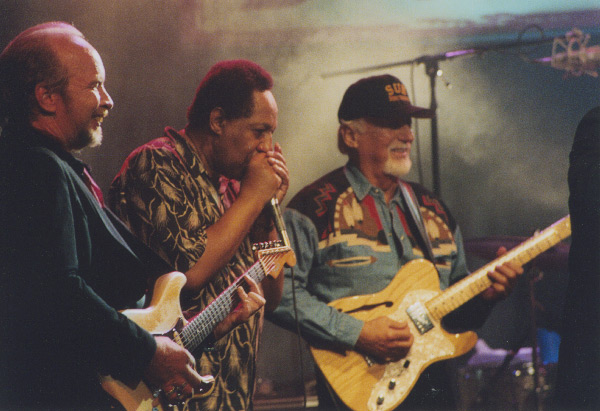
 In the years following Dave's departure from the Blasters, in 1986, the brothers often sparred anew as they drifted through the transom of their shared lives—sometimes via Blasters re-ups, other times in self-aware duets like "What's Up with Your Brother?," from Dave's 2011 solo album Eleven Eleven, or in joint projects like 2014's Common Ground: Dave Alvin & Phil Alvin Sing the Songs of Big Bill Broonzy and 2015's Lost Time, the latter featuring down-home covers of songs from Big Joe Turner, James Brown, Willie Dixon (pictured with Alvin below), and others (footnote 1).
 Through all the sibling conflict, the one constant, which had intertwined the brothers since they grew up together under the same roof in Downey, California, was a shared passion for music—and, for much of that time, for record collecting. Teenagers as the 1970s got underway, the Alvin brothers were notorious as the youngest, savviest 78 collectors in Southern California. "Phil and I, we started collecting 78s and 45s real early in our lives, and we became really adept at 78 collecting," Dave told me during our interview. "That was something my brother and I shared. For us, that's really where we bonded as brothers—besides all the blood feuds," he concluded with a knowing, brotherly laugh.
 Eventually, Dave carved out a fine career as a solo artist and songwriter steeped in the deep-rooted traditions of the blues, country, rockabilly, and folk. With Romeo's Escape, his flag-planting 1987 solo debut on Epic, Alvin established his solo lane, leading to a decade-plus of genre-driven works on Hightone before settling in at Yep Roc, his label home since 2004.
"You never know what people are gonna like," Alvin says, "but I do feel like I've written a few songs that don't have a cultural expiration date."
In addition to the other conflicts, Alvin has had to fight for his own life in recent years, battling cancer into a state of remission. "The past three years have been what I call Cancer Life," he explains. "The thing I learned after all the surgeries and recurrences is, you don't really beat cancer—you learn to live with it." Residing constantly under the sword of Damocles fueled fervent musical explorations that look forward and back at the same time, exemplified by his recent shepherding of a special edition of his 2011 Yep Roc effort, Eleven Eleven, released, of course, on November 11, 2022. Eleven Eleven 11th Anniversary Expanded Edition is available, as these things often are, in several versions including an expanded, resequenced CD and a double 180gm black vinyl LP set. What's behind the clever 11/11 symmetry? For one thing, 11/11 is Alvin's birthday.
Eventually, Dave carved out a fine career as a solo artist and songwriter steeped in the deep-rooted traditions of the blues, country, rockabilly, and folk. With Romeo's Escape, his flag-planting 1987 solo debut on Epic, Alvin established his solo lane, leading to a decade-plus of genre-driven works on Hightone before settling in at Yep Roc, his label home since 2004.
"You never know what people are gonna like," Alvin says, "but I do feel like I've written a few songs that don't have a cultural expiration date."
In addition to the other conflicts, Alvin has had to fight for his own life in recent years, battling cancer into a state of remission. "The past three years have been what I call Cancer Life," he explains. "The thing I learned after all the surgeries and recurrences is, you don't really beat cancer—you learn to live with it." Residing constantly under the sword of Damocles fueled fervent musical explorations that look forward and back at the same time, exemplified by his recent shepherding of a special edition of his 2011 Yep Roc effort, Eleven Eleven, released, of course, on November 11, 2022. Eleven Eleven 11th Anniversary Expanded Edition is available, as these things often are, in several versions including an expanded, resequenced CD and a double 180gm black vinyl LP set. What's behind the clever 11/11 symmetry? For one thing, 11/11 is Alvin's birthday.
 Mike Mettler: The care and detail you put into the presentation and packaging of your solo records, like the newly expanded version of Eleven Eleven—that came out of your record collecting experiences growing up, didn't it?
Dave Alvin: Yeah. I remember when I was a kid, when you'd get an album, you could always tell when somebody was just throwing something together. You'd go, "Wait a second!" You just knew. [laughs]
Mike Mettler: The care and detail you put into the presentation and packaging of your solo records, like the newly expanded version of Eleven Eleven—that came out of your record collecting experiences growing up, didn't it?
Dave Alvin: Yeah. I remember when I was a kid, when you'd get an album, you could always tell when somebody was just throwing something together. You'd go, "Wait a second!" You just knew. [laughs]
 Alvin: It depended. There were things I liked that Phil hated.
Mettler: Like what? Give me an example.
Alvin: I loved the guitar sound on "Get It On (Bang a Gong)," by T. Rex (footnote 3). I love that guitar sound! [laughs] But Phil, he was not so much the T. Rex fan. The thing is, I could listen to Blind Lemon Jefferson, Archie Shepp, Merle Haggard, and T. Rex. I mean, why not? But I know that confuses people.
Due to our older cousin's taste in music, we had already been exposed to everything from doo-wop, hardcore R&B, Ray Charles, and Big Joe Turner. My cousin Mike played banjo and guitar, and he was into Dave Van Ronk and Ramblin' Jack [Elliott], Sonny Terry, Brownie McGhee, and all that. By the time I was 12, we had Sonny Boy Williamson records—and I already knew at that age there were two Sonny Boy Williamsons.
Then we started figuring out there was this whole world of music on 78s. In those days—the late '60s and early '70s—there were some reissues, but in general, no, there really weren't. It was not like today where you can just click on Spotify, type in "Charley Patton," and find everything Charley Patton ever cut.
Alvin: It depended. There were things I liked that Phil hated.
Mettler: Like what? Give me an example.
Alvin: I loved the guitar sound on "Get It On (Bang a Gong)," by T. Rex (footnote 3). I love that guitar sound! [laughs] But Phil, he was not so much the T. Rex fan. The thing is, I could listen to Blind Lemon Jefferson, Archie Shepp, Merle Haggard, and T. Rex. I mean, why not? But I know that confuses people.
Due to our older cousin's taste in music, we had already been exposed to everything from doo-wop, hardcore R&B, Ray Charles, and Big Joe Turner. My cousin Mike played banjo and guitar, and he was into Dave Van Ronk and Ramblin' Jack [Elliott], Sonny Terry, Brownie McGhee, and all that. By the time I was 12, we had Sonny Boy Williamson records—and I already knew at that age there were two Sonny Boy Williamsons.
Then we started figuring out there was this whole world of music on 78s. In those days—the late '60s and early '70s—there were some reissues, but in general, no, there really weren't. It was not like today where you can just click on Spotify, type in "Charley Patton," and find everything Charley Patton ever cut.
 There was a couple of Bob Wills reissues, and that was it for the Western swing I had. I told this one collector, I said, "I'll tell you what. You give me some Chess blues records and all the Western swing you got, and the Louis Armstrong and Fletcher Henderson is yours." The guy comes back five days later with a lot of Chess records and about 75 Bob and Luke Wills records, and I was like, "You got it!"
Mettler: Why did you make that trade?
Alvin: Because I'd listened to the Louis Armstrong and Fletcher Henderson, and I had already got what I wanted out of it. It was like, "Okay, now I've got 75 Western swing records and some beloved Chicago blues records, so I'm happy." But then the word got back, "That guy, he's an idiot! He traded the kid 75 Western swing records!"
Mettler: What equipment did you play all those 78s on, growing up?
Alvin: It was a set from the '50s. Later on, Phil got a real, state-of-the-art 78 player.
There was a couple of Bob Wills reissues, and that was it for the Western swing I had. I told this one collector, I said, "I'll tell you what. You give me some Chess blues records and all the Western swing you got, and the Louis Armstrong and Fletcher Henderson is yours." The guy comes back five days later with a lot of Chess records and about 75 Bob and Luke Wills records, and I was like, "You got it!"
Mettler: Why did you make that trade?
Alvin: Because I'd listened to the Louis Armstrong and Fletcher Henderson, and I had already got what I wanted out of it. It was like, "Okay, now I've got 75 Western swing records and some beloved Chicago blues records, so I'm happy." But then the word got back, "That guy, he's an idiot! He traded the kid 75 Western swing records!"
Mettler: What equipment did you play all those 78s on, growing up?
Alvin: It was a set from the '50s. Later on, Phil got a real, state-of-the-art 78 player.
Footnote 1: Two of Dave Alvin's albums have been featured as Stereophile's Recording of the Month: Black Jack David in August 1998 and Out in California in October 2002.—Ed. Footnote 2: Phil was the oldest, born in 1953, two years before Dave. Footnote 3: From 1971's Electric Warrior. Footnote 4: "Prince of Wails" was released in 1924 on Puritan 11367, but some pundits think Armstrong's horn is not discernible, or even present, on the recording.















