

John Atkinson wrote about the Dayton B652-AIR in February 2014 (Vol.38 No.2):
Stephen Mejias reviewed the Dayton Audio B652 bookshelf loudspeaker in Stereophile's January 2013 issue. Sold direct by Parts Express as well as by Amazon, and priced at just $39.80/pair (including two 9½'-long 20AWG speaker cables), the B652 is by far the cheapest speaker we have reviewed. The B652 is still available, but has been joined by a new version, the B652-AIR ($59.80/pair, footnote 1). Like the earlier speaker, the 'AIR is a small, two-way, sealed-cabinet design with a 6.5" polypropylene mid/woofer and an enclosure made of ½"-thick MDF with a 5/8"-thick front baffle. But the original's 55/8" polycarbonate-dome tweeter has been replaced by a 1"-square, pleated-ribbon AMT driver claimed to add "even more smoothness and detail."




Footnote 1: The B652-AIR is Part #300-651.
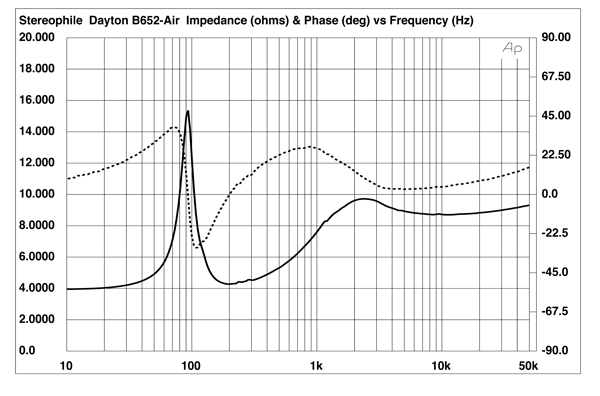
Fig.1 Dayton B652-AIR, electrical impedance (solid) and phase (dashed) (2 ohms/vertical div.).
Before describing my auditioning of the B652-AIR to hear if its AMT tweeter delivered what was promised, I'll discuss the speaker's measured performance. I used DRA Labs' MLSSA system and a calibrated DPA 4006 microphone to measure the Dayton's frequency response in the farfield, and an Earthworks QTC-40 for the nearfield responses. (The grille was left off for all measurements as well as the listening.) My estimate of the B652-AIR's voltage sensitivity was 87dB(B)/2.83V/m, confirming the specification. The speaker's impedance is specified as 6 ohms; its magnitude is the solid trace in fig.1. It rises above 6 ohms at 750Hz, and stays there throughout the upper midrange and treble. As the impedance doesn't drop below 4.3 ohms and the electrical phase angle (dotted trace) is generally benign, the Dayton speaker will work well with modestly powered amplifiers.
The small discontinuities between 200 and 300Hz and around 1100Hz indicate the presence of some sort of resonances in these regions. As with the earlier B652, the 'AIR's enclosure was very lively when tested with the traditional knuckle-rap test, producing very strong resonances between 250 and 350Hz. These were very audible with the half-step–spaced tonebursts on my Editor's Choice CD (Stereophile STPH016-2).
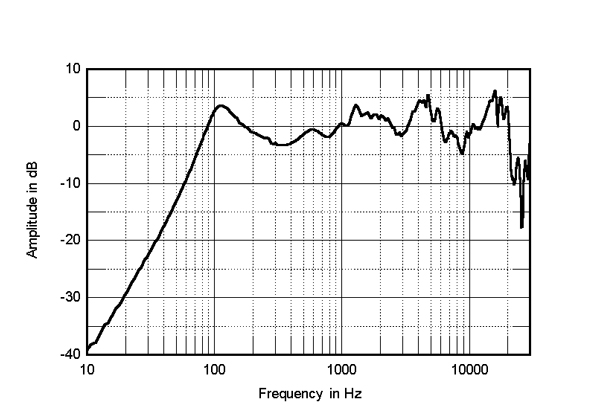
Fig.2 Dayton B652-AIR, anechoic response on tweeter axis at 50", averaged across 30° horizontal window and corrected for microphone response, with nearfield woofer response plotted below 300Hz.
Fig.3 Dayton B652, anechoic response on tweeter axis at 50", averaged across 30° horizontal window and corrected for microphone response, with nearfield woofer response plotted below 300Hz.
The impedance peak at 93.5Hz suggests that this is the tuning frequency of the woofer in its sealed enclosure, which is slightly lower in frequency than in the original B652. The woofer's nearfield output (fig.2, below 300Hz) does peak between 80 and 200Hz, and, as in the earlier speaker, the woofer's farfield response gently rises throughout the midrange, with then a large peak between 3 and 5kHz before crossing over to the tweeter. Unlike the B652's dome tweeter, which was peaky in its passband (fig.3), the 'AIR's AMT HF unit is much better behaved.
Fig.4 Dayton B652-AIR, lateral response family at 50", normalized to response on tweeter axis, from back to front: differences in response 90–5° off axis, reference response, differences in response 5–90° off axis.
Fig.5 Dayton B652-AIR, vertical response family at 50", normalized to response on tweeter axis, from back to front: differences in response 45–5° above axis, reference response, differences in response 5–45° below axis.
The Dayton's plot of lateral dispersion, normalized to the tweeter-axis response (fig.4), indicates that the speaker becomes quite directional in the region of the on-axis treble peak. To some extent, this will tend to ameliorate the peak's audibility. But other than that, the contour lines in this graph are relatively even and well controlled. In the vertical plane (fig.5), a suckout in the crossover region develops above the tweeter axis, suggesting that the B652-AIR should be used on high rather than low stands. (I used 24"-high stands, which meant I had to slouch a little in my chair for my ears to be on the tweeter axes.)
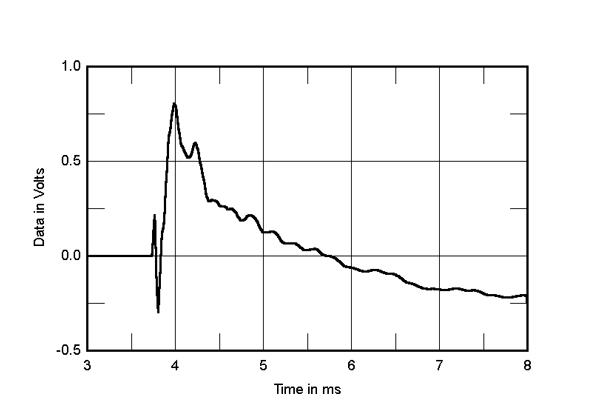
Fig.6 Dayton B652-AIR, step response on tweeter axis at 50" (5ms time window, 30kHz bandwidth).
Fig.7 Dayton B652-AIR, cumulative spectral-decay plot on tweeter axis at 50" (0.15ms risetime).
The step response on the tweeter axis (fig.6) reveals that both drive-units are connected with positive acoustic polarity. The ripples in the decay of the woofer's step will be due to a resonance in the treble; the cumulative spectral-decay plot (fig.7) features a strong resonance at 4.3kHz, and there is another, less severe resonance at 1100Hz, the frequency of one of the wrinkles in the impedance traces.
Footnote 1: The B652-AIR is Part #300-651.















