

Listening to the AIRs
I auditioned the Daytons with my usual high-end rig. It is a fair criticism that no one will use these speakers in a system costing upward of $50,000, but it's important to change as little as possible when inserting a new component in a reviewer's reference system. Connection is via a pair of spring-clip speaker terminals; to connect the Daytons to my usual speaker cables, I used pigtails with bare wire at one end and dual banana plugs at the other. The Daytons were used well out in the room, though it's fair to note that they could well benefit from some boundary reinforcement, the low and midbass, of course, being suppressed with such a small speaker. Phil Lesh's majestic bass-guitar lines in "I Used to Be a King," from Graham Nash's Songs for Beginners (24-bit/48kHz ALAC files ripped from DVD-A, Atlantic/Rhino R2 35257-2), were mostly missing in action, and Pino Palladino's Fender bass in "Every Day I Have the Blues," from the John Mayer Trio's Where the Light Is: John Mayer Live in Los Angeles (16/48 ALAC ripped from DVD-V, Sony 722727), was both a little lightweight and had a somewhat "grumbly" quality. "Believe it or not, music through the little Dayton B652s was always very enjoyable," wrote Stephen in his review of the original version. "Its sins were of omission: Though it could sound big and dramatic enough to fill my listening room, the Dayton lacked deep bass, high-frequency extension, and ultimate control, sounding a bit hard and bothered during the most complex passages of music and when pushed to high volumes." I didn't go all the way with Stephen's like of the earlier B652—its top octaves were too spitty for my taste. By contrast, the B652-AIR's high treble sounded very clean, if slightly suppressed in absolute terms. Steve Jordan's cymbals on the John Mayer video had a little too much of a sshh rather than ssss character. The cymbals in Nash's "I Used to Be a King" sounded slightly too metallic, and there was a slight emphasis of vocal sibilants in "Going Home," from Leonard Cohen's Old Ideas (ALAC ripped from CD, Columbia 88697986712). Similarly, Yo-Yo Ma's cello was a little too wiry on top in the Aria from J.S. Bach's Goldberg Variations, in an arrangement for cello and organ on Simply Baroque II (ALAC ripped from CD, Sony Classical SK 60681).
Though the B652-AIR's treble definitely had some character, its midrange sounded surprisingly natural, even after I listened again to that lively enclosure with a stethoscope. The piano in Busoni's arrangement of Bach's Chaconne for solo violin, performed by Wolf Harden (CD, Naxos 8.555699), sounded convincing, as did Lorraine Hunt Lieberson's rich contralto in "Deep River" (ALAC ripped from CD, Wigmore Hall Live 0013). However, her voice acquired a shrieky quality in the song's bridge, when she sings loudly. At high levels, the speakers did start to sound "shouty" and midrange textures coarsened, which made me want to turn down the volume with recordings that are brightly balanced to begin with, such as Miles Davis's We Want Miles (CD, Columbia 469402 2). Soundstages on naturally recorded orchestral music were relatively flat, with little depth.
I auditioned the Daytons with my usual high-end rig. It is a fair criticism that no one will use these speakers in a system costing upward of $50,000, but it's important to change as little as possible when inserting a new component in a reviewer's reference system. Connection is via a pair of spring-clip speaker terminals; to connect the Daytons to my usual speaker cables, I used pigtails with bare wire at one end and dual banana plugs at the other. The Daytons were used well out in the room, though it's fair to note that they could well benefit from some boundary reinforcement, the low and midbass, of course, being suppressed with such a small speaker. Phil Lesh's majestic bass-guitar lines in "I Used to Be a King," from Graham Nash's Songs for Beginners (24-bit/48kHz ALAC files ripped from DVD-A, Atlantic/Rhino R2 35257-2), were mostly missing in action, and Pino Palladino's Fender bass in "Every Day I Have the Blues," from the John Mayer Trio's Where the Light Is: John Mayer Live in Los Angeles (16/48 ALAC ripped from DVD-V, Sony 722727), was both a little lightweight and had a somewhat "grumbly" quality. "Believe it or not, music through the little Dayton B652s was always very enjoyable," wrote Stephen in his review of the original version. "Its sins were of omission: Though it could sound big and dramatic enough to fill my listening room, the Dayton lacked deep bass, high-frequency extension, and ultimate control, sounding a bit hard and bothered during the most complex passages of music and when pushed to high volumes." I didn't go all the way with Stephen's like of the earlier B652—its top octaves were too spitty for my taste. By contrast, the B652-AIR's high treble sounded very clean, if slightly suppressed in absolute terms. Steve Jordan's cymbals on the John Mayer video had a little too much of a sshh rather than ssss character. The cymbals in Nash's "I Used to Be a King" sounded slightly too metallic, and there was a slight emphasis of vocal sibilants in "Going Home," from Leonard Cohen's Old Ideas (ALAC ripped from CD, Columbia 88697986712). Similarly, Yo-Yo Ma's cello was a little too wiry on top in the Aria from J.S. Bach's Goldberg Variations, in an arrangement for cello and organ on Simply Baroque II (ALAC ripped from CD, Sony Classical SK 60681).
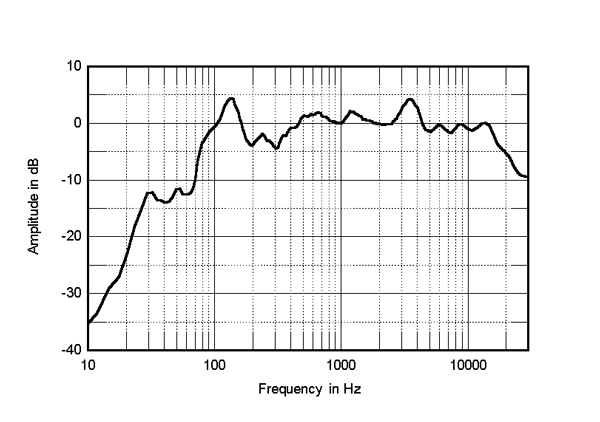
Fig.8 Dayton B652-AIR, spatially averaged, 1/6-octave response in JA's listening room.
Following my listening, I performed my usual spatially averaged measurement of the speakers' in-room response. The result is shown in fig.8. The balance is commendably flat through the upper midrange and treble, other than a significant peak between 3 and 4kHz, this no doubt giving rise to the coloration I noted. The low frequencies roll off below the tuning frequency of the woofer, of course.
At $59.80, a pair of B652-AIRs costs less than I spend to refuel my '84 Benz—even with the current low price of gasoline. But despite its low price, the Dayton speaker is, overall, a well-balanced design, provided it isn't played too loudly. Recommended for those looking for the least-expensive way to share our enthusiasm for recorded music.—John Atkinson














