

Sidebar 3: Measurements
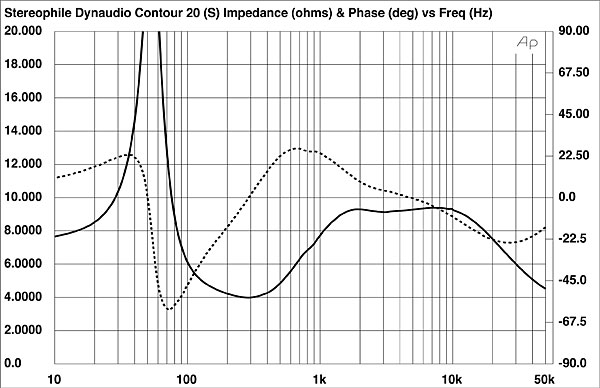
I used DRA Labs' MLSSA system and a calibrated DPA 4006 microphone to measure the Dynaudio Contour 20's frequency response in the farfield, and an Earthworks QTC-40 for the nearfield responses. I estimated the Dynaudio's voltage sensitivity as 84.2dB(B)/2.83V/m, which is slightly lower than the specified 86dB. On the other hand, while the nominal impedance is specified as 4 ohms, I found that it remained above 4 ohms for most of the audioband (fig.1, solid trace), with a minimum value of 4 ohms at 285Hz. Though there is a combination of 5.2 ohms and –38° capacitive phase angle at 120Hz, the Contour 20 will work well with tube amplifiers, as Herb found. This graph was taken with the rear-firing port open; as Herb had difficulty optimizing the speaker's low-frequency behavior in his room, I also examined the impedance with the port sealed with the supplied foam plug. The result (fig.2) is typical of a sealed enclosure tuned to 53Hz.

 The green and blue traces in fig.4 respectively show the woofer's nearfield response, measured with and without the port plugged; the red trace shows the port's output. With the port open, the minimum-motion notch in the woofer's output occurs at a low 32Hz, and the port covers a relatively narrow passband, rolling off above 70Hz. The port's output reveals a small spike between 800 and 900Hz, which is also the region where there is a small suckout in its farfield response on the tweeter axis (fig.4, black trace above 300Hz). Standing behind the speaker and playing white noise, I could hear a faint whistle in this region—but as the port fires to the rear, this mode should be inaudible at the listening position.


Fig.1 Dynaudio Contour 20, reflex mode, electrical impedance (solid) and phase (dashed) (5 ohms/vertical div.).
Fig.2 Dynaudio Contour 20, infinite-baffle mode, electrical impedance (solid) and phase (dashed) (5 ohms/vertical div.).
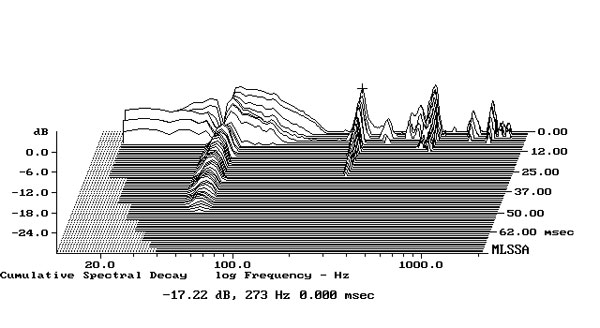
The impedance traces are free from any discontinuities that would suggest the presence of cabinet panel resonances. The enclosure seemed very inert; testing for resonances with an accelerometer did reveal some modes on the sidewall (fig.3), but these are very low in level.
Fig.3 Dynaudio Contour 20, cumulative spectral-decay plot calculated from output of accelerometer fastened to center of side panel (MLS driving voltage to speaker, 7.55V; measurement bandwidth, 2kHz).
Fig.4 Dynaudio Contour 20, anechoic response on tweeter axis at 50", averaged across 30° horizontal window and corrected for microphone response, with nearfield responses of woofer in sealed-box mode (green), woofer in reflex mode (blue), and port (red), plotted in the ratios of the square roots of their radiating areas, and complex sum of nearfield responses plotted below 300Hz (black).
Higher in frequency in fig.4, the Contour 20's farfield response is commendably flat, other than a slight lack of energy in the presence region. However, the speaker's plot of lateral dispersion, with the traces normalized to the tweeter-axis response (fig.5), reveals that this small suckout fills in to the Contour 20's sides. This graph also reveals that the fabric-dome tweeter gets quite directional above 10kHz; as the top-octave on-axis response is flat, the Dynaudio might sound a bit mellow in large or overdamped rooms. In the vertical plane (fig.6), suckouts in the crossover region develop more than 15° above and below the tweeter axis; stand height should thus not be critical.
Fig.5 Dynaudio Contour 20, lateral response family at 50", normalized to response on tweeter axis, from back to front: differences in response 90–5° off axis, reference response, differences in response 5–90° off axis.
Fig.6 Dynaudio Contour 20, vertical response family at 50", normalized to response on tweeter axis, from back to front: differences in response 45–5° above axis, reference response, difference in response 5–45° below axis.
In the time domain, the step response on the tweeter axis (fig.7) reveals that both drive-units are connected in the same, positive polarity. This is somewhat at odds with the specifications, which state that the crossover uses second-order filters. Usually, with a second-order crossover and a flat baffle, one drive-unit needs to be connected in inverted polarity, to compensate for the filters' phase shifts in the crossover region. Yet the tweeter's and woofer's individual step responses do blend optimally in fig.7, and, as you can see in fig.4, the Contour 20's drivers sum correctly in the amplitude domain. Perhaps the Contour 20's specs don't tell the whole story.
Fig.7 Dynaudio Contour 20, step response on tweeter axis at 50" (5ms time window, 30kHz bandwidth).
You can see in fig.7 that the decay of the woofer's step has a small amount of ripple, with a period around 1ms. This is presumably due to the peak in the port's output and the suckout on the farfield response between 800 and 900Hz—the cumulative spectral-decay plot (fig.8) does reveal delayed energy in this region. I placed the cursor in this graph at 7.4kHz, the frequency of a small mode in the tweeter's passband, but this will be too low in level to have any audible consequences. Other than those issues, this plot reveals a superbly clean decay of the speaker's treble output.
Fig.8 Dynaudio Contour 20, cumulative spectral-decay plot on tweeter axis at 50" (0.15ms risetime).
Overall, the Dynaudio Contour 20's measured performance indicates excellent audio engineering, as I have come to expect from Dynaudio.—John Atkinson















