Sidebar 3: Measurements
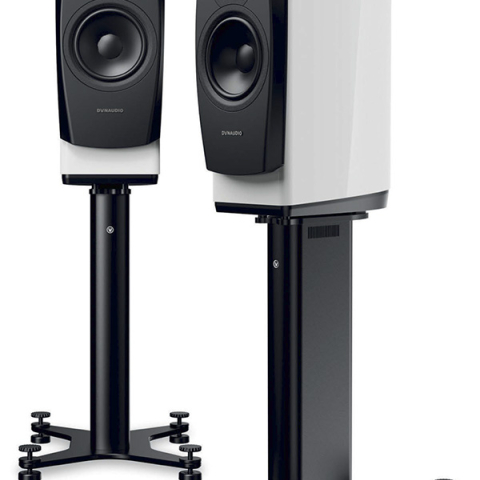
I used DRA Labs' MLSSA system and a calibrated DPA 4006 microphone to measure the Dynaudio Focus 200 XD's frequency response in the farfield; and, for the nearfield frequency responses, an Earthworks QTC-40, which has a ¼" capsule and thus doesn't present a significant obstacle to the sound.
I measured the Dynaudio at its analog input. As the Focus 200 XD is a powered speaker, my estimate of its voltage sensitivity can't be directly compared with those I publish for conventional speakers. But with a pink-noise input at 115mV RMS, the 200 XD's rotary Speaker Position knob set to Neutral, its Treble switch set to 0dB, its sensitivity switch set to its central, 0dB position, and the volume control set to its maximum with the wireless remote control, the SPL at 1m was 88.5dB(C). This increased and decreased by 5.6dB when this last switch was set to +6dB and –6dB, respectively.
The 200 XD's enclosure was extremely inert with the knuckle-rap test, and when I examined the individual panels' vibrational behavior with a plastic-tape accelerometer, all I could find was a low-level mode at 59Hz (fig.1). Though this is suspiciously close to the AC mains frequency, I couldn't find any grounding problem that might give rise to hum—and I heard none.

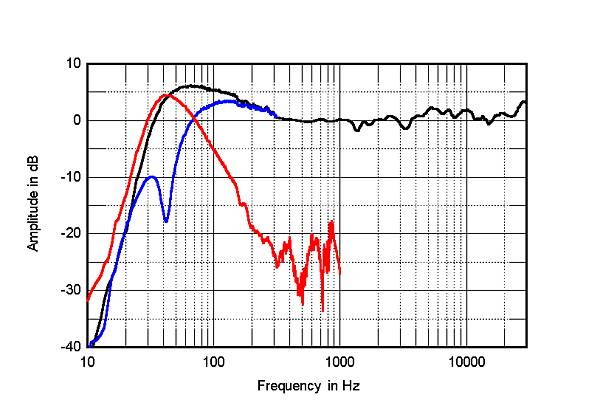 The black trace above 300Hz in fig.2 shows the Dynaudio's farfield anechoic response averaged across a 30° horizontal window centered on the tweeter axis. Other than a slight lift in the mid-treble, the response is superbly flat, meeting limits of +2.3/–1.8dB from 300Hz to 30kHz. This graph was taken with the Treble switch set to 0dB. The +1dB position raised the level above 2kHz by 0.5dB, and the –1dB position lowered the level by 1dB.
The 200 XD's horizontal dispersion (fig.3) is textbook in nature, with an even, well-controlled radiation pattern up to 10kHz or so, above which the speaker's output falls off more rapidly to the sides, as is typical of a 1" dome tweeter. In the vertical plane (fig.4), a suckout at the crossover frequency begins to develop 10° below and 20° above the tweeter axis, suggesting that listeners should sit with their ears close to or on the tweeter axis.
The black trace above 300Hz in fig.2 shows the Dynaudio's farfield anechoic response averaged across a 30° horizontal window centered on the tweeter axis. Other than a slight lift in the mid-treble, the response is superbly flat, meeting limits of +2.3/–1.8dB from 300Hz to 30kHz. This graph was taken with the Treble switch set to 0dB. The +1dB position raised the level above 2kHz by 0.5dB, and the –1dB position lowered the level by 1dB.
The 200 XD's horizontal dispersion (fig.3) is textbook in nature, with an even, well-controlled radiation pattern up to 10kHz or so, above which the speaker's output falls off more rapidly to the sides, as is typical of a 1" dome tweeter. In the vertical plane (fig.4), a suckout at the crossover frequency begins to develop 10° below and 20° above the tweeter axis, suggesting that listeners should sit with their ears close to or on the tweeter axis.
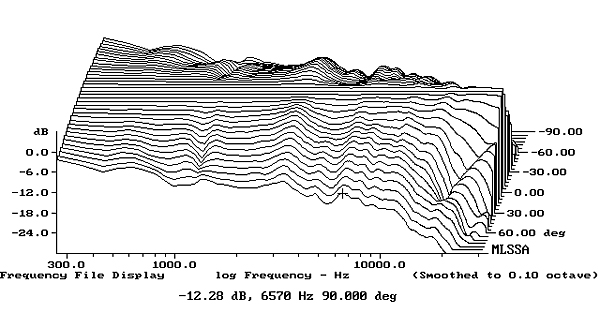


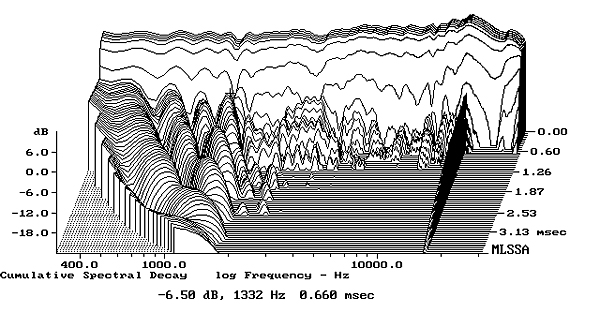
Fig.1 Dynaudio Focus 200 XD, cumulative spectral-decay plot calculated from output of accelerometer fastened to center of side panel (measurement bandwidth, 2kHz).
The black trace below 300Hz in fig.2 shows the complex sum of the nearfield responses of the woofer (blue) and rear-panel port (red), taking into account acoustic phase and the different distances of each from a nominal farfield microphone position. The sharply defined notch in the woofer's output at 42Hz suggests that this is the port's tuning frequency; the port's output peaks sharply between 30 and 70Hz, and though there are a couple of resonant modes evident between 400Hz and 1kHz, these are well down in level and shouldn't have audible consequences. Some of the boost in the upper bass in the summed response (black trace) will be due to the nearfield measurement technique, which assumes that the woofer and port are mounted in a flat baffle that extends to infinity in both planes. But the shape of the curve, and the >12dB/octave rolloff of both woofer and port below the port resonance frequency, imply that the Focus 200 XD's bass alignment is actually assisted with some bass boost.
Fig.2 Dynaudio Focus 200 XD, anechoic response on tweeter axis at 50", averaged across 30° horizontal window and corrected for microphone response, with nearfield responses of port (red) and woofer (blue) plotted in the ratios of their radiating diameters, and the complex sum of the nearfield responses, respectively plotted below 1kHz, 300Hz, 300Hz.
Fig.3 Dynaudio Focus 200 XD, lateral response family at 50", normalized to response on tweeter axis, from back to front: differences in response 90–5° off axis, reference response, differences in response 5–90° off axis.
Fig.4 Dynaudio Focus 200 XD, vertical response family at 50", normalized to response on tweeter axis, from back to front: differences in response 45–5° above axis, reference response, differences in response 5–45° below axis.
As I measured the Dynaudio at its analog input, which is subsequently digitized, I wasn't surprised to discover a latency of some 4ms between input and output. This can be seen in the speaker's step response at 50" (fig.5), where, instead of starting at around the 3.5ms mark, this corresponding to the distance divided by the speed of sound, the step begins closer to 7.5ms. But note the step's perfect right-triangle shape—to produce time-coincident arrivals of the drivers' outputs, the Dynaudio corrects for the fact that its tweeter's acoustic center is closer to the microphone than its woofer's. The cumulative spectral-decay plot (fig.6) features a superbly clean initial decay.
Fig.5 Dynaudio Focus 200 XD, step response on tweeter axis at 50" (5ms time window, 30kHz bandwidth).
Fig.6 Dynaudio Focus 200 XD, cumulative spectral-decay plot on tweeter axis at 50" (0.15ms risetime).
To optimize its acoustic performance in both time- and frequency-domains, Dynaudio has made use of the fact that the Focus 200 XD is a powered speaker with both digital and analog inputs and DSP. Its measured performance is, in a word, superb.—John Atkinson