

Sidebar 3: Measurements
I used DRA Labs' MLSSA system and a calibrated DPA 4006 microphone to measure the Dynaudio Special Forty's frequency response in the farfield, and an Earthworks QTC-40 for the nearfield and spatially averaged room responses.
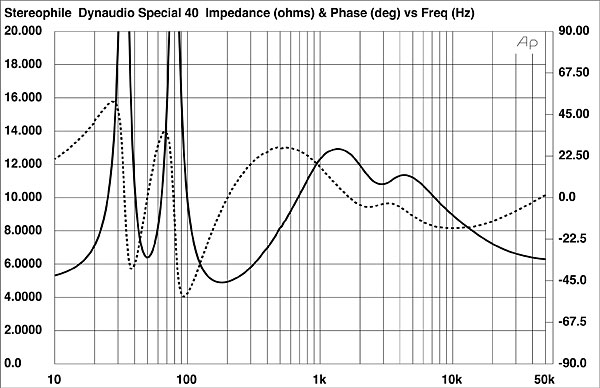
The Special Forty's voltage sensitivity is specified as 86dB(B)/2.83V/m; my estimate was a little lower, at 84.4dB/2.83V/m. Specified as a nominal 6 ohm load, the Special Forty's impedance drops below 6 ohms between 125 and 320Hz, with a minimum magnitude of 4.9 ohms at 178Hz (fig.1). However, the impedance remains above 8 ohms for most of the treble and bass, and though the electrical phase angle reaches an extreme –54° at 94Hz, the magnitude is high at that frequency, ameliorating any drive difficulty. Fig.1 was taken with the rear-panel port open; blocking it with the supplied foam plug turned the Dynaudio into a sealed-box design with the woofer tuned to 69Hz (fig.2).

 The impedance traces with the port open suggest that the reflex-loaded woofer is tuned to 51Hz, which is confirmed by the sharply defined null at this frequency in the woofer's nearfield response (fig.4, blue trace). The port's output (red trace) peaks in textbook fashion between 30 and 100Hz, but its upper-frequency rolloff has a severe resonance spike at 700Hz. Fortunately, the port faces to the speaker's rear, which should reduce the audibility of this mode.
 The plot of the Special Forty's lateral dispersion, normalized to the tweeter-axis response (fig.5), reveals that the tweeter starts to become directional above 7kHz, which might well make the speaker sound a bit lacking in top-octave air in large or overdamped rooms. Below the top octave, the Dynaudio's lateral dispersion is well controlled and even. In the vertical plane (fig.6), the use of a first-order crossover means that a suckout develops at the crossover frequency above the listening axis. This speaker will give its flattest balance on or just below the tweeter axis.

 The speaker that preceded the Dynaudio in my listening room was the 19-times-the-price Wilson Alexia Series 2. Fig.7 compares the spatially averaged response in my room of the Dynaudios (red trace) and Alexias (blue). (The traces were generated by averaging 20 1/6-octave–smoothed spectra, taken for the left and right speakers individually using SMUGSoftware's FuzzMeasure 3.0 program and a 96kHz sample rate, in a vertical rectangular grid 36" wide by 18" high and centered on the positions of my ears.) The two speakers appear to have broadly similar responses throughout the midrange and treble, but the Dynaudios have a little more energy in the presence region, a lot more energy in the upper midrange, and reduced output above 15kHz. The Wilsons, of course, have considerably more bass energy and low-frequency extension than the modest-size Special Fortys, but excited the lowest-frequency mode in my room a lot more.

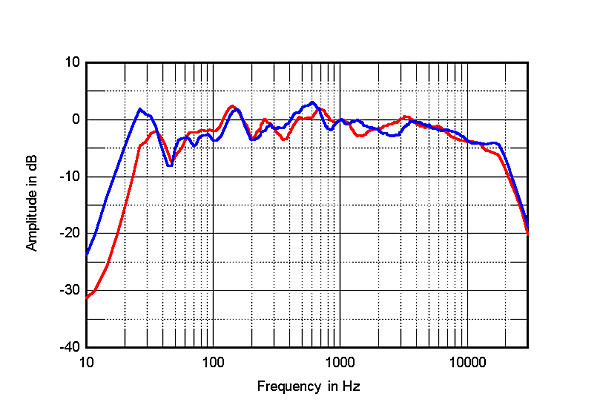


Fig.1 Dynaudio Special Forty with port open, electrical impedance (solid) and phase (dashed) (2 ohms/vertical div.).
Fig.2 Dynaudio Special Forty with port blocked, electrical impedance (solid) and phase (dashed) (2 ohms/vertical div.).
The traces in fig.1 are free from the small wrinkles that would imply the presence of cabinet-wall resonances. However, the top panel had a low-level but sharply defined mode at 730Hz. More significant, I found a very strong mode at 512Hz on the sidewalls, with more, lower-level modes just below 300Hz and between 600 and 750Hz (fig.3). This behavior correlates with the problem I heard in my auditioning.
Fig.3 Dynaudio Special Forty, cumulative spectral-decay plot calculated from output of accelerometer fastened to center of sidewall (MLS driving voltage to speaker, 7.55V; measurement bandwidth, 2kHz).
Fig.4 Dynaudio Special Forty, anechoic response on tweeter axis at 50", averaged across 30° horizontal window and corrected for microphone response, with nearfield responses of: woofer (blue) and port (red), respectively plotted below 350Hz and 1kHz, and complex sum of nearfield responses plotted below 300Hz (black).
Higher in frequency in fig.4, the black trace below 300Hz shows the complex sum of the nearfield drive-unit outputs, taking into account both amplitude and phase. The broad peak in the midbass will be mostly due to the nearfield measurement technique, which assumes that the drive-units are mounted in a baffle that extends to infinity in both planes. Above 300Hz, and averaged across a 30° horizontal window centered on the listening axis, the response is impressively flat, other than the gentle top-octave rolloff and a small peak just above 1kHz, followed by a narrow suckout. I have conjectured in the past that this latter behavior might be due to a cone-termination problem and, if severe, should result in a slight nasal coloration. As I heard no such problem, it would appear that in the Special Forty this measures worse than it sounds.
Fig.5 Dynaudio Special Forty, lateral response family at 50", normalized to response on tweeter axis, from back to front: differences in response 90–5° off axis, reference response, differences in response 5–90° off axis.
Fig.6 Dynaudio Special Forty, vertical response family at 50", normalized to response on tweeter axis, from back to front: differences in response 45–5° above axis, reference response, differences in response 5–45° below axis.
Fig.7 Dynaudio Special Forty, spatially averaged, 1/6-octave response in JA's listening room (red); and of Wilson Alexia 2 (blue).
A fairer comparison would be with Dynaudio's Contour 20, which I favorably reviewed in May 2017. The Contour 20's in-room response, measured in the identical manner, is shown in fig.8 (blue trace). Between 300 and 1200Hz it is very close to that of the Special Forty (red trace), though with slightly more energy in the midrange. The Contour 20 has greater bass extension, which excites the lowest-frequency room mode to a greater extent.
Fig.8 Dynaudio Special Forty, spatially averaged, 1/6-octave response in JA's listening room (red); and of Dynaudio Contour 20 (blue).
In the time domain, the Special Forty's step response on the tweeter axis is shown in fig.9; it reveals that both drive-units are connected in positive acoustic polarity, with the tweeter's output arriving at the microphone before that of the woofer. The slight undulation in the decay of the woofer's step is associated with a ridge of delayed energy at 1.11kHz in the Dynaudio's cumulative spectral-decay plot (fig.10). However, the decay in the treble is very clean, which suggests that the Esotar Forty is an excellent tweeter.
Fig.9 Dynaudio Special Forty, step response on tweeter axis at 50" (5ms time window, 30kHz bandwidth).
Fig.10 Dynaudio Special Forty, cumulative spectral-decay plot on tweeter axis at 50" (0.15ms risetime).
Dynaudio's Special Forty offers generally excellent measured performance, but I was bothered by the woofer's behavior just above 1kHz, and even more so by that very strong vibrational resonance on the sidewalls.—John Atkinson















